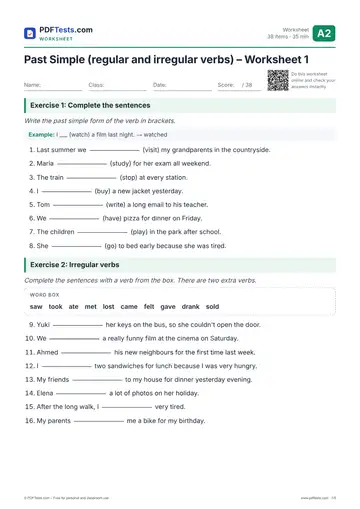
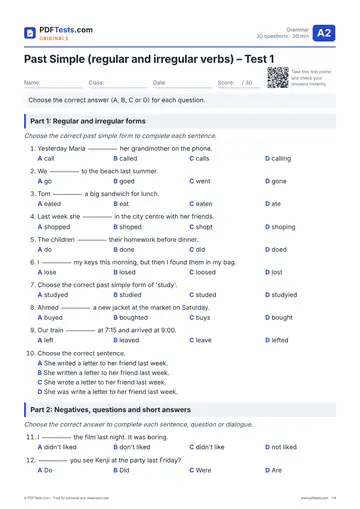
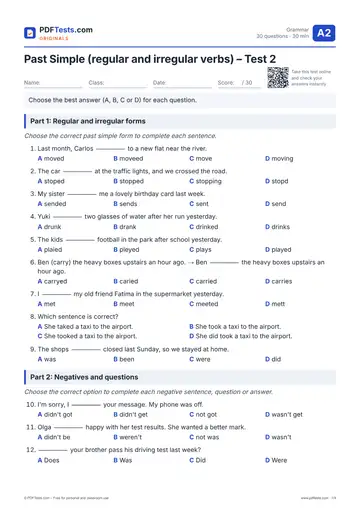
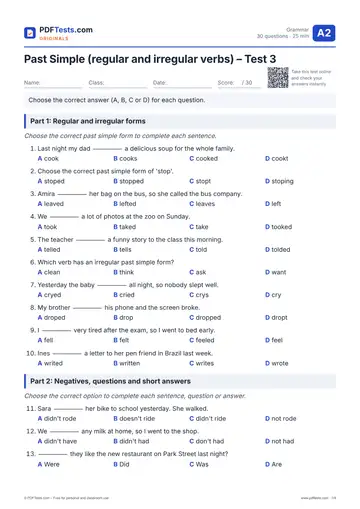
The Past Simple is the tense we use to talk about finished actions and situations in the past, such as I visited my grandmother last weekend. Regular verbs add -ed (work → worked), and irregular verbs have their own past form (go → went). In negatives and questions, we use did / didn’t with the base verb.
When do we use the Past Simple?
1. Finished actions at a specific time in the past
The action is complete, and we know or say when it happened.
- I watched a film last night.
- She started her new job in March.
- We met in 2019.
2. A series of actions in a story
When we tell a story, the Past Simple shows actions in the order they happened.
- I got up, had a shower and left the house at eight.
- He opened the door, saw the mess and called his sister.
3. Past habits and repeated actions
We can use the Past Simple for things that happened regularly in the past but are now finished.
- When I was a child, I walked to school every day.
- My dad played football every Saturday.
4. Past states and finished periods
The Past Simple also describes situations that lasted for a time and then ended.
- They lived in Madrid for five years. (They don’t live there now.)
- I worked at a café from 2020 to 2022.
Form
The Past Simple is the same for all persons: I, you, he, she, it, we, they. There is no -s for he, she or it.
Affirmative
| Subject | Verb (past form) | Example |
|---|---|---|
| I / You / We / They | worked / went | I worked late yesterday. |
| He / She / It | worked / went | She went to the gym. |
Negative
Use did not (didn’t) + the base form of the verb. The main verb does not change.
| Subject | didn’t + base verb | Example |
|---|---|---|
| I / You / We / They | didn’t work / didn’t go | We didn’t go out last night. |
| He / She / It | didn’t work / didn’t go | He didn’t call me. |
Questions
Use did + subject + base form.
| (Question word) | did | Subject | Base verb | Example |
|---|---|---|---|---|
| – | Did | you | see | Did you see the match? |
| Where | did | she | go | Where did she go on holiday? |
| What | did | they | buy | What did they buy? |
Short answers
| Question | Yes | No |
|---|---|---|
| Did you enjoy the party? | Yes, I did. | No, I didn’t. |
| Did he pass the exam? | Yes, he did. | No, he didn’t. |
Subject questions
When who or what is the subject of the question, we don’t use did. The verb is in the past form.
- Who called you? (Someone called you.)
- What happened at the meeting?
Compare: Who did you call? – here you is the subject, so we need did.
Regular verbs: spelling rules
Most verbs simply add -ed, but some spelling changes are important.
| Rule | Base verb | Past Simple |
|---|---|---|
| Most verbs: add -ed | work, play, clean | worked, played, cleaned |
| Verb ends in -e: add -d | live, like, dance | lived, liked, danced |
| Consonant + y: change y to -ied | study, try, carry | studied, tried, carried |
| Vowel + y: just add -ed | play, stay, enjoy | played, stayed, enjoyed |
| One syllable, consonant–vowel–consonant: double the last consonant | stop, plan, drop | stopped, planned, dropped |
| Two syllables, stress on the end: double the consonant | prefer, admit | preferred, admitted |
| Verbs ending in w, x, y: never double | fix, snow, play | fixed, snowed, played |
Note: In British English, verbs ending in vowel + l double the l: travel → travelled, cancel → cancelled. American English usually writes traveled, canceled.
Pronunciation of -ed
The -ed ending has three pronunciations. It depends on the last sound of the base verb.
| Sound | When | Examples |
|---|---|---|
| /t/ | after voiceless sounds: /p/, /k/, /s/, /ʃ/, /tʃ/, /f/ | stopped, worked, missed, washed, watched, laughed |
| /d/ | after voiced sounds and vowels | played, lived, opened, cleaned, called |
| /ɪd/ | after /t/ and /d/ | wanted, needed, started, decided |
Learners often add an extra syllable to every verb. Worked is one syllable (/wɜːkt/), not work-ed. Only verbs ending in a /t/ or /d/ sound get the extra syllable: want-ed, need-ed.
Irregular verbs
Many common verbs are irregular. They don’t follow a rule, so you need to learn them. The good news: the irregular form is only used in affirmative sentences. In negatives and questions, you use the base form after did.
| Base verb | Past Simple | Base verb | Past Simple |
|---|---|---|---|
| be | was / were | leave | left |
| begin | began | lose | lost |
| buy | bought | make | made |
| come | came | meet | met |
| do | did | pay | paid |
| drink | drank | put | put |
| drive | drove | read | read (/red/) |
| eat | ate | say | said |
| feel | felt | see | saw |
| find | found | sit | sat |
| get | got | sleep | slept |
| give | gave | take | took |
| go | went | tell | told |
| have | had | think | thought |
| know | knew | write | wrote |
Some verbs don’t change at all: put, cut, cost, hit, let, set. The past of read is spelled the same but pronounced like red.
- I bought a new phone last week.
- We ate at a Thai restaurant on Friday.
- She didn’t buy anything. (not didn’t bought)
- Did you eat breakfast? (not Did you ate)
A special case: was and were
The verb be is different. It doesn’t use did in negatives and questions: I wasn’t tired. Were you at home? For full practice with this verb, see our guide to the Past Simple of to be (was, were).
Signal words
These time expressions often appear with the Past Simple because they refer to a finished time:
- yesterday, yesterday morning, the day before yesterday
- last night / week / month / year / summer
- ago: two days ago, ten minutes ago, a long time ago
- in + past year or month: in 2015, in July
- when + past situation: when I was ten, when we lived in London
- at + time: at 7 o’clock this morning
Examples:
- I saw Tom two days ago.
- They moved to Berlin in 2021.
- When I was a student, I shared a flat with three friends.
Past Simple vs Present Perfect
Learners often confuse these two tenses. The key question is: is the time finished?
| Past Simple | Present Perfect |
|---|---|
| Finished time, often stated | Time not stated, or time up to now |
| I lost my keys yesterday. | I**’ve lost** my keys. (I don’t have them now.) |
| She visited Rome in 2018. | She**’s been** to Rome. (at some time in her life) |
| Did you finish it last night? | Have you finished it yet? |
If you say when the action happened (yesterday, last year, ago), use the Past Simple. For a full comparison, read our guide to Present Perfect vs Past Simple.
The Past Simple is also often used together with the Past Continuous: I was cooking when the phone rang. The Past Continuous describes the longer background action; the Past Simple describes the short, complete action. See Past Continuous vs Past Simple for more.
Common mistakes
- ✗ I didn’t went to the party. → ✓ I didn’t go to the party. After didn’t, always use the base form.
- ✗ Did you saw the news? → ✓ Did you see the news? Did already shows the past, so the main verb stays in the base form.
- ✗ She goed home early. → ✓ She went home early. Go is irregular; its past form is went.
- ✗ I study for three hours yesterday. → ✓ I studied for three hours yesterday. Yesterday is past time, so the verb needs a past form.
- ✗ He studyed English. → ✓ He studied English. Consonant + y changes to -ied.
- ✗ We stoped at a café. → ✓ We stopped at a café. One-syllable consonant–vowel–consonant verbs double the last letter.
- ✗ When you arrived? → ✓ When did you arrive? Past Simple questions need did before the subject.
- ✗ Who did call you? → ✓ Who called you? When who is the subject, don’t use did.
- ✗ I have seen him yesterday. → ✓ I saw him yesterday. With a finished time like yesterday, use the Past Simple.
- ✗ I didn’t was at home. → ✓ I wasn’t at home. The verb be makes negatives with wasn’t / weren’t, not didn’t.
Quick check
Choose or write the correct Past Simple form.
- We ______ (plan) the trip last month.
- She didn’t ______ (buy) a ticket.
- ______ you ______ (enjoy) the concert?
- I ______ (write) three emails this morning before work.
- Correct the mistake: He didn’t came to class yesterday.
Answers
- planned – double the n (consonant–vowel–consonant).
- buy – base form after didn’t.
- Did you enjoy – did + subject + base verb; enjoy is a vowel + y verb.
- wrote – write is irregular.
- He didn’t come to class yesterday.
Next step
Now put the rules into practice. Start with our A2 Past Simple test to check your regular and irregular forms, negatives and questions. When you feel confident, try the second Past Simple test for more practice with spelling, irregular verbs and time expressions. Note any verbs you get wrong, add them to your own irregular verb list, and review them again in a few days.
Was this page helpful?
What was the problem?
Thank you for your feedback!