PDFTests Originals

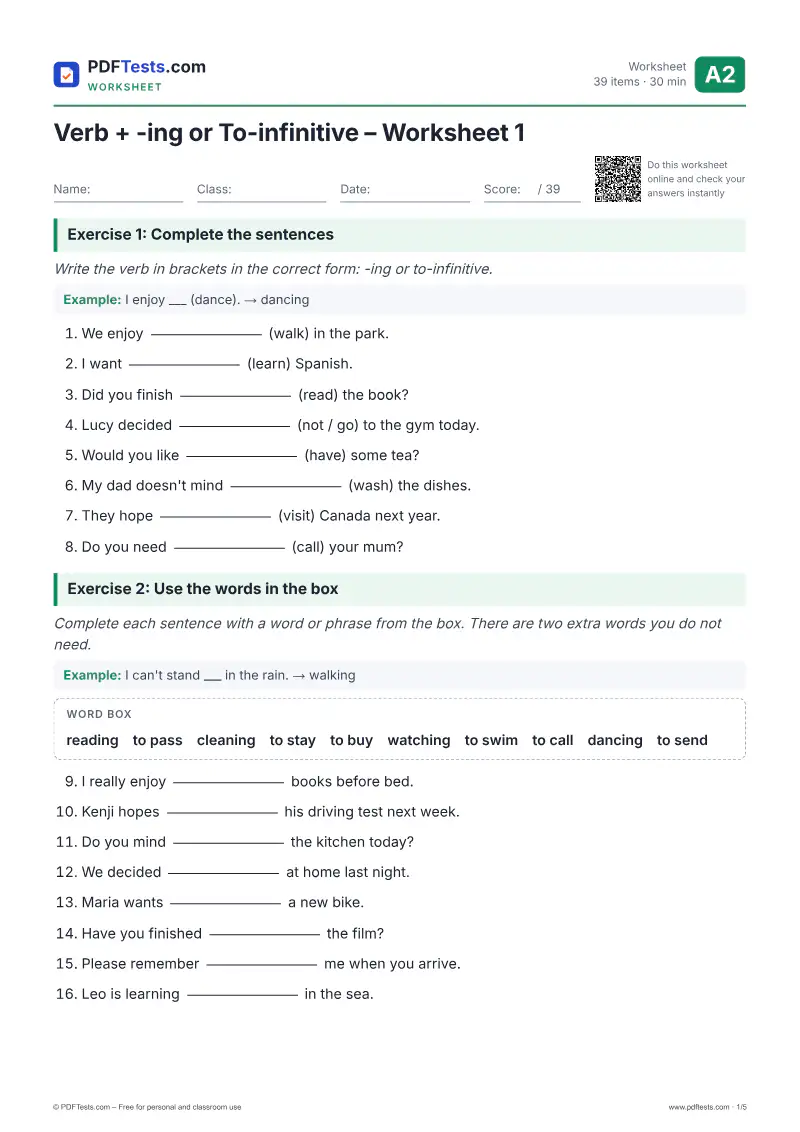
Verb + -ing or To-infinitive – Worksheet 1

A2 Elementary WorksheetEnglish

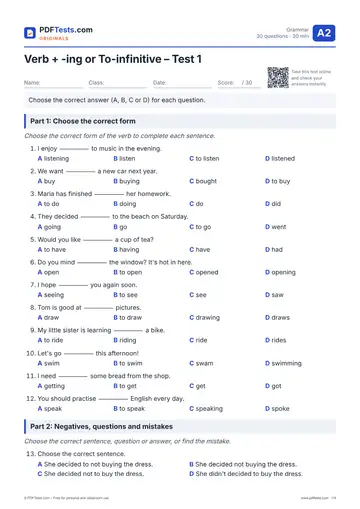
This worksheet practises which verbs are followed by the -ing form (enjoy, finish, mind) and which take the to-infinitive (want, decide, hope, would like). Learners also form negatives and questions with these patterns. It is designed for A2 learners in class or at home.
items
39
Time
30 min
PDF
5 pages
Answer key
Included
  • 100% free
  • No sign-up or email
  • Print-ready A4 PDF
Preview of page 1 of Verb + -ing or To-infinitive – Worksheet 1 Open PDF
New to this topic? Read the guide first: Verb + -ing or To-infinitive: Rules, Examples and Common Mistakes

Do the worksheet online

Type your answers, then press “Check my answers”. Alternative correct answers are accepted.

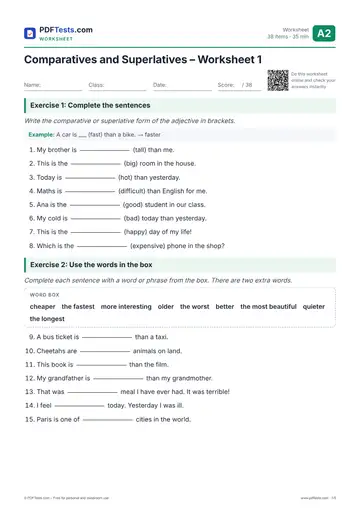
Exercise 1: Complete the sentences

Write the verb in brackets in the correct form: -ing or to-infinitive.

Example: I enjoy ___ (dance). → dancing

  1. We enjoy (walk) in the park.

  2. I want (learn) Spanish.

  3. Did you finish (read) the book?

  4. Lucy decided (not / go) to the gym today.

  5. Would you like (have) some tea?

  6. My dad doesn't mind (wash) the dishes.

  7. They hope (visit) Canada next year.

  8. Do you need (call) your mum?

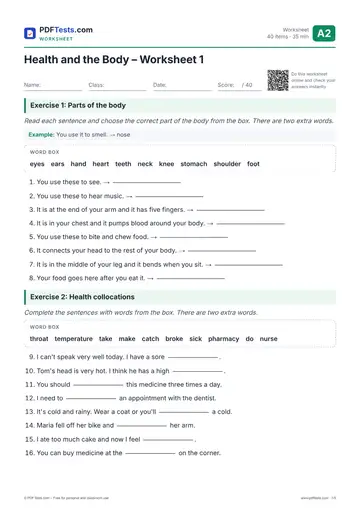
Exercise 2: Use the words in the box

Complete each sentence with a word or phrase from the box. There are two extra words you do not need.

Example: I can't stand ___ in the rain. → walking

Word box readingto passcleaningto stayto buywatchingto swimto calldancingto send

  1. I really enjoy books before bed.

  2. Kenji hopes his driving test next week.

  3. Do you mind the kitchen today?

  4. We decided at home last night.

  5. Maria wants a new bike.

  6. Have you finished the film?

  7. Please remember me when you arrive.

  8. Leo is learning in the sea.

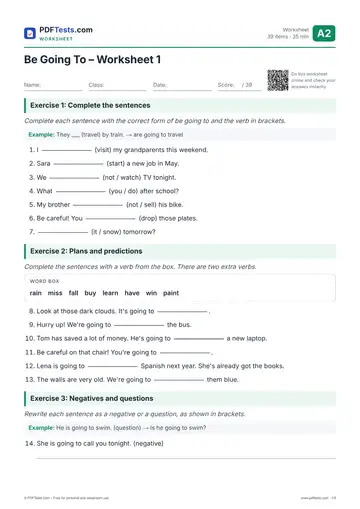
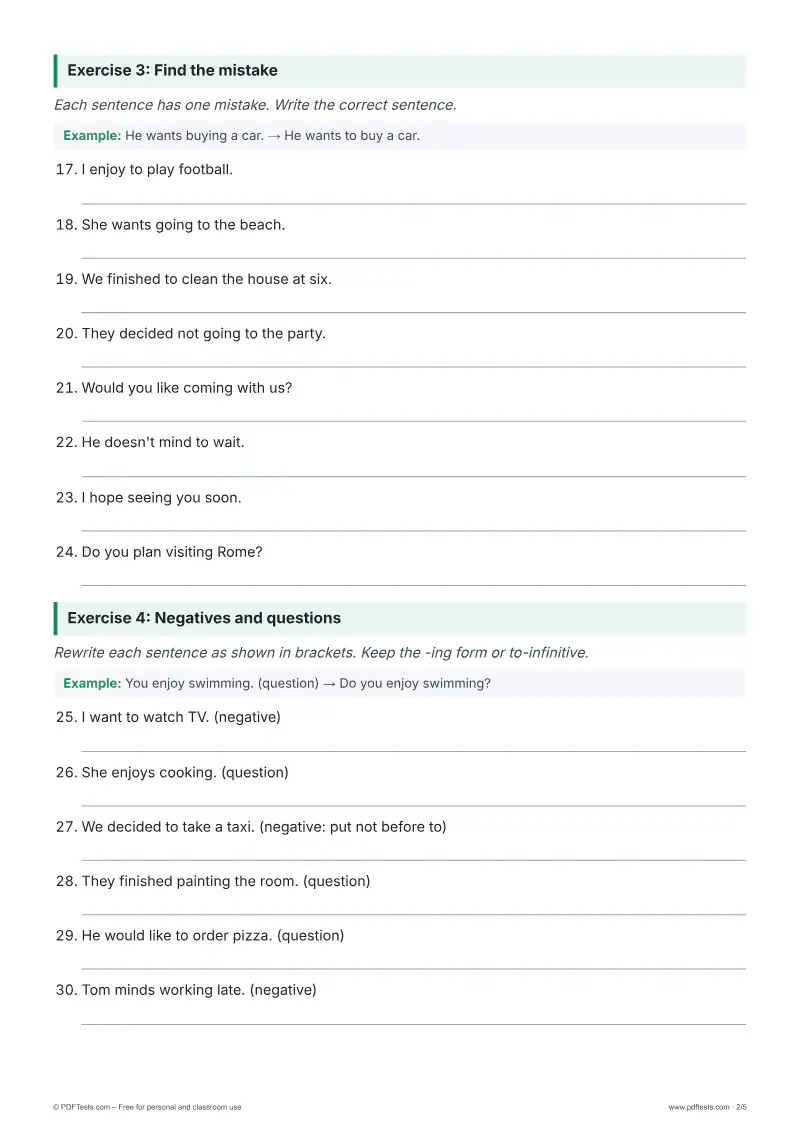
Exercise 3: Find the mistake

Each sentence has one mistake. Write the correct sentence.

Example: He wants buying a car. → He wants to buy a car.

  1. I enjoy to play football.

  2. She wants going to the beach.

  3. We finished to clean the house at six.

  4. They decided not going to the party.

  5. Would you like coming with us?

  6. He doesn't mind to wait.

  7. I hope seeing you soon.

  8. Do you plan visiting Rome?

Exercise 4: Negatives and questions

Rewrite each sentence as shown in brackets. Keep the -ing form or to-infinitive.

Example: You enjoy swimming. (question) → Do you enjoy swimming?

  1. I want to watch TV. (negative)

  2. She enjoys cooking. (question)

  3. We decided to take a taxi. (negative: put not before to)

  4. They finished painting the room. (question)

  5. He would like to order pizza. (question)

  6. Tom minds working late. (negative)

  7. Ana needs to buy milk. (negative)

  8. You plan to travel this summer. (question)

Exercise 5: Put the words in order

Put the words in the correct order to make sentences or questions.

Example: likes / Ben / cooking / → Ben likes cooking.

  1. you / to / do / want / dance / ?

  2. enjoys / my / sister / photos / taking

  3. decided / to / we / not / the car / buy

  4. finished / your homework / have / doing / you / ?

  5. mind / doesn't / early / she / getting up

  6. learning / Paolo / is / to / drive

  7. would / like / I / a coffee / to / have

Was this page helpful?

Report a mistake

Spotted a wrong answer, a typo or an unclear explanation? Tell us and we will fix it.

Preview

About this test

Printable A2 worksheet on verb + -ing or to-infinitive (enjoy doing, want to do), with negatives, questions and answers.

Topics covered

Verb + -ingVerb + to-infinitiveNegative infinitive (not to do)Questions with want / enjoy / would likeWord order

Notes for teachers

Start by sorting common verbs into two columns on the board: -ing verbs (enjoy, finish, mind) and to-infinitive verbs (want, need, decide, hope, plan, learn, would like). A typical mistake is 'I enjoy to play' or 'I want going'. Another is 'decided to not go' instead of 'decided not to go'. As a follow-up, pairs ask each other 'What do you enjoy doing?' and 'What do you want to do next year?' and report back.

All English A2 tests →