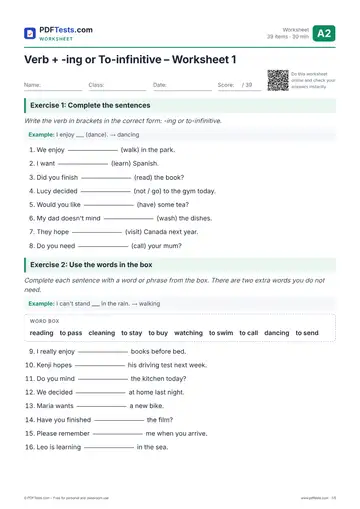
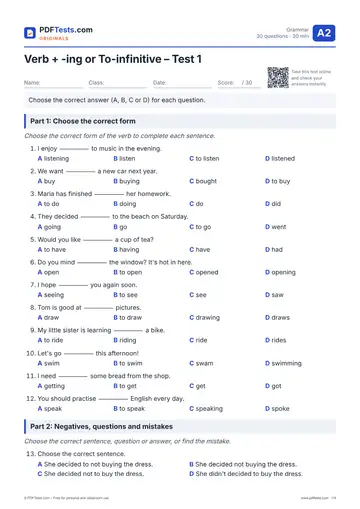
When one verb follows another verb, the second verb can take the -ing form (I enjoy cooking) or the to-infinitive (I want to cook). The choice depends on the first verb, so you need to learn which verbs go with which form. This guide covers the most common A2 verbs, the verbs that can take both forms and the mistakes learners make most often.
The basic rule
Look at the first verb. That verb decides the form of the second verb.
- enjoy + -ing → She enjoys reading.
- want + to-infinitive → She wants to read more.
There is no simple meaning rule that works every time. The best approach is to learn the common verbs in groups, like vocabulary.
Verbs followed by -ing
These verbs are followed by the -ing form of the next verb.
| Verb | Example |
|---|---|
| enjoy | I enjoy playing tennis at the weekend. |
| finish | Have you finished doing your homework? |
| (not) mind | I don’t mind waiting. Take your time. |
| practise | She practises speaking English every day. |
| keep | He keeps forgetting his keys. |
| miss | I miss living near the sea. |
| suggest | Tom suggested going to the cinema. |
| imagine | Can you imagine living without a phone? |
| give up | My dad gave up smoking last year. |
| can’t stand | I can’t stand getting up early. |
A lot of these verbs talk about activities in general, likes and dislikes, or things that are already happening.
Go + -ing for activities
We use go + -ing for many free-time and sports activities:
- We go swimming every Saturday.
- Let’s go shopping this afternoon.
- They went camping in the summer.
Other common examples: go running, go skiing, go fishing, go dancing.
Verbs followed by to-infinitive
These verbs are followed by to + the base form of the next verb.
| Verb | Example |
|---|---|
| want | I want to learn Spanish. |
| would like | I**’d like to book** a table for two, please. |
| decide | We decided to stay at home. |
| hope | She hopes to find a new job soon. |
| plan | They’re planning to move to London. |
| need | You need to drink more water. |
| learn | My son is learning to swim. |
| agree | He agreed to help me. |
| promise | I promise to call you tonight. |
| offer | She offered to drive us to the station. |
| refuse | The child refused to eat his vegetables. |
| can’t afford | We can’t afford to buy a new car. |
Many of these verbs talk about the future: plans, wishes, decisions and promises. Want, hope, plan and decide all look forward to an action that has not happened yet. This is a useful memory tip, but it does not work for every verb.
Verbs followed by both forms
Some common verbs can take either form with little or no change in meaning.
| Verb | -ing | to-infinitive |
|---|---|---|
| like | I like swimming. | I like to swim. |
| love | She loves dancing. | She loves to dance. |
| hate | He hates getting up early. | He hates to get up early. |
| start | It started raining. | It started to rain. |
| begin | They began talking. | They began to talk. |
| prefer | I prefer walking. | I prefer to walk. |
Both versions are correct and natural. At A2, you can use either one.
Like vs would like
Be careful: like can take both forms, but would like only takes the to-infinitive.
- I like cooking. (in general – I enjoy it)
- I*’d like to cook** dinner tonight.* (a wish for a specific time)
The same is true for would love and would prefer: I’d love to come to your party.
Verbs that change meaning: stop and remember
A few verbs take both forms, but the meaning changes. Two are important at A2.
Stop
- stop + -ing = you end an activity: I stopped eating sugar. (I don’t eat sugar now.)
- stop + to-infinitive = you stop one thing in order to do another: I stopped to eat a sandwich. (I stopped walking/working so I could eat.)
Remember and forget
- remember / forget + to-infinitive = an action you need to do: Please remember to lock the door. / I forgot to buy milk.
- remember + -ing = a memory of the past: I remember meeting her at a party.
There are more verbs like this, such as try and regret. You can study them later in our Gerunds and Infinitives guide at B1 level.
Form
The first verb changes for tense and person. The second verb (-ing or to-infinitive) does not change.
Affirmative
| Subject | First verb | Second verb |
|---|---|---|
| I / You / We / They | enjoy | watching films. |
| He / She / It | enjoys | watching films. |
| I / You / We / They | want | to watch a film. |
| He / She / It | wants | to watch a film. |
| She | decided | to watch a film. |
Negative
There are two kinds of negative.
1. Make the first verb negative (the most common):
| Example |
|---|
| I don’t enjoy watching horror films. |
| He doesn’t want to go out tonight. |
| We didn’t decide to leave early. |
2. Make the second verb negative by putting not before it:
| Example |
|---|
| She decided not to go to the party. |
| I promise not to be late. |
| I enjoy not working on Fridays. |
Notice the difference: I didn’t decide to go (there was no decision) and I decided not to go (I made a decision: no).
Questions
| Question | Short answer |
|---|---|
| Do you enjoy cooking? | Yes, I do. / No, I don’t. |
| Does she want to come with us? | Yes, she does. / No, she doesn’t. |
| Have you finished cleaning? | Yes, I have. / No, I haven’t. |
| What do you want to do? | I want to stay at home. |
Spelling of the -ing form
Most verbs simply add -ing: read → reading, play → playing. Some verbs change:
| Rule | Examples |
|---|---|
| Verb ends in -e: drop the e | make → making, write → writing |
| Short verb ending in consonant + vowel + consonant: double the last letter | swim → swimming, run → running, get → getting |
| Verb ends in -ie: change to -y | lie → lying, die → dying |
These are the same rules you use for the present continuous. See our Present Continuous guide for more examples.
After prepositions: always -ing
When a verb comes after a preposition (at, in, of, about, for, without), it is always in the -ing form.
- She’s good at drawing.
- I’m interested in learning Japanese.
- Thanks for helping me.
- How about going for a walk?
- He left without saying goodbye.
Look forward to is a special case. Here, to is a preposition, not part of an infinitive, so it takes -ing: I’m looking forward to seeing you.
Don’t confuse: modal verbs
Modal verbs such as can, must, should, will and might are followed by the base form without to, not by -ing or the to-infinitive.
- I can swim. (not can to swim or can swimming)
- You should call her.
But have to and need to already include to: I have to go now. For more, read our guide to Must, Have To and Should.
Common mistakes
- ✗ I enjoy to swim. → ✓ I enjoy swimming. — Enjoy is always followed by -ing.
- ✗ I want going home. → ✓ I want to go home. — Want is followed by the to-infinitive.
- ✗ I’d like going to Paris. → ✓ I’d like to go to Paris. — Would like only takes the to-infinitive.
- ✗ She wants to goes. → ✓ She wants to go. — The verb after to never changes; only the first verb takes -s.
- ✗ Have you finished to eat? → ✓ Have you finished eating? — Finish takes -ing.
- ✗ I’m interested in learn English. → ✓ I’m interested in learning English. — After a preposition, use -ing.
- ✗ I look forward to see you. → ✓ I look forward to seeing you. — The to in look forward to is a preposition.
- ✗ Let’s go to swim. → ✓ Let’s go swimming. — Use go + -ing for activities.
- ✗ You must to study. → ✓ You must study. — Modal verbs take the base form without to.
- ✗ I decided to not go. → ✓ I decided not to go. — In standard English, not usually goes before to.
Quick check
Choose the correct form.
- My brother keeps ______ (ask) me for money.
- We hope ______ (visit) Canada next year.
- Would you like ______ (have) a coffee?
- I’m not very good at ______ (cook).
- She stopped ______ (buy) a newspaper on her way to work, then she continued walking.
Answers
- asking — keep + -ing
- to visit — hope + to-infinitive
- to have — would like + to-infinitive
- cooking — after the preposition at, use -ing
- to buy — stop + to means she stopped in order to do something else
Next step
Start with the most useful verbs: enjoy, finish, mind, keep (+ -ing) and want, would like, decide, hope, need (+ to-infinitive). Write two or three true sentences about yourself with each one, such as I enjoy walking to work or I need to buy new shoes. Then test yourself with our A2 Verb + -ing or To-infinitive test to see which verbs you already know and which ones need more practice. When you feel confident, move on to the B1 Gerunds and Infinitives test for more verbs and meaning changes.
Was this page helpful?
What was the problem?
Thank you for your feedback!