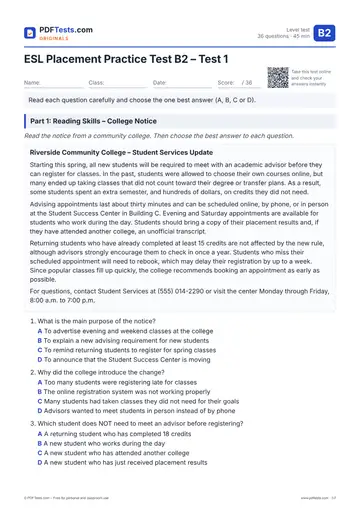
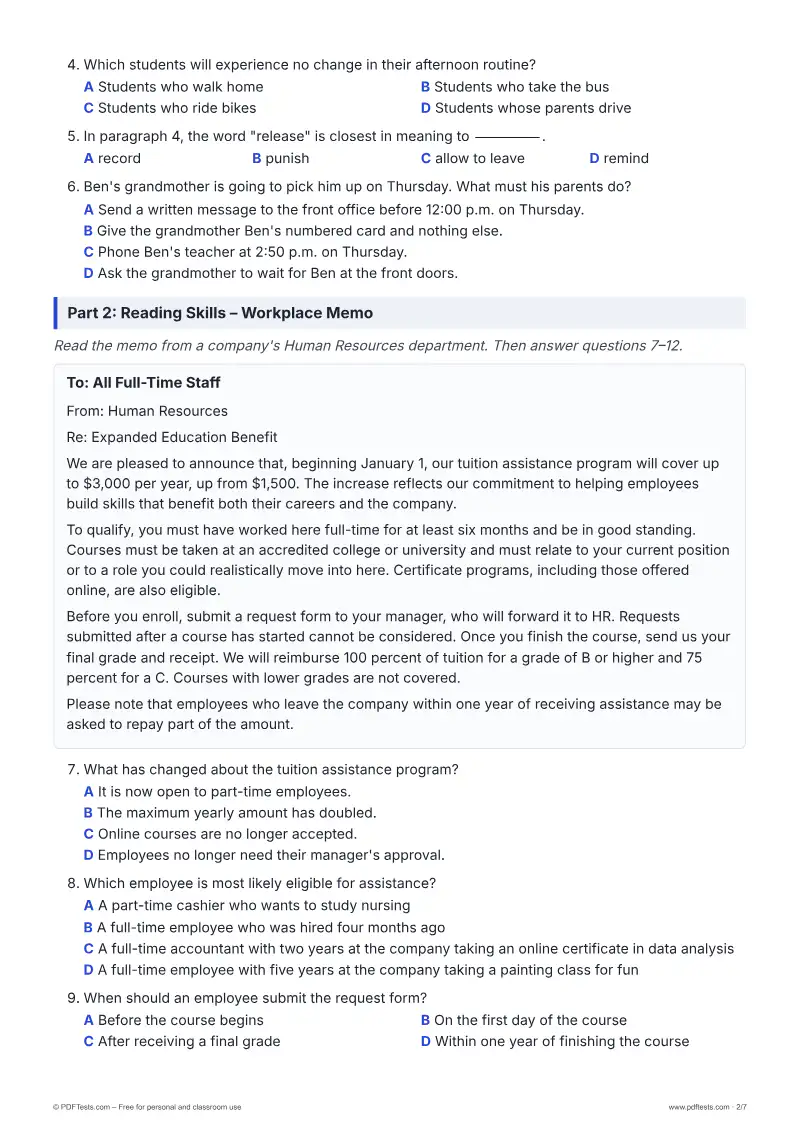
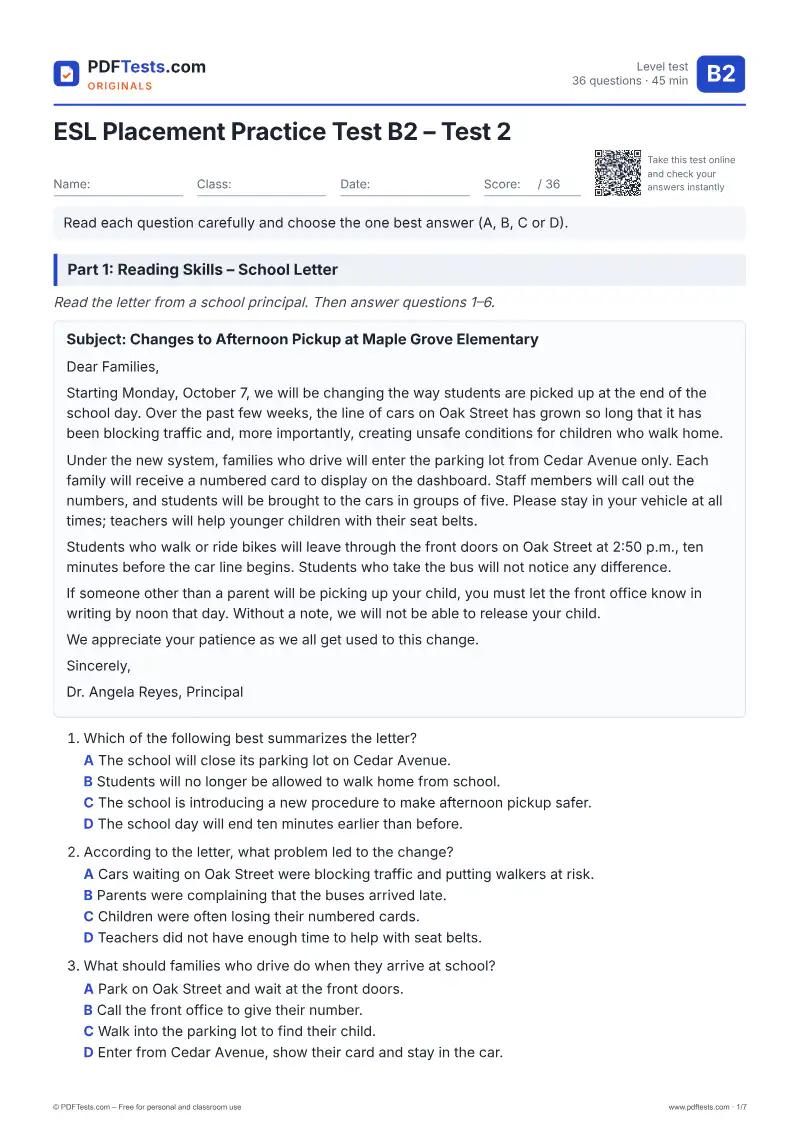
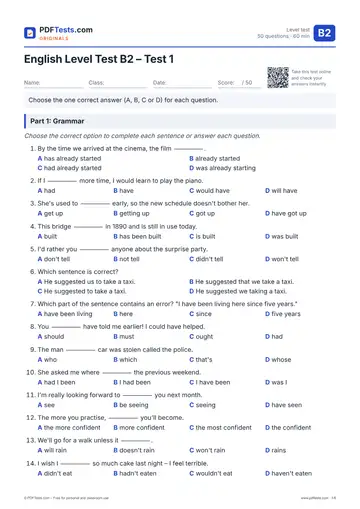
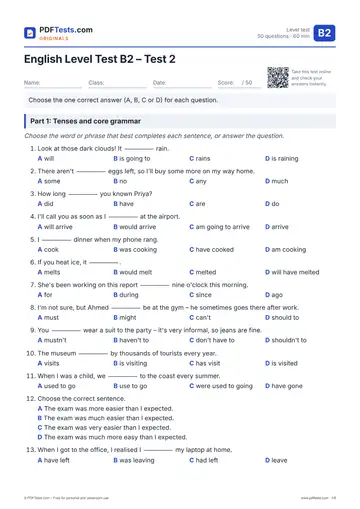
This upper-intermediate (B2) ESL placement practice test is modeled on the kind of placement exams used in US colleges and adult-education programs. It has two short reading texts about school and work in the United States, followed by sections on sentence meaning and language use. It suits adult learners and teachers who want to check whether a student is secure at B2.
Read each question carefully and choose the one best answer (A, B, C or D). Choose your answers, then press “Check my answers”.
0%
Your result
[["Keep practising","This topic needs more practice. Start with the guide, then try a worksheet."],["Good start","You know the basics. Read the guide and practise the parts you missed."],["Very good!","Just a few slips. Review your mistakes, then try the next test."],["Excellent!","You have mastered this topic. Ready for the next challenge?"]]
Please describe the problem in a few words. Sorry, the report could not be sent. Please email us at [email protected].
Preview
About this test
This upper-intermediate (B2) ESL placement practice test is modeled on the kind of placement exams used in US colleges and adult-education programs. It has two short reading texts about school and work in the United States, followed by sections on sentence meaning and language use. It suits adult learners and teachers who want to check whether a student is secure at B2.
Topics covered
Reading comprehensionPhrasal verbs and idiomsParaphrasing sentencesConditionalsPassive voiceReported speechRelative clausesPerfect tenses
How to use this test
Download the PDF and print it, or take the test online below.
Answer every question without a dictionary or time pressure.
Check your answers and note the topics you need to review.
Notes for teachers
Give students about 45 minutes and no dictionary. A score of 29 or more (about 80%) suggests the learner is secure at B2, 22–28 suggests a solid B1+/developing B2, and lower scores point to placement at B1. The sentence-meaning section targets common confusions with phrasal verbs, idioms and formal structures (should + subject, no sooner), while the language-use section checks tense choice, passives, reported questions and conditionals. Review wrong answers with students and ask them to rewrite the original sentences in their own words as a follow-up.
 B2
 Open PDF
 B2
 B2
 B2
 B2
 B2
 B2
 B2