PDFTests Originals

Test de placement d'anglais B2 – Test 2

B2 Intermédiaire avancé Test de niveauAnglais

Ce test d'entraînement au placement en anglais de niveau intermédiaire avancé (B2) s'inspire des tests de positionnement utilisés dans les universités américaines et les programmes de formation pour adultes. Il comprend deux courts textes de lecture sur l'école et le travail aux États-Unis, suivis de parties consacrées au sens des phrases et à l'usage de la langue. Il s'adresse aux apprenants adultes et aux enseignants qui souhaitent vérifier si un élève maîtrise solidement le niveau B2.
Questions
36
Durée
45 min
PDF
7 pages
Corrigé
Inclus
  • 100 % gratuit
  • Sans inscription
  • PDF A4 prêt à imprimer
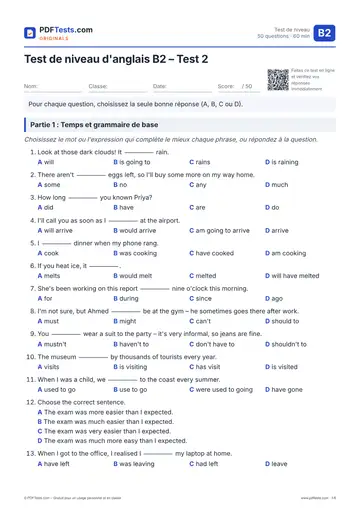
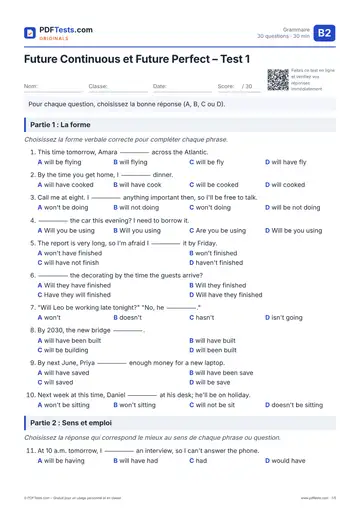
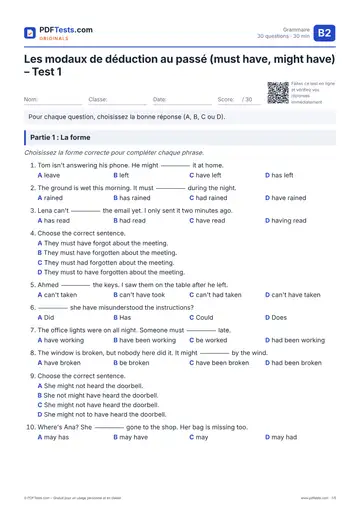
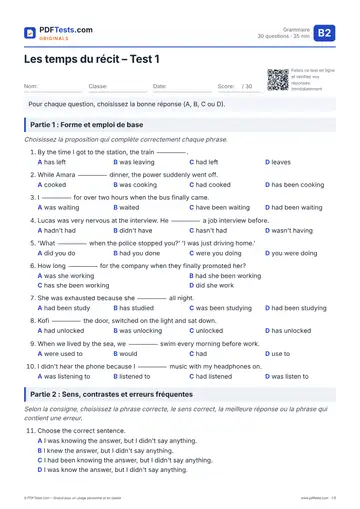
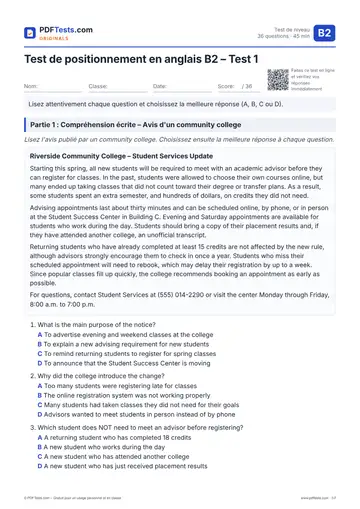
Aperçu de la page 1 : Test de placement d'anglais B2 – Test 2 Ouvrir le PDF
Test de placement ESL · tous les tests d’entraînement, niveaux et conseils

Faire le test en ligne

Lisez attentivement chaque question et choisissez la meilleure réponse (A, B, C ou D). Choisissez vos réponses, puis cliquez sur « Vérifier mes réponses ».

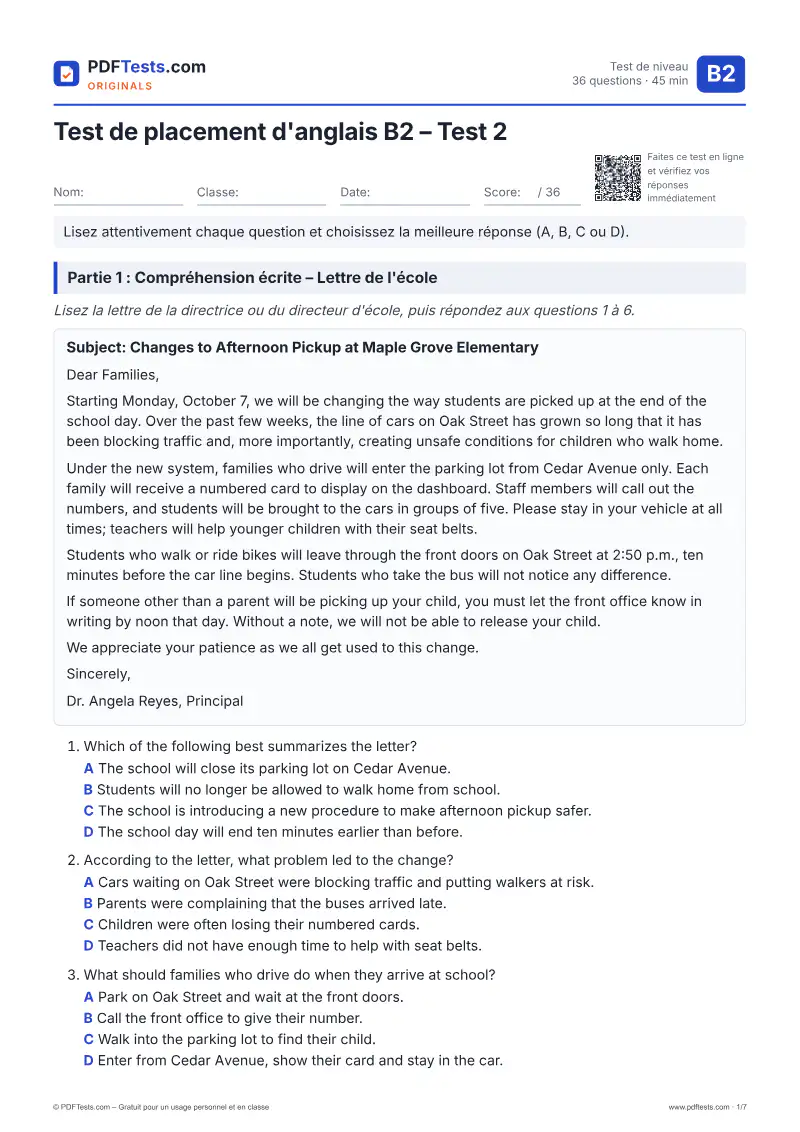
Partie 1 : Compréhension écrite – Lettre de l'école

Lisez la lettre de la directrice ou du directeur d'école, puis répondez aux questions 1 à 6.

Subject: Changes to Afternoon Pickup at Maple Grove Elementary

Dear Families,

Starting Monday, October 7, we will be changing the way students are picked up at the end of the school day. Over the past few weeks, the line of cars on Oak Street has grown so long that it has been blocking traffic and, more importantly, creating unsafe conditions for children who walk home.

Under the new system, families who drive will enter the parking lot from Cedar Avenue only. Each family will receive a numbered card to display on the dashboard. Staff members will call out the numbers, and students will be brought to the cars in groups of five. Please stay in your vehicle at all times; teachers will help younger children with their seat belts.

Students who walk or ride bikes will leave through the front doors on Oak Street at 2:50 p.m., ten minutes before the car line begins. Students who take the bus will not notice any difference.

If someone other than a parent will be picking up your child, you must let the front office know in writing by noon that day. Without a note, we will not be able to release your child.

We appreciate your patience as we all get used to this change.

Sincerely,

Dr. Angela Reyes, Principal

  1. Which of the following best summarizes the letter?

  2. According to the letter, what problem led to the change?

  3. What should families who drive do when they arrive at school?

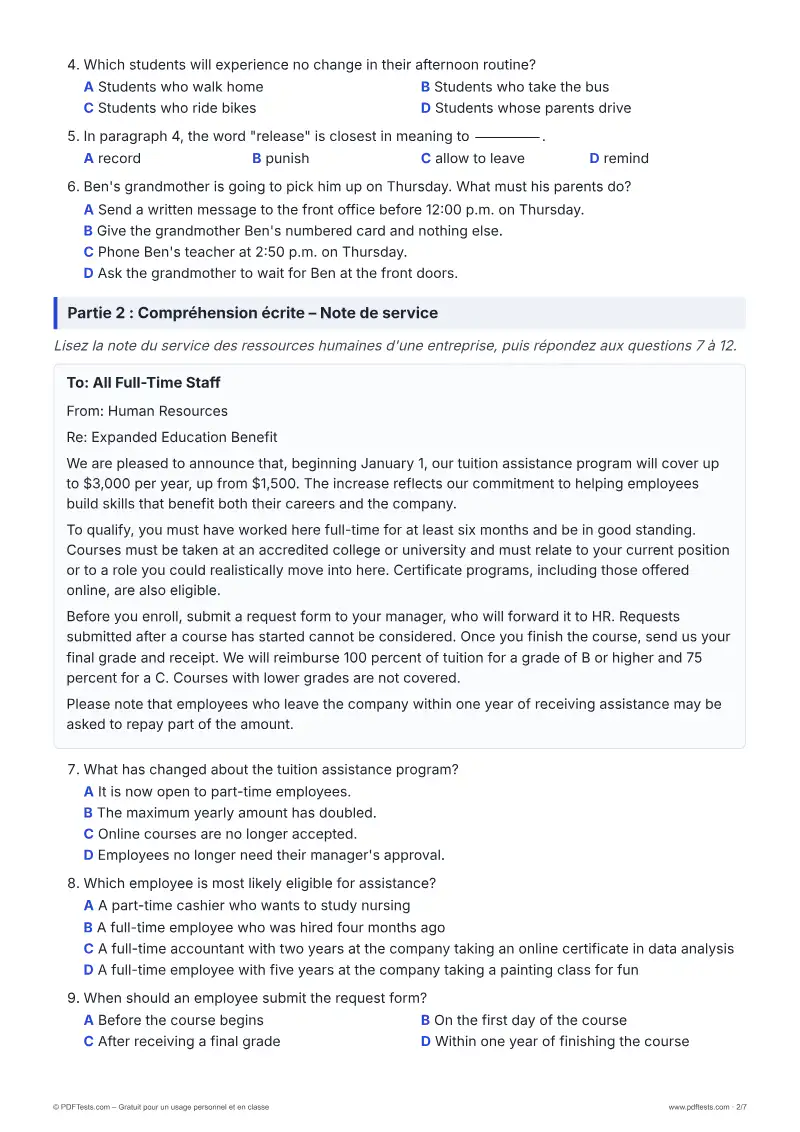
  4. Which students will experience no change in their afternoon routine?

  5. In paragraph 4, the word "release" is closest in meaning to _____.

  6. Ben's grandmother is going to pick him up on Thursday. What must his parents do?

Partie 2 : Compréhension écrite – Note de service

Lisez la note du service des ressources humaines d'une entreprise, puis répondez aux questions 7 à 12.

To: All Full-Time Staff

From: Human Resources

Re: Expanded Education Benefit

We are pleased to announce that, beginning January 1, our tuition assistance program will cover up to $3,000 per year, up from $1,500. The increase reflects our commitment to helping employees build skills that benefit both their careers and the company.

To qualify, you must have worked here full-time for at least six months and be in good standing. Courses must be taken at an accredited college or university and must relate to your current position or to a role you could realistically move into here. Certificate programs, including those offered online, are also eligible.

Before you enroll, submit a request form to your manager, who will forward it to HR. Requests submitted after a course has started cannot be considered. Once you finish the course, send us your final grade and receipt. We will reimburse 100 percent of tuition for a grade of B or higher and 75 percent for a C. Courses with lower grades are not covered.

Please note that employees who leave the company within one year of receiving assistance may be asked to repay part of the amount.

  1. What has changed about the tuition assistance program?

  2. Which employee is most likely eligible for assistance?

  3. When should an employee submit the request form?

  4. Jordan took a $1,000 course and received a C. How much will the company pay?

  5. In paragraph 2, the phrase "in good standing" most likely means _____.

  6. Why might the company ask an employee to pay back some of the money?

Partie 3 : Sens des phrases

Choisissez la phrase qui a le même sens que la phrase d'origine, ou le mot qui complète le mieux le sens de la phrase.

  1. Marcus is very _____; he always arrives on time and finishes his work by the deadline.

  2. "I'll look into the problem with your account." Which sentence has the same meaning?

  3. "The grocery store ran out of milk this morning." Which sentence has the same meaning?

  4. "You'd better bring a jacket tonight." Which sentence has the same meaning?

  5. "Jenna really takes after her father." Which sentence has the same meaning?

  6. The job offer was very _____, so Priya accepted it right away.

  7. After months of training, Daniel finally _____ his goal of running a marathon.

  8. "We had no choice but to cancel the trip." Which sentence has the same meaning?

  9. "It's no use complaining to the manager." Which sentence has the same meaning?

  10. "The report was supposed to be finished by Friday." Which sentence has the same meaning?

  11. "Should you need any help, call the front desk." Which sentence has the same meaning?

  12. "No sooner had we sat down than the fire alarm went off." Which sentence has the same meaning?

Partie 4 : Usage de la langue

Choisissez la forme correcte pour compléter la phrase, ou la réponse grammaticalement correcte.

  1. "How long _____ in Denver?" "Since 2019."

  2. If it _____ tomorrow, we'll have the picnic indoors.

  3. This is the most interesting class I _____.

  4. Choose the sentence with no grammatical mistakes.

  5. The package _____ to the wrong address yesterday.

  6. At the interview, the manager asked me where _____.

  7. My phone battery is almost dead. It needs _____.

  8. The new software, _____ was installed last week, has already crashed twice.

  9. We've been discussing this for weeks. It's time we _____ a decision about the budget.

  10. Which part of this sentence is incorrect? "The manager, who has worked here for ten years, know every employee by name."

  11. By next June, Carlos _____ at the company for ten years.

  12. Had I known about the sale, I _____ more groceries.

Cette page vous a-t-elle été utile ?

Signaler une erreur

Une mauvaise réponse, une faute de frappe ou une explication peu claire ? Dites-le-nous, nous corrigerons.

Aperçu

À propos de ce test

Ce test d'entraînement au placement en anglais de niveau intermédiaire avancé (B2) s'inspire des tests de positionnement utilisés dans les universités américaines et les programmes de formation pour adultes. Il comprend deux courts textes de lecture sur l'école et le travail aux États-Unis, suivis de parties consacrées au sens des phrases et à l'usage de la langue. Il s'adresse aux apprenants adultes et aux enseignants qui souhaitent vérifier si un élève maîtrise solidement le niveau B2.

Thèmes abordés

Compréhension écriteVerbes à particule (phrasal verbs) et expressions idiomatiquesReformulation de phrasesLes conditionnelles (conditionals)La voix passive (passive voice)Le discours indirect (reported speech)Les propositions relatives (relative clauses)Les temps du parfait (perfect tenses)

Comment utiliser ce test

  1. Téléchargez le PDF et imprimez-le, ou faites le test en ligne ci-dessous.
  2. Répondez à toutes les questions sans dictionnaire et sans vous presser.
  3. Vérifiez vos réponses et notez les points à revoir.

Notes pour l’enseignant

Prévoyez environ 45 minutes, sans dictionnaire. Un score de 29 ou plus (environ 80 %) indique un niveau B2 solidement acquis ; entre 22 et 28, un niveau B1+ solide ou un B2 en cours d'acquisition ; un score inférieur oriente vers un placement en B1. La partie sur le sens des phrases cible les confusions fréquentes liées aux phrasal verbs, aux expressions idiomatiques et aux structures soutenues (should + sujet, no sooner), tandis que la partie sur l'usage de la langue vérifie le choix des temps, le passif, les questions au discours indirect et les conditionnelles. Corrigez les erreurs avec les élèves, puis demandez-leur, en prolongement, de reformuler les phrases d'origine avec leurs propres mots.