PDFTests Originals

Test de nivel de inglés B2 (ESL Placement) – Test 2

B2 Intermedio alto Prueba de nivelInglés

Este test de nivel de inglés de nivel intermedio alto (B2) sigue el modelo de los exámenes de ubicación (placement tests) que se usan en los colleges y programas de educación para adultos de Estados Unidos. Incluye dos textos breves de lectura sobre la escuela y el trabajo en EE. UU., seguidos de secciones sobre el significado de frases y el uso de la lengua. Está pensado para estudiantes adultos y para docentes que quieran comprobar si un alumno domina con seguridad el nivel B2.
Preguntas
36
Tiempo
45 min
PDF
7 páginas
Soluciones
Incluidas
  • 100 % gratis
  • Sin registro
  • PDF A4 listo para imprimir
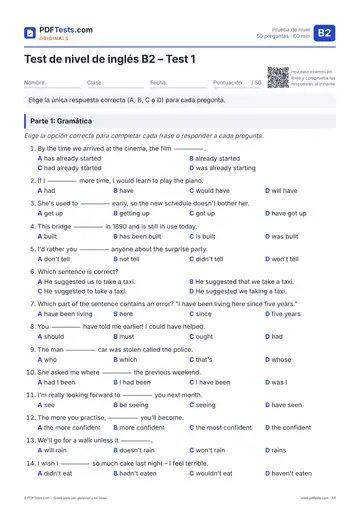
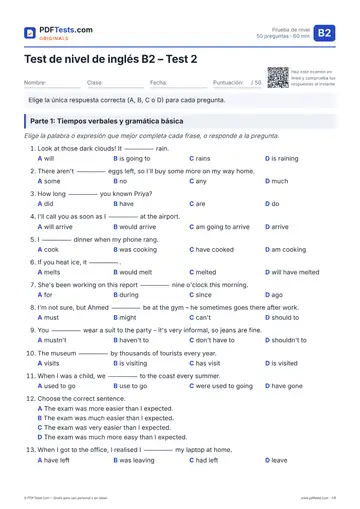
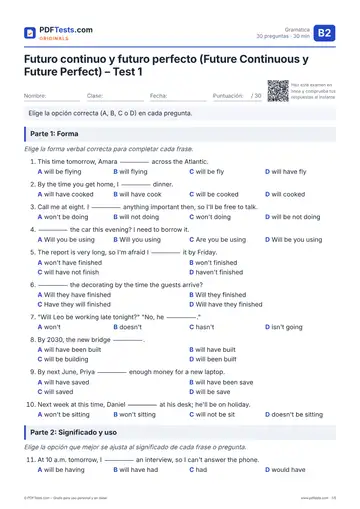
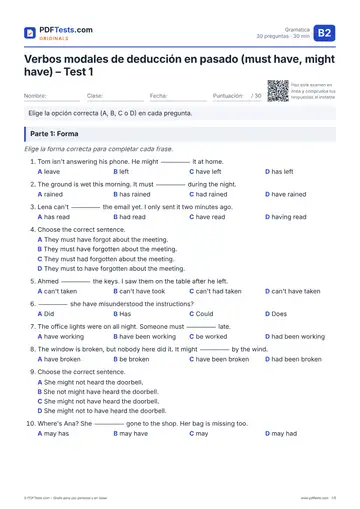
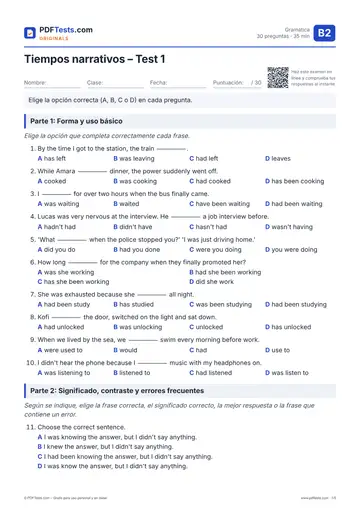
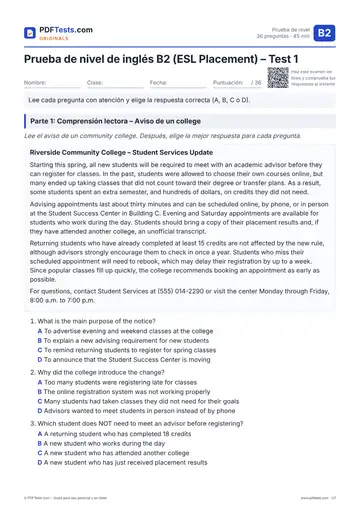
Vista previa de la página 1: Test de nivel de inglés B2 (ESL Placement) – Test 2 Abrir PDF
Examen de ubicación ESL · todos los exámenes de práctica, niveles y consejos

Haz el examen en línea

Lee cada pregunta con atención y elige la única respuesta correcta (A, B, C o D). Elige tus respuestas y pulsa «Comprobar respuestas».

Parte 1: Comprensión lectora – Carta del colegio

Lee la carta de la directora de un colegio. Después responde a las preguntas 1–6.

Subject: Changes to Afternoon Pickup at Maple Grove Elementary

Dear Families,

Starting Monday, October 7, we will be changing the way students are picked up at the end of the school day. Over the past few weeks, the line of cars on Oak Street has grown so long that it has been blocking traffic and, more importantly, creating unsafe conditions for children who walk home.

Under the new system, families who drive will enter the parking lot from Cedar Avenue only. Each family will receive a numbered card to display on the dashboard. Staff members will call out the numbers, and students will be brought to the cars in groups of five. Please stay in your vehicle at all times; teachers will help younger children with their seat belts.

Students who walk or ride bikes will leave through the front doors on Oak Street at 2:50 p.m., ten minutes before the car line begins. Students who take the bus will not notice any difference.

If someone other than a parent will be picking up your child, you must let the front office know in writing by noon that day. Without a note, we will not be able to release your child.

We appreciate your patience as we all get used to this change.

Sincerely,

Dr. Angela Reyes, Principal

  1. Which of the following best summarizes the letter?

  2. According to the letter, what problem led to the change?

  3. What should families who drive do when they arrive at school?

  4. Which students will experience no change in their afternoon routine?

  5. In paragraph 4, the word "release" is closest in meaning to _____.

  6. Ben's grandmother is going to pick him up on Thursday. What must his parents do?

Parte 2: Comprensión lectora – Circular de empresa

Lee la circular del departamento de Recursos Humanos de una empresa. Después responde a las preguntas 7–12.

To: All Full-Time Staff

From: Human Resources

Re: Expanded Education Benefit

We are pleased to announce that, beginning January 1, our tuition assistance program will cover up to $3,000 per year, up from $1,500. The increase reflects our commitment to helping employees build skills that benefit both their careers and the company.

To qualify, you must have worked here full-time for at least six months and be in good standing. Courses must be taken at an accredited college or university and must relate to your current position or to a role you could realistically move into here. Certificate programs, including those offered online, are also eligible.

Before you enroll, submit a request form to your manager, who will forward it to HR. Requests submitted after a course has started cannot be considered. Once you finish the course, send us your final grade and receipt. We will reimburse 100 percent of tuition for a grade of B or higher and 75 percent for a C. Courses with lower grades are not covered.

Please note that employees who leave the company within one year of receiving assistance may be asked to repay part of the amount.

  1. What has changed about the tuition assistance program?

  2. Which employee is most likely eligible for assistance?

  3. When should an employee submit the request form?

  4. Jordan took a $1,000 course and received a C. How much will the company pay?

  5. In paragraph 2, the phrase "in good standing" most likely means _____.

  6. Why might the company ask an employee to pay back some of the money?

Parte 3: Significado de frases

Elige la oración que tiene el mismo significado que la original, o la palabra que mejor completa el sentido de la oración.

  1. Marcus is very _____; he always arrives on time and finishes his work by the deadline.

  2. "I'll look into the problem with your account." Which sentence has the same meaning?

  3. "The grocery store ran out of milk this morning." Which sentence has the same meaning?

  4. "You'd better bring a jacket tonight." Which sentence has the same meaning?

  5. "Jenna really takes after her father." Which sentence has the same meaning?

  6. The job offer was very _____, so Priya accepted it right away.

  7. After months of training, Daniel finally _____ his goal of running a marathon.

  8. "We had no choice but to cancel the trip." Which sentence has the same meaning?

  9. "It's no use complaining to the manager." Which sentence has the same meaning?

  10. "The report was supposed to be finished by Friday." Which sentence has the same meaning?

  11. "Should you need any help, call the front desk." Which sentence has the same meaning?

  12. "No sooner had we sat down than the fire alarm went off." Which sentence has the same meaning?

Parte 4: Uso de la lengua

Elige la forma correcta para completar la oración, o la respuesta gramaticalmente correcta.

  1. "How long _____ in Denver?" "Since 2019."

  2. If it _____ tomorrow, we'll have the picnic indoors.

  3. This is the most interesting class I _____.

  4. Choose the sentence with no grammatical mistakes.

  5. The package _____ to the wrong address yesterday.

  6. At the interview, the manager asked me where _____.

  7. My phone battery is almost dead. It needs _____.

  8. The new software, _____ was installed last week, has already crashed twice.

  9. We've been discussing this for weeks. It's time we _____ a decision about the budget.

  10. Which part of this sentence is incorrect? "The manager, who has worked here for ten years, know every employee by name."

  11. By next June, Carlos _____ at the company for ten years.

  12. Had I known about the sale, I _____ more groceries.

¿Te ha resultado útil esta página?

Informar de un error

¿Has visto una respuesta incorrecta, una errata o una explicación poco clara? Avísanos y lo corregiremos.

Vista previa

Sobre este examen

Este test de nivel de inglés de nivel intermedio alto (B2) sigue el modelo de los exámenes de ubicación (placement tests) que se usan en los colleges y programas de educación para adultos de Estados Unidos. Incluye dos textos breves de lectura sobre la escuela y el trabajo en EE. UU., seguidos de secciones sobre el significado de frases y el uso de la lengua. Está pensado para estudiantes adultos y para docentes que quieran comprobar si un alumno domina con seguridad el nivel B2.

Temas

Comprensión lectoraPhrasal verbs y expresiones idiomáticasParáfrasis de oracionesOraciones condicionales (conditionals)Voz pasiva (passive voice)Estilo indirecto (reported speech)Oraciones de relativo (relative clauses)Tiempos perfectos (perfect tenses)

Cómo usar este examen

  1. Descarga el PDF e imprímelo, o haz el examen en línea más abajo.
  2. Responde todas las preguntas sin diccionario y sin prisas.
  3. Comprueba tus respuestas y apunta los temas que debes repasar.

Notas para el profesor

Conceda unos 45 minutos y no permita el uso de diccionario. Una puntuación de 29 o más (alrededor del 80 %) indica que el alumno domina el nivel B2; entre 22 y 28, un B1+ sólido o un B2 en desarrollo; y las puntuaciones inferiores aconsejan ubicarlo en B1. La sección de significado de frases se centra en confusiones habituales con phrasal verbs, expresiones idiomáticas y estructuras formales (should + sujeto, no sooner), mientras que la de uso de la lengua evalúa la elección de tiempos verbales, la pasiva, las preguntas en estilo indirecto y las condicionales. Repase los errores con los alumnos y, como actividad de seguimiento, pídales que reformulen las oraciones originales con sus propias palabras.