PDFTests Originals

Notwendige und nicht notwendige Relativsätze (Defining and Non-defining Relative Clauses) – Test 1

B2 Gute Mittelstufe GrammatikEnglisch

Dieser B2-Grammatiktest mit 30 Aufgaben prüft, wie sicher du notwendige und nicht notwendige Relativsätze (defining and non-defining relative clauses) im Englischen verwendest. Er behandelt Relativpronomen und Relativadverbien, die Kommasetzung, die Frage, wann 'that' möglich ist oder das Pronomen wegfallen kann, 'which' mit Bezug auf einen ganzen Satz, Präpositionen mit 'whom' und 'which' sowie typische Fehler von Lernenden. Er eignet sich für Lernende auf der oberen Mittelstufe, für Prüfungskandidaten und für Lehrkräfte, die eine fertige Lernkontrolle für den Unterricht suchen.
Fragen
30
Zeit
30 Min.
PDF
5 Seiten
Lösungen
Enthalten
  • 100 % kostenlos
  • Ohne Anmeldung
  • Druckfertiges A4-PDF
Vorschau von Seite 1: Notwendige und nicht notwendige Relativsätze (Defining and Non-defining Relative Clauses) – Test 1 PDF öffnen

Test online machen

Wähle bei jeder Aufgabe die eine richtige Antwort. Wählen Sie Ihre Antworten und klicken Sie auf „Antworten prüfen“.

Teil 1: Relativpronomen und Relativadverbien

Wähle das Wort, das den Satz jeweils richtig ergänzt.

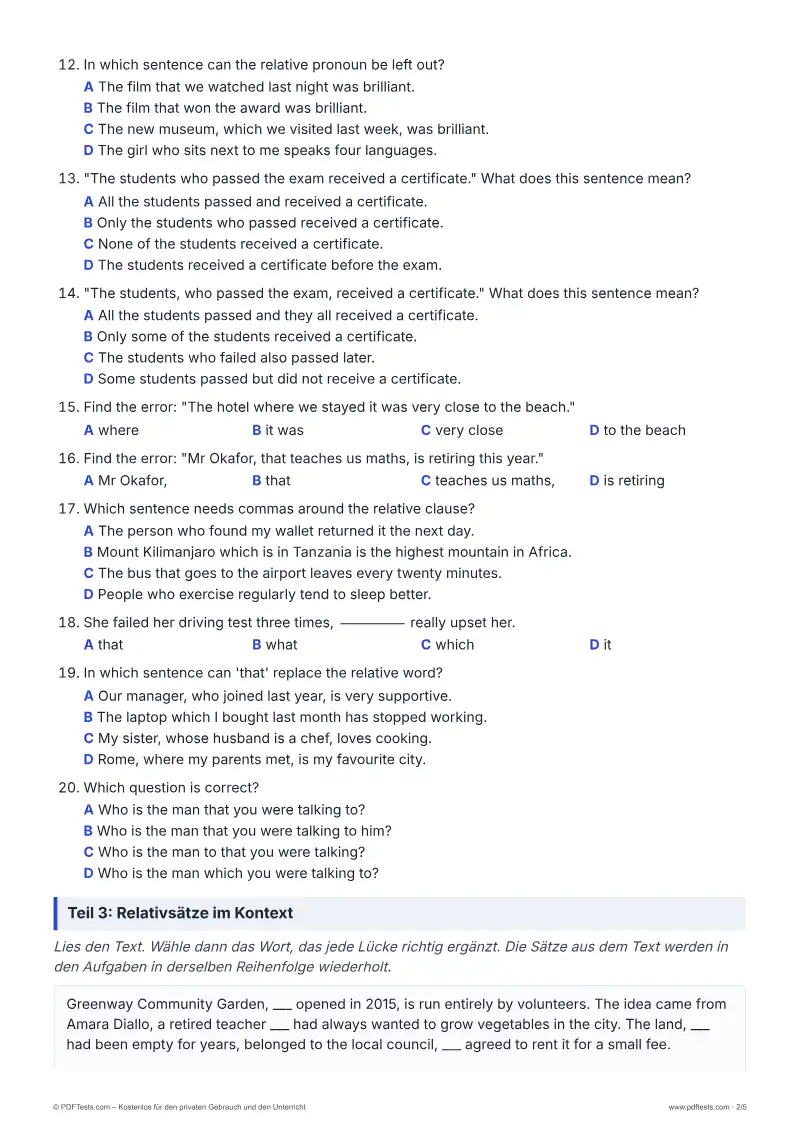
  1. The woman _____ lives next door is a nurse.

  2. Is this the book _____ you were talking about?

  3. I have a friend _____ brother plays in a jazz band.

  4. That's the café _____ we first met.

  5. I'll never forget the day _____ I passed my driving test.

  6. Do you know the reason _____ she left early?

  7. Lagos, _____ is the largest city in Nigeria, is home to over 15 million people.

  8. My grandmother, _____ is 92, still goes swimming every morning.

  9. Everything _____ he told us turned out to be true.

  10. The man to _____ I spoke on the phone was very helpful.

Teil 2: Notwendig oder nicht notwendig? Form, Bedeutung und Fehler

Wähle bei jeder Aufgabe den richtigen Satz, die richtige Bedeutung, die richtige Antwort oder den Fehler.

  1. Sam has only one brother. Which sentence is correct?

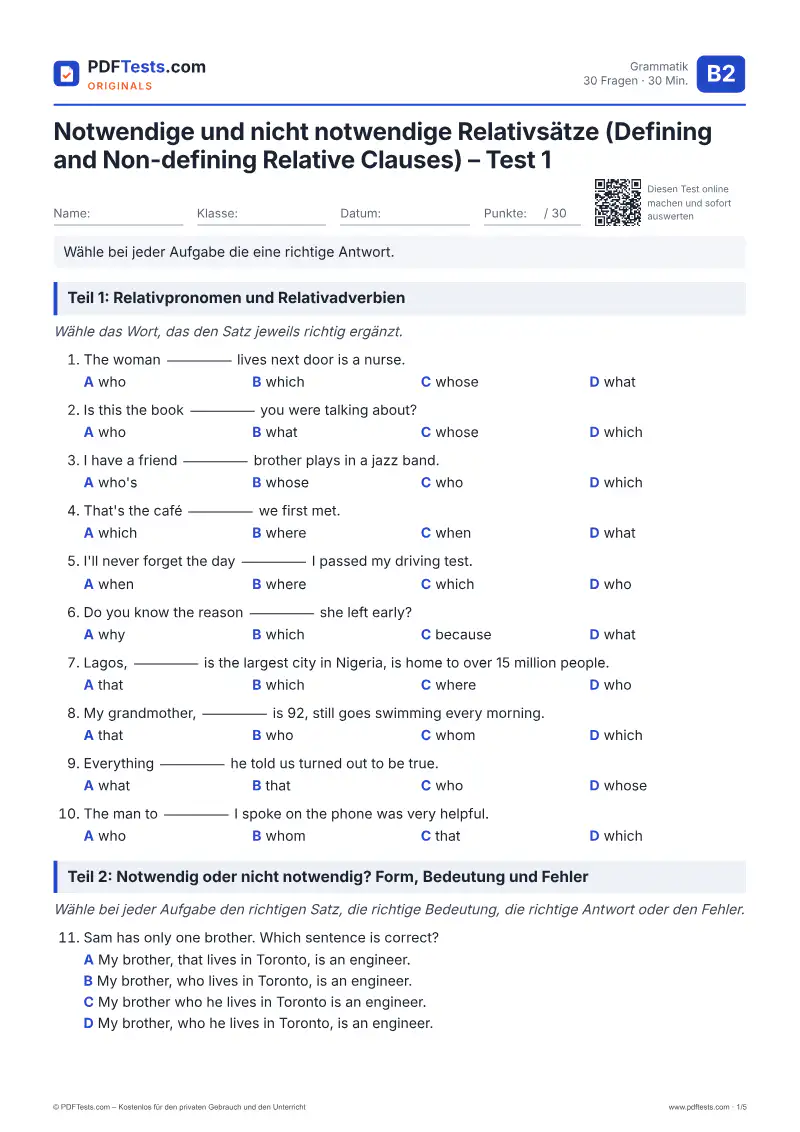
  2. In which sentence can the relative pronoun be left out?

  3. "The students who passed the exam received a certificate." What does this sentence mean?

  4. "The students, who passed the exam, received a certificate." What does this sentence mean?

  5. Find the error: "The hotel where we stayed it was very close to the beach."

  6. Find the error: "Mr Okafor, that teaches us maths, is retiring this year."

  7. Which sentence needs commas around the relative clause?

  8. She failed her driving test three times, _____ really upset her.

  9. In which sentence can 'that' replace the relative word?

  10. Which question is correct?

Teil 3: Relativsätze im Kontext

Lies den Text. Wähle dann das Wort, das jede Lücke richtig ergänzt. Die Sätze aus dem Text werden in den Aufgaben in derselben Reihenfolge wiederholt.

Greenway Community Garden, ___ opened in 2015, is run entirely by volunteers. The idea came from Amara Diallo, a retired teacher ___ had always wanted to grow vegetables in the city. The land, ___ had been empty for years, belonged to the local council, ___ agreed to rent it for a small fee.

Today the garden has around sixty members, most of ___ live in the flats nearby. There is a small shed ___ tools are kept, and a notice board on ___ volunteers write their names for each task. Members ___ plots are not looked after for three months may lose them, ___ seems fair to most people. Amara says the best thing about the garden is the friendships ___ people have made there.

  1. Greenway Community Garden, _____ opened in 2015, is run entirely by volunteers.

  2. The idea came from Amara Diallo, a retired teacher _____ had always wanted to grow vegetables in the city.

  3. The land, _____ had been empty for years, belonged to the local council.

  4. The land belonged to the local council, _____ agreed to rent it for a small fee.

  5. Today the garden has around sixty members, most of _____ live in the flats nearby.

  6. There is a small shed _____ tools are kept.

  7. There is a notice board on _____ volunteers write their names for each task.

  8. Members _____ plots are not looked after for three months may lose them.

  9. Members may lose their plots, _____ seems fair to most people.

  10. Amara says the best thing about the garden is the friendships _____ people have made there.

Vorschau

Über diesen Test

Dieser B2-Grammatiktest mit 30 Aufgaben prüft, wie sicher du notwendige und nicht notwendige Relativsätze (defining and non-defining relative clauses) im Englischen verwendest. Er behandelt Relativpronomen und Relativadverbien, die Kommasetzung, die Frage, wann 'that' möglich ist oder das Pronomen wegfallen kann, 'which' mit Bezug auf einen ganzen Satz, Präpositionen mit 'whom' und 'which' sowie typische Fehler von Lernenden. Er eignet sich für Lernende auf der oberen Mittelstufe, für Prüfungskandidaten und für Lehrkräfte, die eine fertige Lernkontrolle für den Unterricht suchen.

Themen

Relativpronomen: who, which, whose, whom, thatRelativadverbien: where, when, whyNotwendige vs. nicht notwendige RelativsätzeKommasetzung und BedeutungWeglassen des Relativpronomens (Kontaktsätze)Präpositionen in RelativsätzenMengenangaben + whom/which'which' mit Bezug auf den ganzen Satz (sentential 'which')

So nutzen Sie diesen Test

  1. Laden Sie das PDF herunter und drucken Sie es aus – oder machen Sie den Test unten online.
  2. Beantworten Sie alle Fragen ohne Wörterbuch und ohne Zeitdruck.
  3. Prüfen Sie Ihre Antworten und notieren Sie, was Sie wiederholen sollten.

Hinweise für Lehrkräfte

Teil 1 eignet sich als Einstieg zur Wahl des richtigen Pronomens, Teil 2 zur Überprüfung von Zeichensetzung, Bedeutung und der Frage, wann 'that' oder das Weglassen des Pronomens möglich ist, und Teil 3 zum Testen von Relativsätzen in einem zusammenhängenden Text. Der Test zielt auf häufige Fehler auf B2-Niveau: 'that' in nicht notwendigen Relativsätzen, ein zusätzliches Pronomen ('where we stayed it was'), die Verwechslung von 'whose' und 'who's' sowie 'that' oder 'what' mit Bezug auf einen ganzen Satz. Als Anschlussübung können die Lernenden Paare kurzer Sätze zu einem Satz mit Relativsatz verbinden und begründen, ob Kommas nötig sind.