PDFTests Originals

Oraciones de relativo especificativas y explicativas (Defining and Non-defining Relative Clauses) – Test 1

B2 Intermedio alto GramáticaInglés

Este test de gramática B2 con 30 preguntas comprueba si sabes usar bien las oraciones de relativo especificativas y explicativas (defining and non-defining relative clauses) en inglés. Trabaja los pronombres y adverbios relativos, el uso de las comas, cuándo se puede usar 'that' o se puede omitir el pronombre, 'which' referido a toda una oración, las preposiciones con 'whom' y 'which', y los errores más habituales de los alumnos. Es ideal para estudiantes de nivel intermedio-alto, candidatos a exámenes oficiales y profesores que necesitan una prueba lista para usar en clase.
Preguntas
30
Tiempo
30 min
PDF
5 páginas
Soluciones
Incluidas
  • 100 % gratis
  • Sin registro
  • PDF A4 listo para imprimir
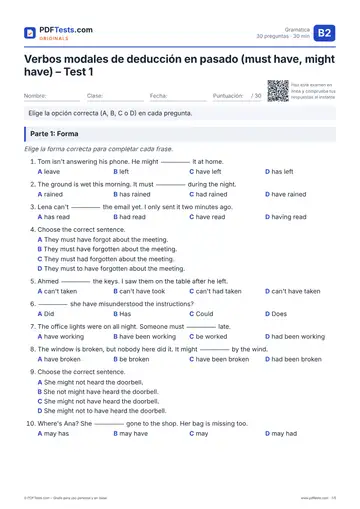
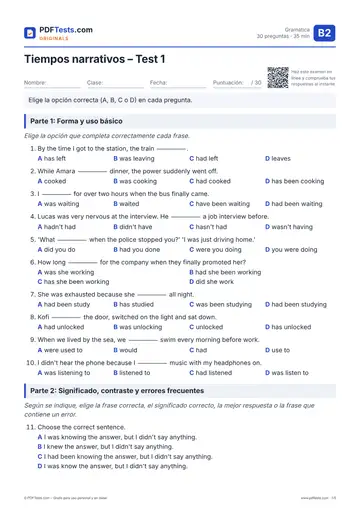
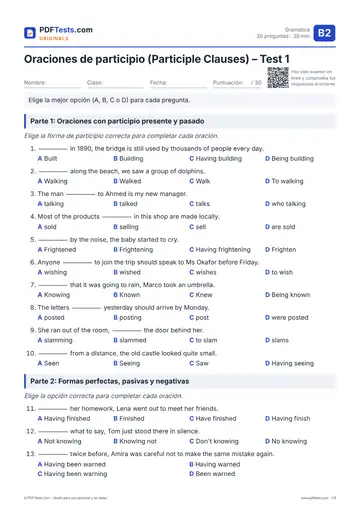
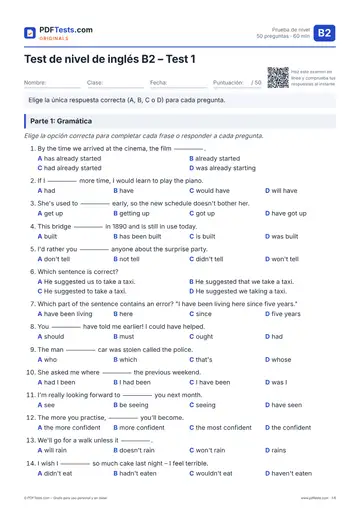
Vista previa de la página 1: Oraciones de relativo especificativas y explicativas (Defining and Non-defining Relative Clauses) – Test 1 Abrir PDF

Haz el examen en línea

Elige la única respuesta correcta en cada pregunta. Elige tus respuestas y pulsa «Comprobar respuestas».

Parte 1: Pronombres y adverbios relativos

Elige la palabra que completa correctamente cada oración.

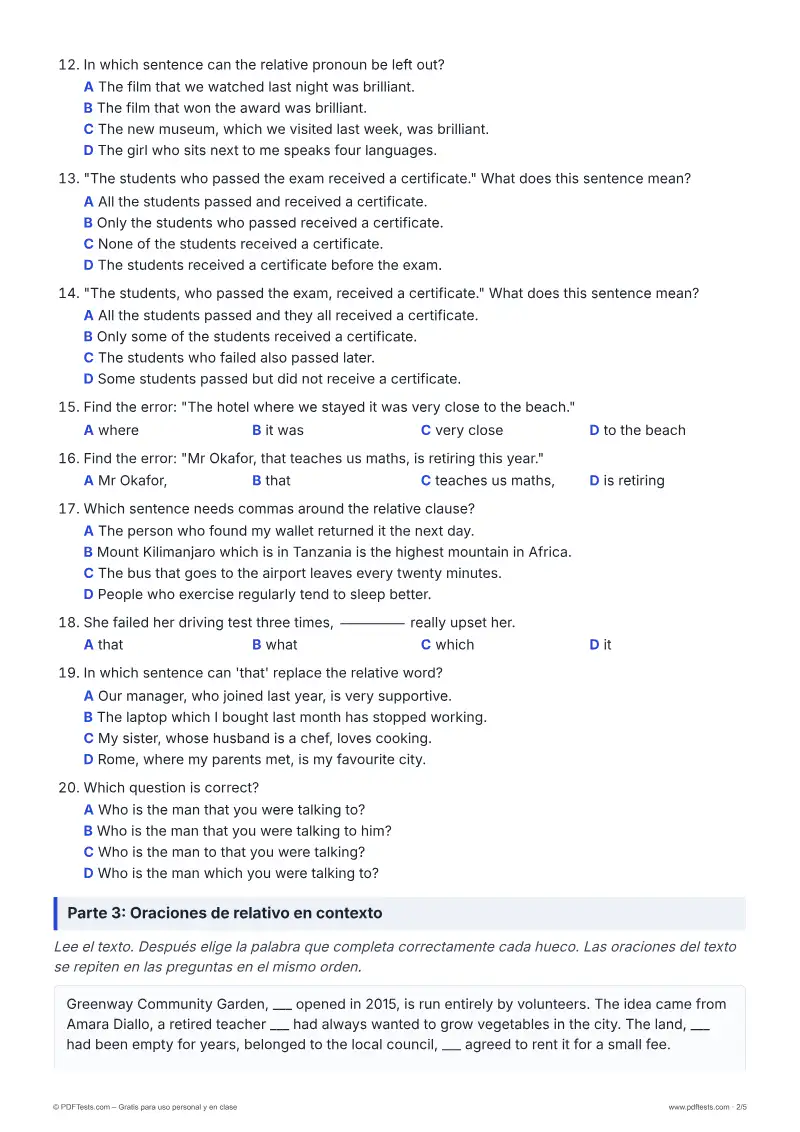
  1. The woman _____ lives next door is a nurse.

  2. Is this the book _____ you were talking about?

  3. I have a friend _____ brother plays in a jazz band.

  4. That's the café _____ we first met.

  5. I'll never forget the day _____ I passed my driving test.

  6. Do you know the reason _____ she left early?

  7. Lagos, _____ is the largest city in Nigeria, is home to over 15 million people.

  8. My grandmother, _____ is 92, still goes swimming every morning.

  9. Everything _____ he told us turned out to be true.

  10. The man to _____ I spoke on the phone was very helpful.

Parte 2: ¿Especificativa o explicativa? Forma, significado y errores

Elige la oración, el significado, la respuesta o el error correcto en cada pregunta.

  1. Sam has only one brother. Which sentence is correct?

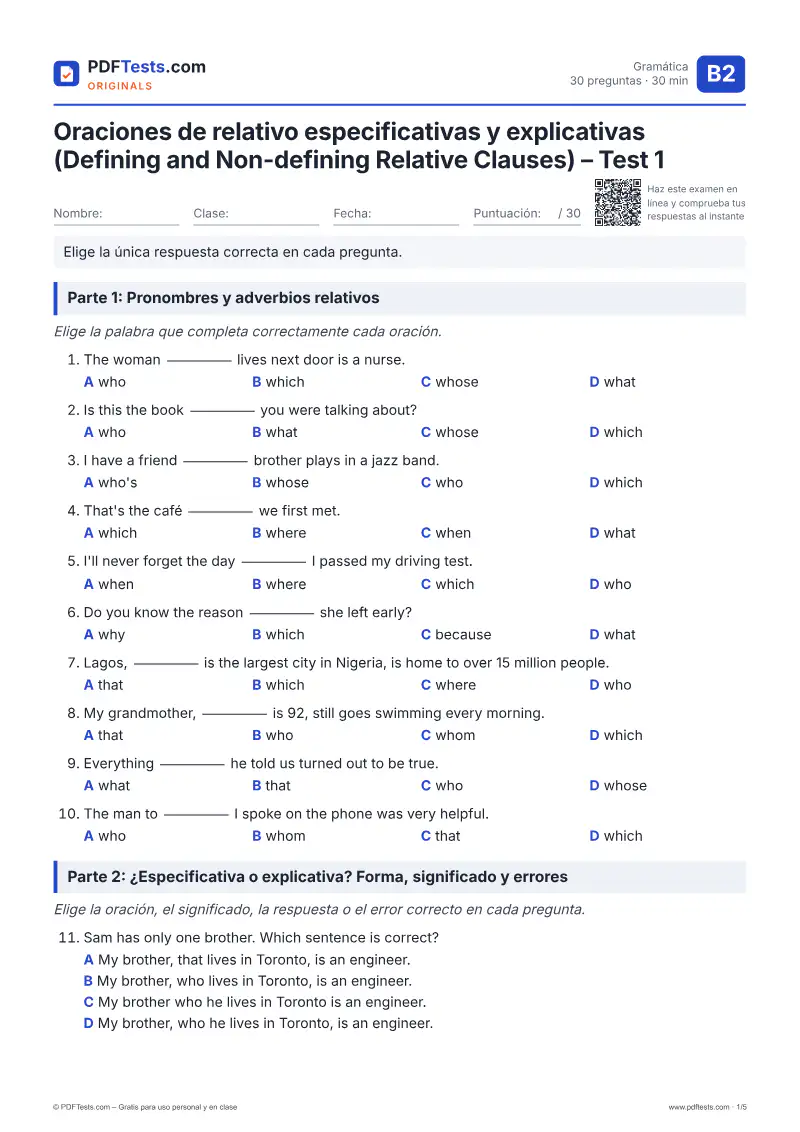
  2. In which sentence can the relative pronoun be left out?

  3. "The students who passed the exam received a certificate." What does this sentence mean?

  4. "The students, who passed the exam, received a certificate." What does this sentence mean?

  5. Find the error: "The hotel where we stayed it was very close to the beach."

  6. Find the error: "Mr Okafor, that teaches us maths, is retiring this year."

  7. Which sentence needs commas around the relative clause?

  8. She failed her driving test three times, _____ really upset her.

  9. In which sentence can 'that' replace the relative word?

  10. Which question is correct?

Parte 3: Oraciones de relativo en contexto

Lee el texto. Después elige la palabra que completa correctamente cada hueco. Las oraciones del texto se repiten en las preguntas en el mismo orden.

Greenway Community Garden, ___ opened in 2015, is run entirely by volunteers. The idea came from Amara Diallo, a retired teacher ___ had always wanted to grow vegetables in the city. The land, ___ had been empty for years, belonged to the local council, ___ agreed to rent it for a small fee.

Today the garden has around sixty members, most of ___ live in the flats nearby. There is a small shed ___ tools are kept, and a notice board on ___ volunteers write their names for each task. Members ___ plots are not looked after for three months may lose them, ___ seems fair to most people. Amara says the best thing about the garden is the friendships ___ people have made there.

  1. Greenway Community Garden, _____ opened in 2015, is run entirely by volunteers.

  2. The idea came from Amara Diallo, a retired teacher _____ had always wanted to grow vegetables in the city.

  3. The land, _____ had been empty for years, belonged to the local council.

  4. The land belonged to the local council, _____ agreed to rent it for a small fee.

  5. Today the garden has around sixty members, most of _____ live in the flats nearby.

  6. There is a small shed _____ tools are kept.

  7. There is a notice board on _____ volunteers write their names for each task.

  8. Members _____ plots are not looked after for three months may lose them.

  9. Members may lose their plots, _____ seems fair to most people.

  10. Amara says the best thing about the garden is the friendships _____ people have made there.

Vista previa

Sobre este examen

Este test de gramática B2 con 30 preguntas comprueba si sabes usar bien las oraciones de relativo especificativas y explicativas (defining and non-defining relative clauses) en inglés. Trabaja los pronombres y adverbios relativos, el uso de las comas, cuándo se puede usar 'that' o se puede omitir el pronombre, 'which' referido a toda una oración, las preposiciones con 'whom' y 'which', y los errores más habituales de los alumnos. Es ideal para estudiantes de nivel intermedio-alto, candidatos a exámenes oficiales y profesores que necesitan una prueba lista para usar en clase.

Temas

Pronombres relativos: who, which, whose, whom, thatAdverbios relativos: where, when, whyOraciones especificativas vs. explicativasLas comas y el significadoOmisión del pronombre relativoPreposiciones en las oraciones de relativoCuantificadores + whom/which'Which' referido a toda la oración

Cómo usar este examen

  1. Descarga el PDF e imprímelo, o haz el examen en línea más abajo.
  2. Responde todas las preguntas sin diccionario y sin prisas.
  3. Comprueba tus respuestas y apunta los temas que debes repasar.

Notas para el profesor

Use la Parte 1 como calentamiento sobre la elección del pronombre, la Parte 2 para comprobar la puntuación, el significado y cuándo es posible usar 'that' u omitir el pronombre, y la Parte 3 para evaluar las oraciones de relativo en un texto continuo. El test se centra en errores frecuentes en el nivel B2: usar 'that' en oraciones explicativas, añadir un pronombre de más ('where we stayed it was'), confundir 'whose' y 'who's', y usar 'that' o 'what' para referirse a toda una oración. Como actividad de seguimiento, pida a los alumnos que unan pares de oraciones cortas en una sola con una oración de relativo y que expliquen si hacen falta comas o no.