PDFTests Originals

Academic Vocabulary – Worksheet 1

C1 Advanced WorksheetEnglish

This C1 worksheet practises essential academic vocabulary such as hypothesis, empirical, implications and robust. Learners work on meaning, typical collocations and word formation in research-style sentences. It is ideal for students preparing for university study, IELTS, Cambridge C1 Advanced or academic writing courses.
items
39
Time
45 min
PDF
5 pages
Answer key
Included
  • 100% free
  • No sign-up or email
  • Print-ready A4 PDF
Preview of page 1 of Academic Vocabulary – Worksheet 1 Open PDF

Do the worksheet online

Type your answers, then press “Check my answers”. Alternative correct answers are accepted.

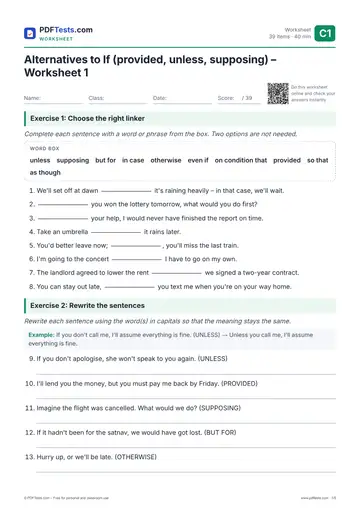
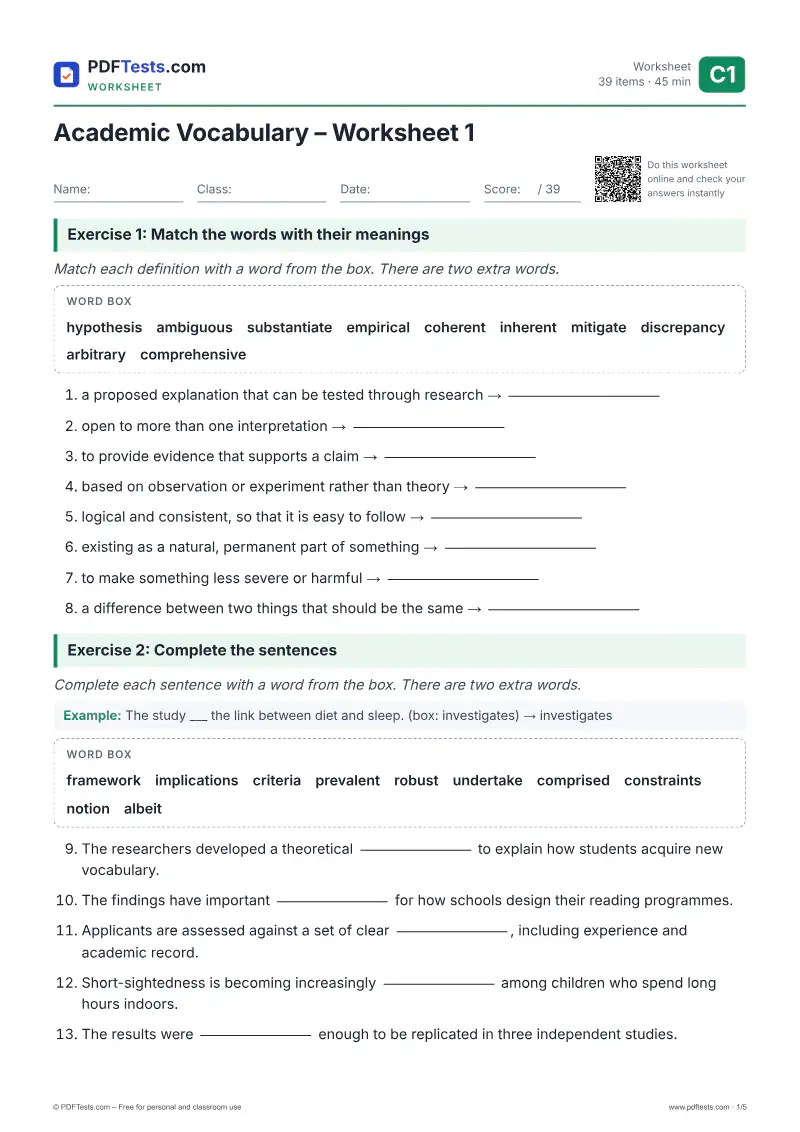
Exercise 1: Match the words with their meanings

Match each definition with a word from the box. There are two extra words.

Word box hypothesisambiguoussubstantiateempiricalcoherentinherentmitigatediscrepancyarbitrarycomprehensive

  1. a proposed explanation that can be tested through research

  2. open to more than one interpretation

  3. to provide evidence that supports a claim

  4. based on observation or experiment rather than theory

  5. logical and consistent, so that it is easy to follow

  6. existing as a natural, permanent part of something

  7. to make something less severe or harmful

  8. a difference between two things that should be the same

Exercise 2: Complete the sentences

Complete each sentence with a word from the box. There are two extra words.

Example: The study ___ the link between diet and sleep. (box: investigates) → investigates

Word box frameworkimplicationscriteriaprevalentrobustundertakecomprisedconstraintsnotionalbeit

  1. The researchers developed a theoretical to explain how students acquire new vocabulary.

  2. The findings have important for how schools design their reading programmes.

  3. Applicants are assessed against a set of clear , including experience and academic record.

  4. Short-sightedness is becoming increasingly among children who spend long hours indoors.

  5. The results were enough to be replicated in three independent studies.

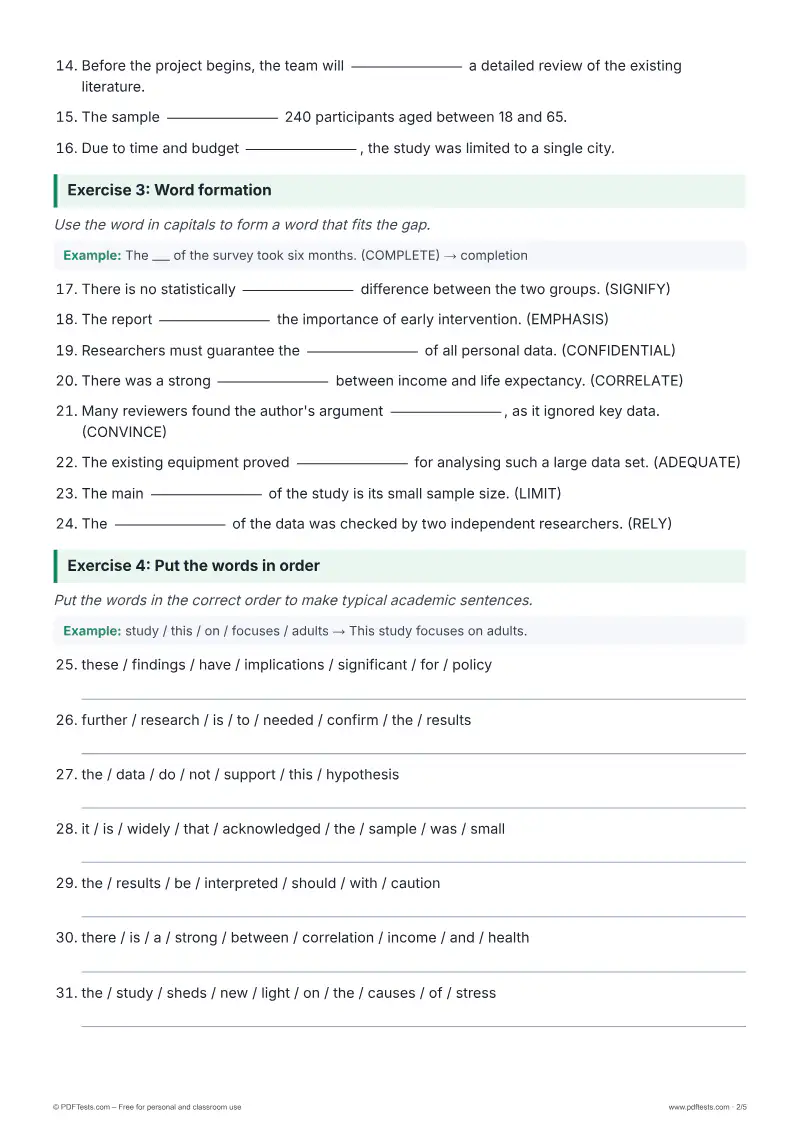
  6. Before the project begins, the team will a detailed review of the existing literature.

  7. The sample 240 participants aged between 18 and 65.

  8. Due to time and budget , the study was limited to a single city.

Exercise 3: Word formation

Use the word in capitals to form a word that fits the gap.

Example: The ___ of the survey took six months. (COMPLETE) → completion

  1. There is no statistically difference between the two groups. (SIGNIFY)

  2. The report the importance of early intervention. (EMPHASIS)

  3. Researchers must guarantee the of all personal data. (CONFIDENTIAL)

  4. There was a strong between income and life expectancy. (CORRELATE)

  5. Many reviewers found the author's argument , as it ignored key data. (CONVINCE)

  6. The existing equipment proved for analysing such a large data set. (ADEQUATE)

  7. The main of the study is its small sample size. (LIMIT)

  8. The of the data was checked by two independent researchers. (RELY)

Exercise 4: Put the words in order

Put the words in the correct order to make typical academic sentences.

Example: study / this / on / focuses / adults → This study focuses on adults.

  1. these / findings / have / implications / significant / for / policy

  2. further / research / is / to / needed / confirm / the / results

  3. the / data / do / not / support / this / hypothesis

  4. it / is / widely / that / acknowledged / the / sample / was / small

  5. the / results / be / interpreted / should / with / caution

  6. there / is / a / strong / between / correlation / income / and / health

  7. the / study / sheds / new / light / on / the / causes / of / stress

Exercise 5: Correct the collocation mistakes

Each sentence contains one mistake in a collocation. Rewrite the sentence correctly.

Example: The study gives a contribution to the field. → The study makes a contribution to the field.

  1. The researchers made an experiment to test their hypothesis.

  2. These results raise serious doubts on the reliability of earlier studies.

  3. The study draws attention on the role of social media in learning.

  4. Several factors play a key part to students' academic success.

  5. The author does a convincing case for reform.

  6. The new data lend strong support at the hypothesis.

  7. Further research is needed to address with this issue.

  8. The findings should be interpreted in caution.

Was this page helpful?

Report a mistake

Spotted a wrong answer, a typo or an unclear explanation? Tell us and we will fix it.

Preview

About this test

C1 academic vocabulary worksheet: practise key academic words, collocations and word forms in context. Printable, with answers.

Topics covered

Academic vocabularyCollocationsWord formationResearch languageAcademic writing

Notes for teachers

Start with the matching task to check meaning, then move through the gap-fill and word-formation tasks before the collocation and error-correction work. Typical mistakes include wrong prepositions in fixed phrases (draw attention on, raise doubts on) and confusing parts of speech, for example signify and significant, or rely and reliability. As a follow-up, ask students to write a short abstract for an imaginary study using at least eight words from the worksheet.

All English C1 tests →