PDFTests Originals

Vocabulaire académique – Fiche 1

C1 Avancé FicheAnglais

Cette fiche de niveau C1 permet de travailler le vocabulaire académique essentiel, comme hypothesis, empirical, implications ou robust. Les apprenants s'exercent sur le sens des mots, les collocations courantes et la formation des mots dans des phrases issues du langage de la recherche. Idéale pour préparer des études universitaires, l'IELTS, le Cambridge C1 Advanced ou un cours de rédaction universitaire.
items
39
Durée
45 min
PDF
5 pages
Corrigé
Inclus
  • 100 % gratuit
  • Sans inscription
  • PDF A4 prêt à imprimer
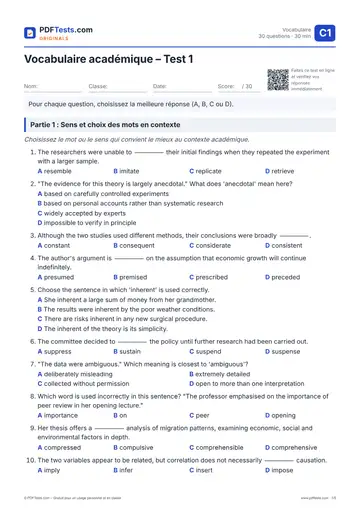
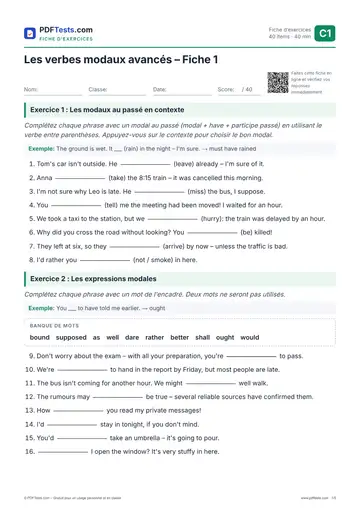
Aperçu de la page 1 : Vocabulaire académique – Fiche 1 Ouvrir le PDF

Faire la fiche en ligne

Tapez vos réponses puis cliquez sur « Vérifier mes réponses ». Les autres réponses correctes sont acceptées.

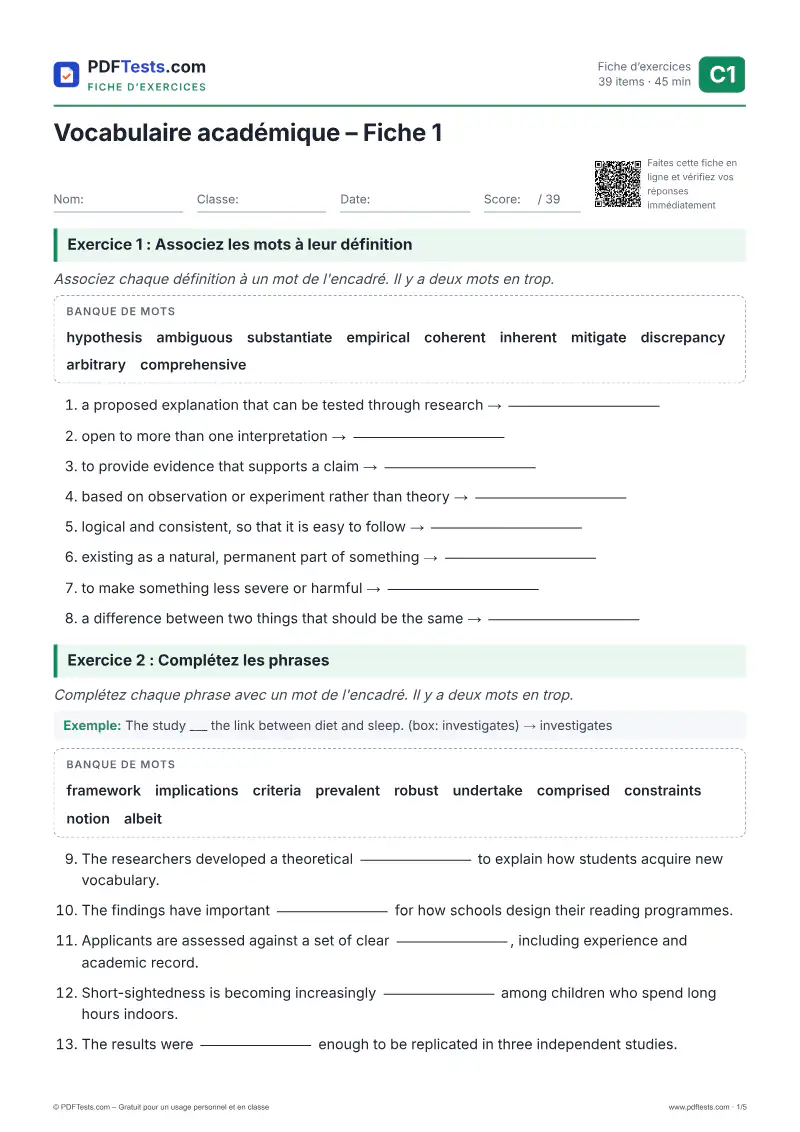
Exercice 1 : Associez les mots à leur définition

Associez chaque définition à un mot de l'encadré. Il y a deux mots en trop.

Banque de mots hypothesisambiguoussubstantiateempiricalcoherentinherentmitigatediscrepancyarbitrarycomprehensive

  1. a proposed explanation that can be tested through research

  2. open to more than one interpretation

  3. to provide evidence that supports a claim

  4. based on observation or experiment rather than theory

  5. logical and consistent, so that it is easy to follow

  6. existing as a natural, permanent part of something

  7. to make something less severe or harmful

  8. a difference between two things that should be the same

Exercice 2 : Complétez les phrases

Complétez chaque phrase avec un mot de l'encadré. Il y a deux mots en trop.

Exemple: The study ___ the link between diet and sleep. (box: investigates) → investigates

Banque de mots frameworkimplicationscriteriaprevalentrobustundertakecomprisedconstraintsnotionalbeit

  1. The researchers developed a theoretical to explain how students acquire new vocabulary.

  2. The findings have important for how schools design their reading programmes.

  3. Applicants are assessed against a set of clear , including experience and academic record.

  4. Short-sightedness is becoming increasingly among children who spend long hours indoors.

  5. The results were enough to be replicated in three independent studies.

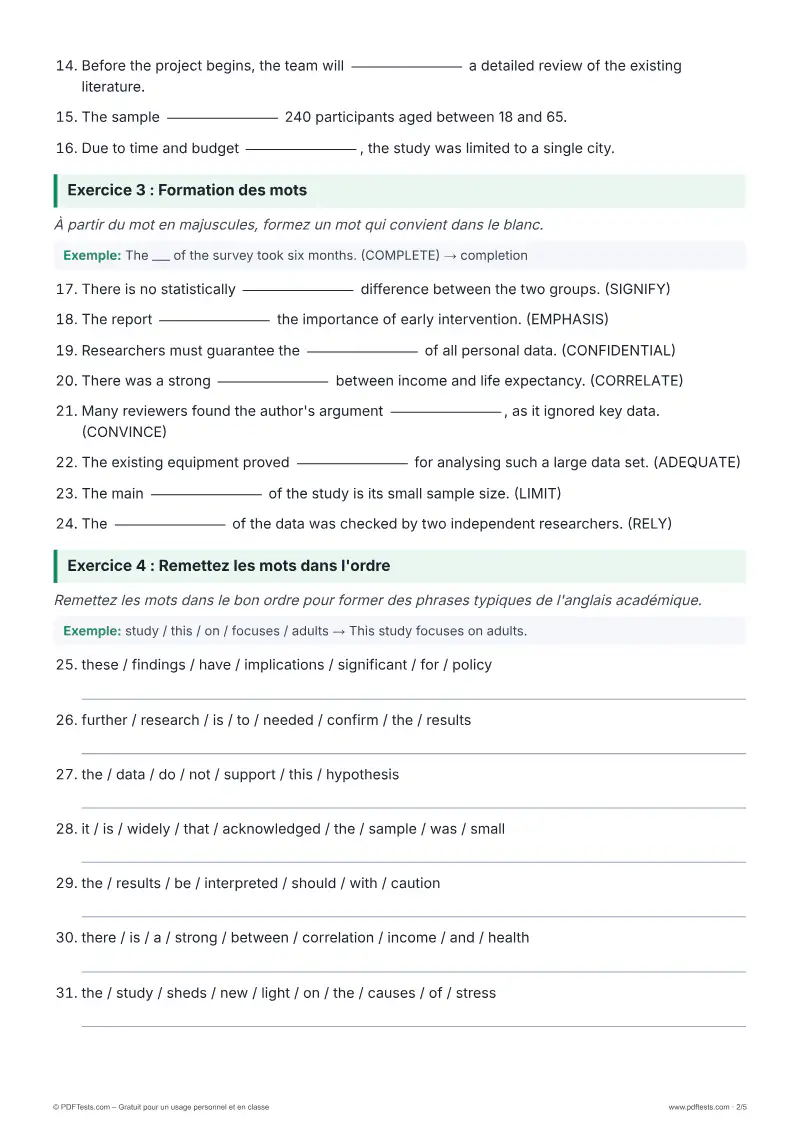
  6. Before the project begins, the team will a detailed review of the existing literature.

  7. The sample 240 participants aged between 18 and 65.

  8. Due to time and budget , the study was limited to a single city.

Exercice 3 : Formation des mots

À partir du mot en majuscules, formez un mot qui convient dans le blanc.

Exemple: The ___ of the survey took six months. (COMPLETE) → completion

  1. There is no statistically difference between the two groups. (SIGNIFY)

  2. The report the importance of early intervention. (EMPHASIS)

  3. Researchers must guarantee the of all personal data. (CONFIDENTIAL)

  4. There was a strong between income and life expectancy. (CORRELATE)

  5. Many reviewers found the author's argument , as it ignored key data. (CONVINCE)

  6. The existing equipment proved for analysing such a large data set. (ADEQUATE)

  7. The main of the study is its small sample size. (LIMIT)

  8. The of the data was checked by two independent researchers. (RELY)

Exercice 4 : Remettez les mots dans l'ordre

Remettez les mots dans le bon ordre pour former des phrases typiques de l'anglais académique.

Exemple: study / this / on / focuses / adults → This study focuses on adults.

  1. these / findings / have / implications / significant / for / policy

  2. further / research / is / to / needed / confirm / the / results

  3. the / data / do / not / support / this / hypothesis

  4. it / is / widely / that / acknowledged / the / sample / was / small

  5. the / results / be / interpreted / should / with / caution

  6. there / is / a / strong / between / correlation / income / and / health

  7. the / study / sheds / new / light / on / the / causes / of / stress

Exercice 5 : Corrigez les erreurs de collocation

Chaque phrase contient une erreur de collocation. Réécrivez la phrase correctement.

Exemple: The study gives a contribution to the field. → The study makes a contribution to the field.

  1. The researchers made an experiment to test their hypothesis.

  2. These results raise serious doubts on the reliability of earlier studies.

  3. The study draws attention on the role of social media in learning.

  4. Several factors play a key part to students' academic success.

  5. The author does a convincing case for reform.

  6. The new data lend strong support at the hypothesis.

  7. Further research is needed to address with this issue.

  8. The findings should be interpreted in caution.

Cette page vous a-t-elle été utile ?

Signaler une erreur

Une mauvaise réponse, une faute de frappe ou une explication peu claire ? Dites-le-nous, nous corrigerons.

Aperçu

À propos de ce test

Fiche d'anglais C1 à imprimer en PDF : vocabulaire académique, collocations et formation des mots en contexte. Exercices avec corrigé.

Thèmes abordés

Vocabulaire académiqueCollocationsFormation des motsLangage de la rechercheRédaction universitaire

Notes pour l’enseignant

Commencez par l'exercice d'association pour vérifier la compréhension du sens, puis enchaînez avec le texte à trous et la formation des mots avant de passer aux collocations et à la correction d'erreurs. Les erreurs fréquentes concernent les prépositions dans les expressions figées (draw attention on, raise doubts on) et la confusion entre natures de mots, par exemple signify et significant, ou rely et reliability. En prolongement, demandez aux élèves de rédiger un court résumé (abstract) d'une étude imaginaire en utilisant au moins huit mots de la fiche.

Tous les tests Anglais C1 →