PDFTests Originals

Collocations (C1) – Worksheet 1

C1 Advanced WorksheetEnglish

This C1 worksheet practises common English collocations in context, such as 'strike a balance', 'jump to conclusions' and 'an overwhelming majority'. Learners work on meaning, natural word partnerships and word forms through five exercises that move from controlled to freer practice. It suits upper-intermediate and advanced learners preparing for exams or wanting more natural, precise English.
items
39
Time
40 min
PDF
5 pages
Answer key
Included
  • 100% free
  • No sign-up or email
  • Print-ready A4 PDF
Preview of page 1 of Collocations (C1) – Worksheet 1 Open PDF

Do the worksheet online

Type your answers, then press “Check my answers”. Alternative correct answers are accepted.

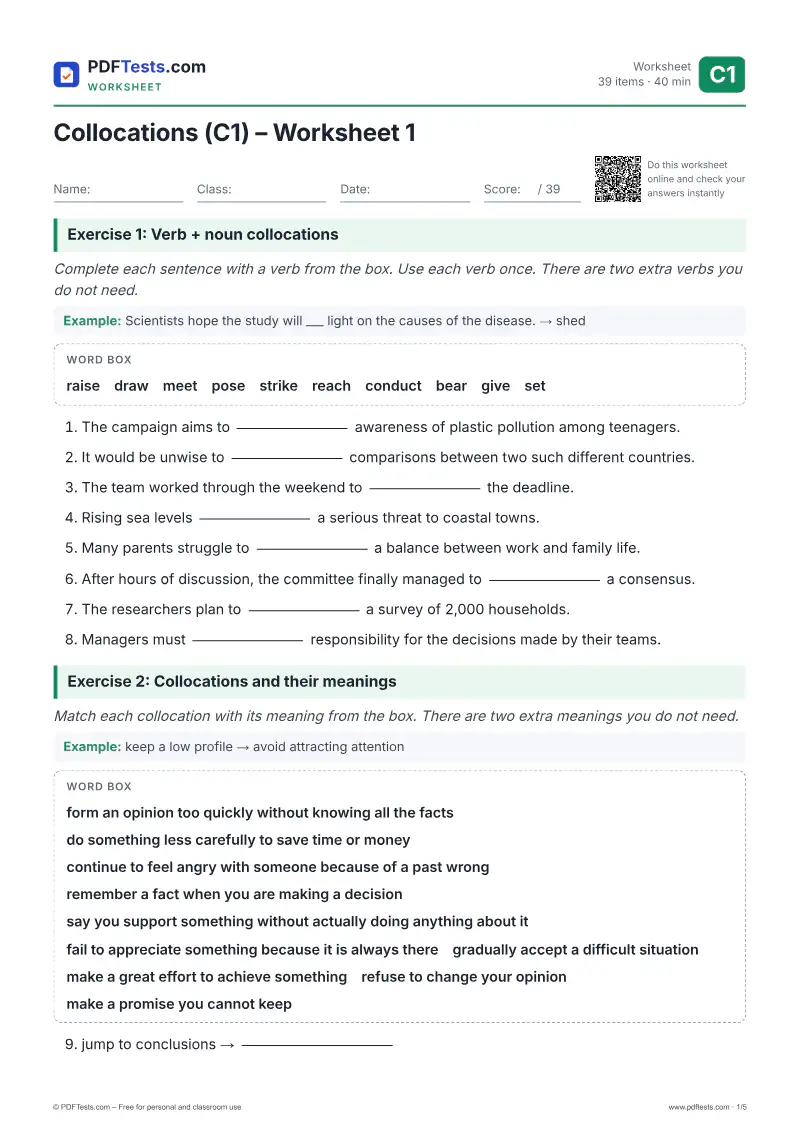
Exercise 1: Verb + noun collocations

Complete each sentence with a verb from the box. Use each verb once. There are two extra verbs you do not need.

Example: Scientists hope the study will ___ light on the causes of the disease. → shed

Word box raisedrawmeetposestrikereachconductbeargiveset

  1. The campaign aims to awareness of plastic pollution among teenagers.

  2. It would be unwise to comparisons between two such different countries.

  3. The team worked through the weekend to the deadline.

  4. Rising sea levels a serious threat to coastal towns.

  5. Many parents struggle to a balance between work and family life.

  6. After hours of discussion, the committee finally managed to a consensus.

  7. The researchers plan to a survey of 2,000 households.

  8. Managers must responsibility for the decisions made by their teams.

Exercise 2: Collocations and their meanings

Match each collocation with its meaning from the box. There are two extra meanings you do not need.

Example: keep a low profile → avoid attracting attention

Word box form an opinion too quickly without knowing all the factsdo something less carefully to save time or moneycontinue to feel angry with someone because of a past wrongremember a fact when you are making a decisionsay you support something without actually doing anything about itfail to appreciate something because it is always theregradually accept a difficult situationmake a great effort to achieve somethingrefuse to change your opinionmake a promise you cannot keep

  1. jump to conclusions

  2. cut corners

  3. hold a grudge

  4. bear something in mind

  5. pay lip service to something

  6. take something for granted

  7. come to terms with something

  8. go to great lengths

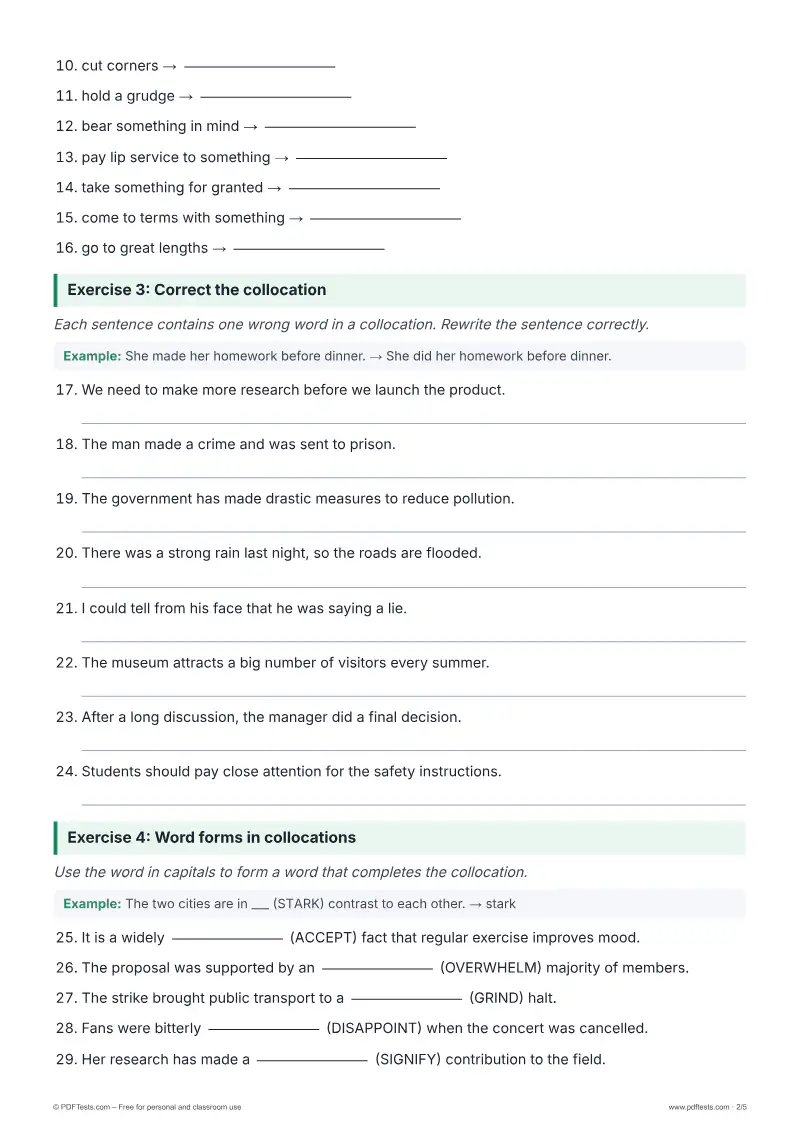
Exercise 3: Correct the collocation

Each sentence contains one wrong word in a collocation. Rewrite the sentence correctly.

Example: She made her homework before dinner. → She did her homework before dinner.

  1. We need to make more research before we launch the product.

  2. The man made a crime and was sent to prison.

  3. The government has made drastic measures to reduce pollution.

  4. There was a strong rain last night, so the roads are flooded.

  5. I could tell from his face that he was saying a lie.

  6. The museum attracts a big number of visitors every summer.

  7. After a long discussion, the manager did a final decision.

  8. Students should pay close attention for the safety instructions.

Exercise 4: Word forms in collocations

Use the word in capitals to form a word that completes the collocation.

Example: The two cities are in ___ (STARK) contrast to each other. → stark

  1. It is a widely (ACCEPT) fact that regular exercise improves mood.

  2. The proposal was supported by an (OVERWHELM) majority of members.

  3. The strike brought public transport to a (GRIND) halt.

  4. Fans were bitterly (DISAPPOINT) when the concert was cancelled.

  5. Her research has made a (SIGNIFY) contribution to the field.

  6. In this storm, it is highly (LIKE) that the match will go ahead.

  7. After years of neglect, the old castle has fallen into (REPAIR).

  8. It is important to draw a clear (DISTINGUISH) between facts and opinions.

Exercise 5: Rewrite with a collocation

Rewrite each sentence using the word in brackets so that the meaning stays the same.

Example: He wants to avoid attracting attention. (PROFILE) → He wants to keep a low profile.

  1. Remember that the shop closes early on Sundays. (MIND)

  2. The new rules will start to apply in January. (FORCE)

  3. I think you are forming an opinion too quickly. (CONCLUSIONS)

  4. She eventually accepted that she had lost her job. (TERMS)

  5. He made a huge effort to keep the project a secret. (LENGTHS)

  6. Many people don't appreciate clean water because it is always available. (GRANTED)

  7. The two sides finally agreed. (CONSENSUS)

Was this page helpful?

Report a mistake

Spotted a wrong answer, a typo or an unclear explanation? Tell us and we will fix it.

Preview

About this test

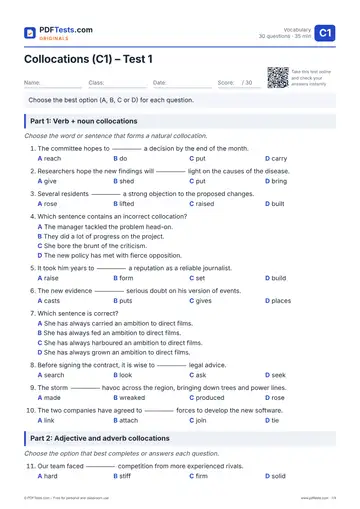
Printable C1 English worksheet on collocations: verb + noun pairs, meanings, word forms, error correction and sentence transformations. Answers included.

Topics covered

Verb + noun collocationsAdverb + adjective collocationsCollocations and meaningWord formationCommon collocation errors

Notes for teachers

Start with Exercise 1 as a warm-up, then ask pairs to compare answers in Exercise 2 before checking as a class. A typical mistake is translating collocations directly from the first language, which leads to errors like 'make research' or 'say a lie', so draw attention to the verb in each pair. As a follow-up, ask learners to write a short opinion paragraph on a topic of their choice using at least six collocations from the worksheet.

All English C1 tests →