PDFTests Originals

Emphatic Structures – Worksheet 1

C1 Advanced WorksheetEnglish

This C1 worksheet practises the main emphatic structures in English: it-clefts, wh-clefts, emphatic do and inversion after negative and limiting adverbials. Learners work from controlled gap-fills to sentence transformations and error correction, including negative and question forms. It suits advanced learners preparing for exams such as C1 Advanced or improving their formal writing.
items
39
Time
40 min
PDF
5 pages
Answer key
Included
  • 100% free
  • No sign-up or email
  • Print-ready A4 PDF
Preview of page 1 of Emphatic Structures – Worksheet 1 Open PDF
New to this topic? Read the guide first: Emphatic Structures: Emphatic Do, Clefts, Inversion and Intensifiers

Do the worksheet online

Type your answers, then press “Check my answers”. Alternative correct answers are accepted.

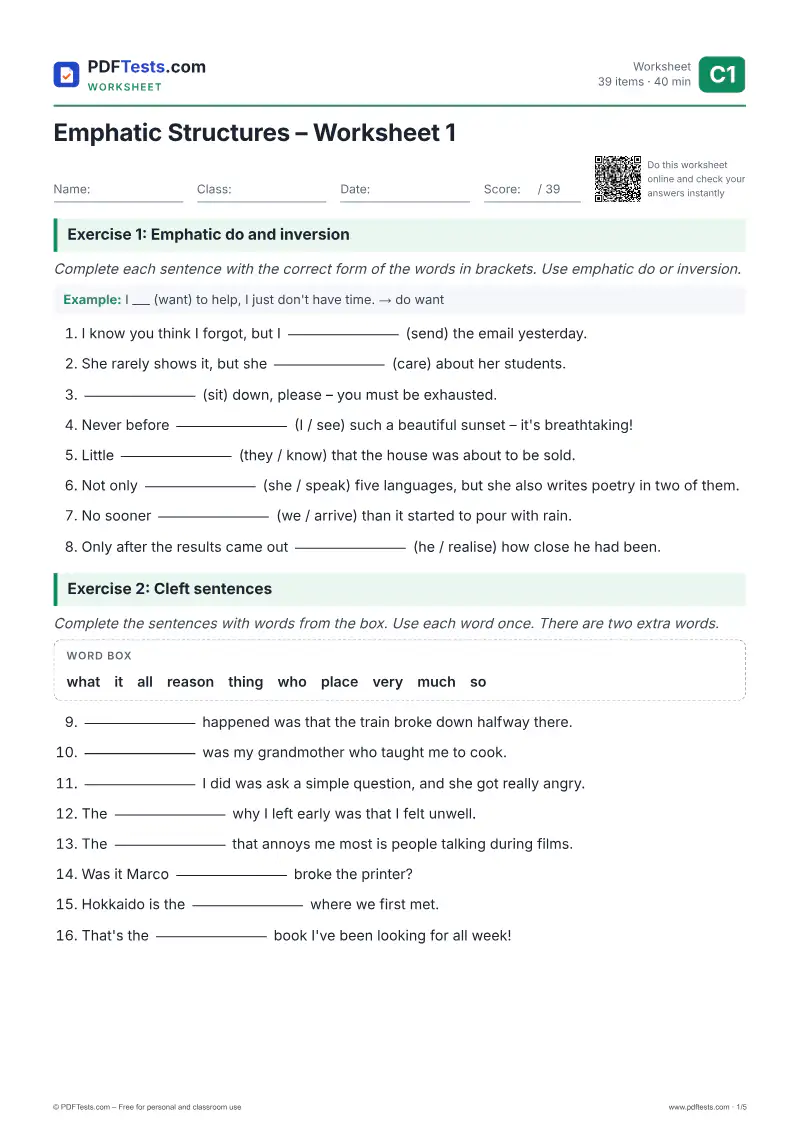
Exercise 1: Emphatic do and inversion

Complete each sentence with the correct form of the words in brackets. Use emphatic do or inversion.

Example: I ___ (want) to help, I just don't have time. → do want

  1. I know you think I forgot, but I (send) the email yesterday.

  2. She rarely shows it, but she (care) about her students.

  3. (sit) down, please – you must be exhausted.

  4. Never before (I / see) such a beautiful sunset – it's breathtaking!

  5. Little (they / know) that the house was about to be sold.

  6. Not only (she / speak) five languages, but she also writes poetry in two of them.

  7. No sooner (we / arrive) than it started to pour with rain.

  8. Only after the results came out (he / realise) how close he had been.

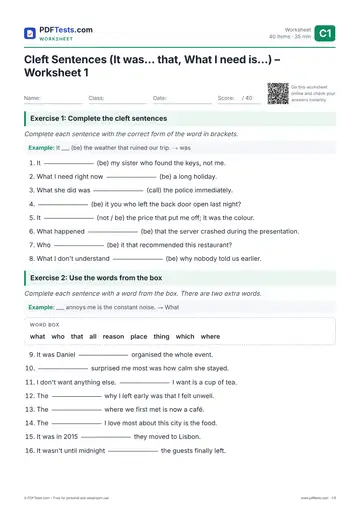
Exercise 2: Cleft sentences

Complete the sentences with words from the box. Use each word once. There are two extra words.

Word box whatitallreasonthingwhoplaceverymuchso

  1. happened was that the train broke down halfway there.

  2. was my grandmother who taught me to cook.

  3. I did was ask a simple question, and she got really angry.

  4. The why I left early was that I felt unwell.

  5. The that annoys me most is people talking during films.

  6. Was it Marco broke the printer?

  7. Hokkaido is the where we first met.

  8. That's the book I've been looking for all week!

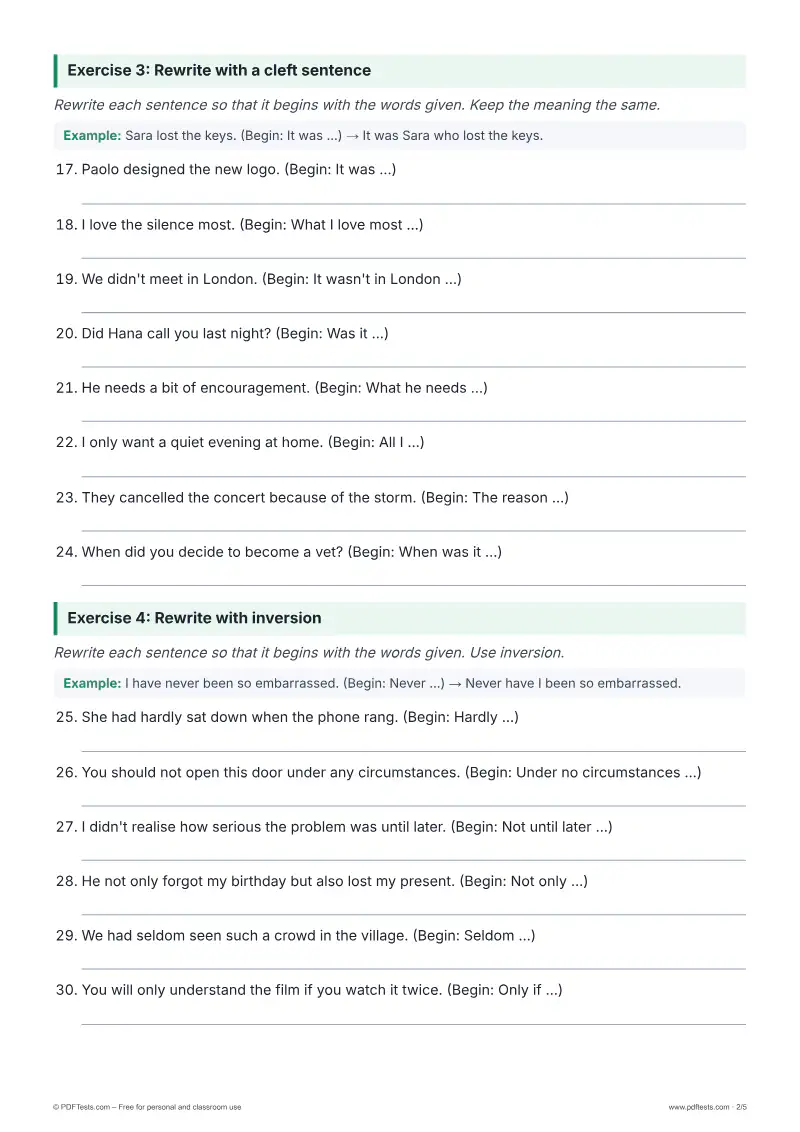
Exercise 3: Rewrite with a cleft sentence

Rewrite each sentence so that it begins with the words given. Keep the meaning the same.

Example: Sara lost the keys. (Begin: It was ...) → It was Sara who lost the keys.

  1. Paolo designed the new logo. (Begin: It was ...)

  2. I love the silence most. (Begin: What I love most ...)

  3. We didn't meet in London. (Begin: It wasn't in London ...)

  4. Did Hana call you last night? (Begin: Was it ...)

  5. He needs a bit of encouragement. (Begin: What he needs ...)

  6. I only want a quiet evening at home. (Begin: All I ...)

  7. They cancelled the concert because of the storm. (Begin: The reason ...)

  8. When did you decide to become a vet? (Begin: When was it ...)

Exercise 4: Rewrite with inversion

Rewrite each sentence so that it begins with the words given. Use inversion.

Example: I have never been so embarrassed. (Begin: Never ...) → Never have I been so embarrassed.

  1. She had hardly sat down when the phone rang. (Begin: Hardly ...)

  2. You should not open this door under any circumstances. (Begin: Under no circumstances ...)

  3. I didn't realise how serious the problem was until later. (Begin: Not until later ...)

  4. He not only forgot my birthday but also lost my present. (Begin: Not only ...)

  5. We had seldom seen such a crowd in the village. (Begin: Seldom ...)

  6. You will only understand the film if you watch it twice. (Begin: Only if ...)

  7. The guests didn't know that the chef was a famous actor. (Begin: Little ...)

  8. I had just closed the window when the storm started. (Begin: No sooner ...)

Exercise 5: Find and correct the mistake

Each sentence has one mistake. Write the corrected sentence.

  1. Never I have seen such a mess in my life.

  2. It was in 2015 when they moved to Canada.

  3. What I need are a strong cup of coffee.

  4. She did told me about the party, but I forgot.

  5. Only when he left did she realised how much she missed him.

  6. Not until the lights went out we noticed the noise.

  7. No sooner had the film started when the fire alarm went off.

Was this page helpful?

Report a mistake

Spotted a wrong answer, a typo or an unclear explanation? Tell us and we will fix it.

Preview

About this test

C1 English worksheet on emphatic structures: cleft sentences, emphatic do and inversion after negative adverbials, with answers.

Topics covered

Cleft sentences (It is/was ... that/who)Wh-clefts (What/All ... is)Emphatic do/does/didInversion after negative adverbialsNot only / No sooner / Hardly

Notes for teachers

Start by contrasting a neutral sentence with its emphatic versions so learners see how the focus shifts, then use the exercises in order. Typical mistakes include forgetting the auxiliary in inversion (*Never I have seen*), using the past form after emphatic did (*did told*), using 'when' instead of 'than' after 'No sooner', and making the verb agree with the complement in wh-clefts. As a follow-up, ask learners to write a short, dramatic story opening that uses at least five different emphatic structures.

All English C1 tests →