PDFTests Originals

The Subjunctive and Formal Structures – Worksheet 1

C1 Advanced WorksheetEnglish

This worksheet practises the English subjunctive and related formal structures. It covers the mandative subjunctive (insist that he be), negatives such as 'that she not be', the were-subjunctive, inverted conditionals (Should you…, Had I…, Were it not for…), and fixed expressions like 'lest', 'come what may' and 'so be it'. It is designed for C1 learners preparing for advanced exams or working in academic and professional settings.
items
40
Time
35 min
PDF
5 pages
Answer key
Included
  • 100% free
  • No sign-up or email
  • Print-ready A4 PDF
Preview of page 1 of The Subjunctive and Formal Structures – Worksheet 1 Open PDF
New to this topic? Read the guide first: The Subjunctive and Formal Structures: Rules, Examples and Common Mistakes

Do the worksheet online

Type your answers, then press “Check my answers”. Alternative correct answers are accepted.

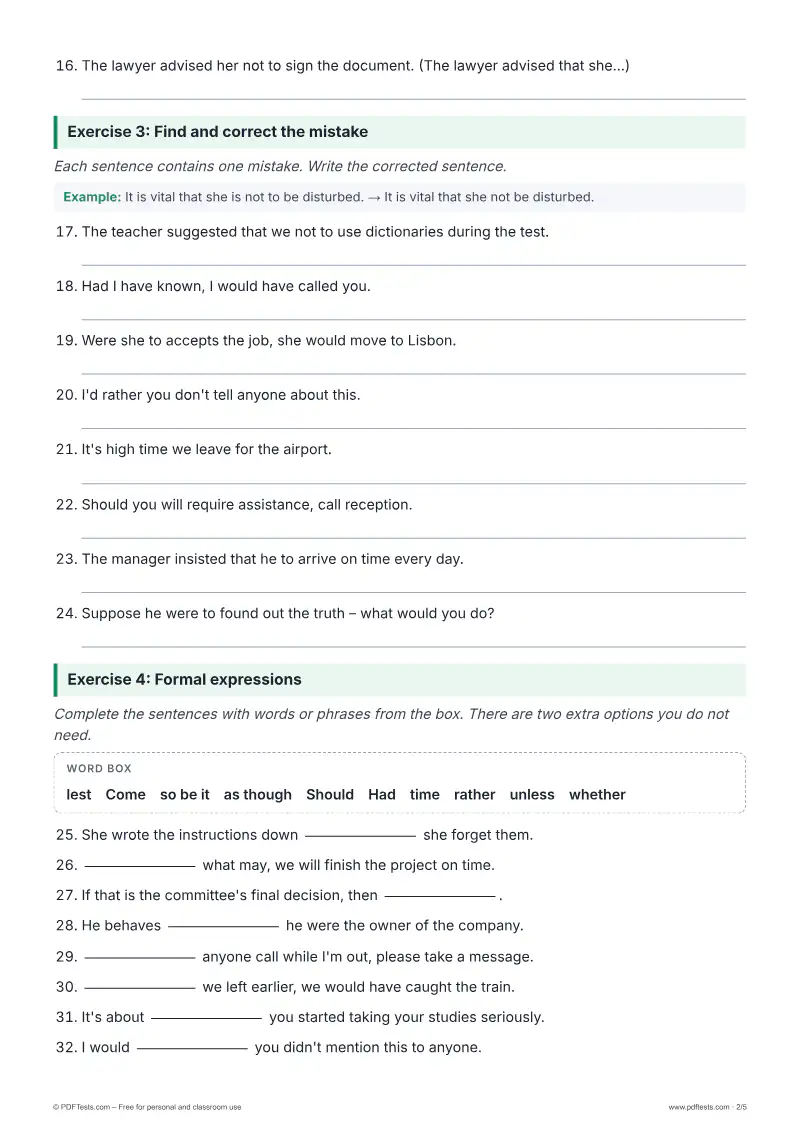
Exercise 1: Complete the sentences

Complete each sentence with the correct form of the word(s) in brackets. Use the subjunctive.

Example: The manager demanded that he ___ (leave) the building. → leave

  1. The board insisted that the director (resign) immediately.

  2. It is essential that every applicant (be) present at the interview.

  3. The doctor recommended that she (not / eat) anything after midnight.

  4. We requested that the meeting (postpone) until Friday.

  5. It is vital that he (not / be) informed until the contract is signed.

  6. The committee proposed that each member (pay) an annual fee.

  7. If I (be) in your position, I would accept the offer.

  8. Far (it / be) from me to criticise, but your report is rather late.

Exercise 2: Rewrite the sentences

Rewrite each sentence, starting with the words given. Keep the meaning the same.

Example: If you should see Maria, give her my regards. (Should…) → Should you see Maria, give her my regards.

  1. If you should need any further information, please contact us. (Should…)

  2. If I had known about the delay, I would have taken a taxi. (Had…)

  3. If the company were to relocate, many staff would resign. (Were…)

  4. If it had not been for your help, we would have failed. (Had…)

  5. If it were not for the scholarship, she could not study abroad. (Were…)

  6. If you should not receive the parcel by Monday, let us know. (Should…)

  7. It was important for all staff to attend the training. (It was important that…)

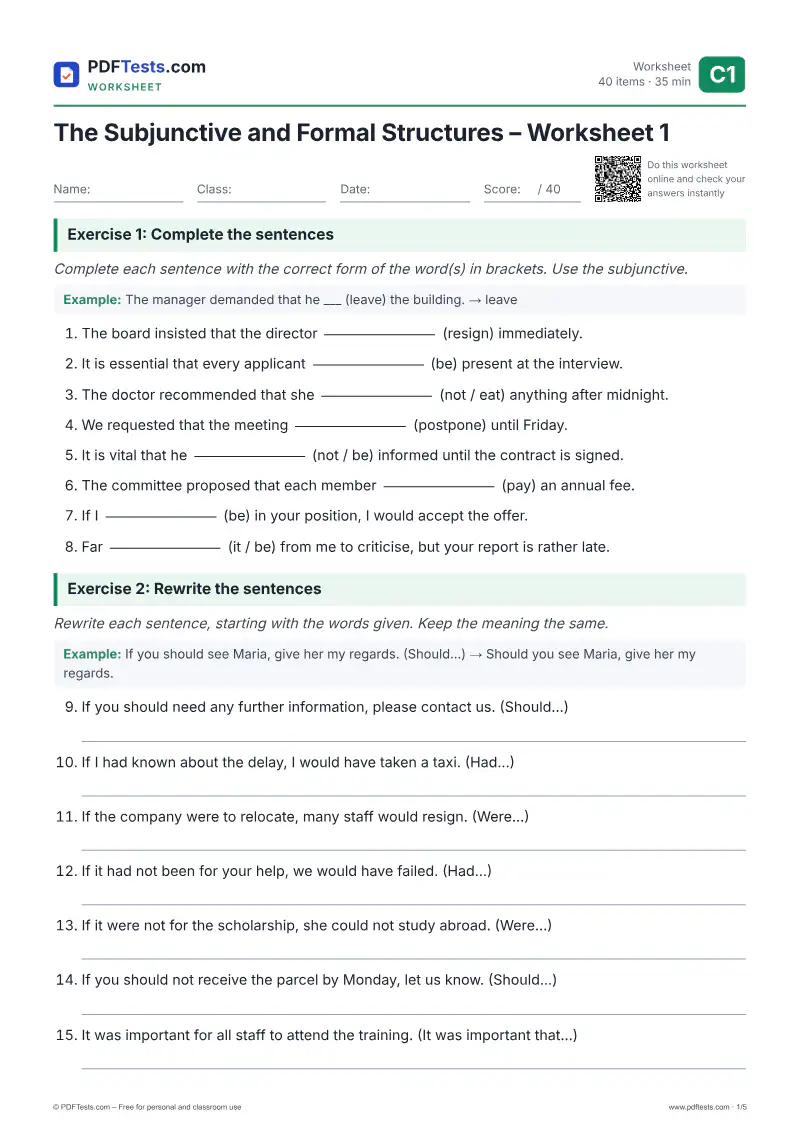
  8. The lawyer advised her not to sign the document. (The lawyer advised that she…)

Exercise 3: Find and correct the mistake

Each sentence contains one mistake. Write the corrected sentence.

Example: It is vital that she is not to be disturbed. → It is vital that she not be disturbed.

  1. The teacher suggested that we not to use dictionaries during the test.

  2. Had I have known, I would have called you.

  3. Were she to accepts the job, she would move to Lisbon.

  4. I'd rather you don't tell anyone about this.

  5. It's high time we leave for the airport.

  6. Should you will require assistance, call reception.

  7. The manager insisted that he to arrive on time every day.

  8. Suppose he were to found out the truth – what would you do?

Exercise 4: Formal expressions

Complete the sentences with words or phrases from the box. There are two extra options you do not need.

Word box lestComeso be itas thoughShouldHadtimeratherunlesswhether

  1. She wrote the instructions down she forget them.

  2. what may, we will finish the project on time.

  3. If that is the committee's final decision, then .

  4. He behaves he were the owner of the company.

  5. anyone call while I'm out, please take a message.

  6. we left earlier, we would have caught the train.

  7. It's about you started taking your studies seriously.

  8. I would you didn't mention this to anyone.

Exercise 5: Put the words in order

Put the words in the correct order to make sentences or questions.

Example: that / we / recommend / he / be / promoted → We recommend that he be promoted.

  1. that / it / essential / is / everyone / on time / be

  2. not / we / suggest / that / she / be / told

  3. Were / the / train / to / be / delayed / we / would / miss / the / connection

  4. Had / told / you / me / I / would / have / helped

  5. rather / I'd / you / here / didn't / smoke

  6. high / it's / time / went / we / home

  7. Is / it / necessary / that / he / be / present / ?

  8. Would / you / rather / I / didn't / come / ?

Was this page helpful?

Report a mistake

Spotted a wrong answer, a typo or an unclear explanation? Tell us and we will fix it.

Preview

About this test

C1 English worksheet on the subjunctive and formal structures: mandative subjunctive, inverted conditionals, would rather, it's time, lest, plus answers.

Topics covered

Mandative subjunctiveWere-subjunctiveInverted conditionalsWould rather / It's timeFormulaic subjunctive expressions

Notes for teachers

Start by eliciting verbs and adjectives that trigger the subjunctive (insist, recommend, essential, vital), and point out that the verb takes the base form for every person. Learners often add -s in the third person, use 'to' after 'not' ('that she not to go'), or keep 'if' in inverted conditionals ('If had I known'). Remind them that 'should + infinitive' is a common British alternative to the subjunctive. As a follow-up, ask learners to write a short formal email or set of meeting minutes that uses at least five of the structures.

All English C1 tests →