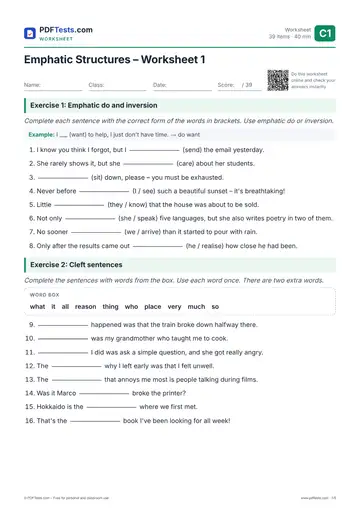
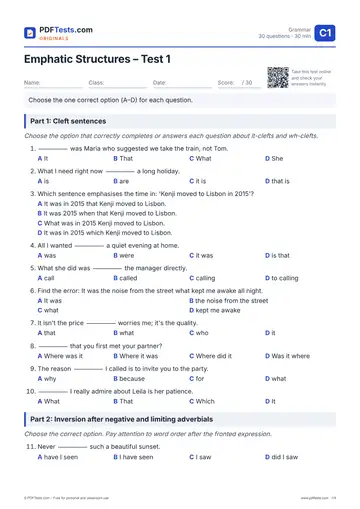
Emphatic structures are grammatical patterns that highlight part of a sentence: a contrast, a correction, strong feeling or the key piece of information. At C1 you are expected to use them deliberately: emphatic do, cleft sentences, negative inversion, fronting and intensifying words. They are common in persuasive writing, formal speech and natural conversation.
Overview: five ways to add emphasis
| Device | Example | Typical effect |
|---|---|---|
| Emphatic do | I did lock the door. | Contradicts doubt, insists |
| Cleft sentence | What I need is a break. | Focuses on one element |
| Negative inversion | Never have I felt so tired. | Dramatic, formal |
| Fronting | That I can’t accept. | Moves the focus to the start |
| Intensifiers | I have no idea whatsoever. | Strengthens a word or phrase |
In speech, much of this work is done by stress and intonation. In writing, where the reader cannot hear your voice, these structures do the job instead.
1. Emphatic do, does, did
In affirmative sentences in the present simple and past simple, we can add do, does or did before the base form of the verb. In speech, the auxiliary is stressed.
Uses
- Contradicting what someone has said or assumed: “You didn’t call her.” “I did call her. She didn’t answer.”
- Contrasting with something else: I don’t eat much meat, but I do eat fish.
- Confirming something expected: I said she’d come, and she did come.
- Expressing strong feeling: I do love this song. / He does go on about football.
- Polite or insistent imperatives: Do sit down. / Do be careful on the stairs.
Form
| Tense | Neutral | Emphatic |
|---|---|---|
| Present simple (I/you/we/they) | I like it. | I do like it. |
| Present simple (he/she/it) | She works hard. | She does work hard. |
| Past simple | We told them. | We did tell them. |
| Imperative | Come in. | Do come in. |
The main verb always returns to the base form: does work, not does works; did tell, not did told.
Other tenses and modals
With be, modal verbs and auxiliaries already present (have, will, can), there is no do. Instead, stress the existing auxiliary, often with its full, uncontracted form:
- I am listening. (not I’m listening)
- She has finished – I checked.
- They will be there, I promise.
Adverbs such as really, certainly and indeed often combine with emphatic do: I really do appreciate it. / Prices did indeed rise.
2. Cleft sentences
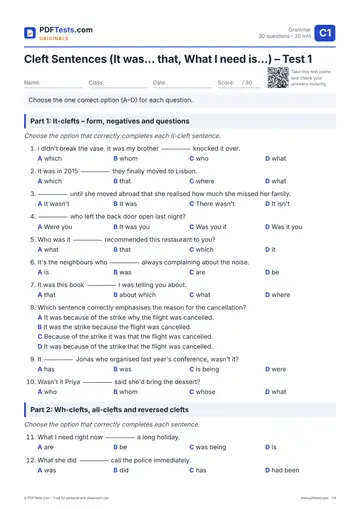
A cleft sentence splits one clause into two to put the spotlight on one element. For a full treatment, see our guide to cleft sentences with It was… that and What I need is….
It-clefts
Form: It + be + focused element + that/who + rest of clause
Neutral: Mia found the keys in the car.
| Focus | Cleft sentence |
|---|---|
| Who | It was Mia who/that found the keys. |
| What | It was the keys that Mia found. |
| Where | It was in the car that Mia found the keys. |
It-clefts are especially useful for correcting information: It wasn’t Tom who complained – it was his manager. Use who or that for people, that for everything else. With times and places, that is the safest choice: It was in 2019 that we moved.
Wh-clefts (pseudo-clefts)
Form: What + clause + be + focused element
- What I need is a long holiday.
- What annoys me is the noise.
- What she did was (to) resign. (focus on an action: do + bare or to-infinitive)
- What happened was (that) the server crashed.
Notice that the what-clause uses statement word order, not question order: What she did was…, never What did she was…
You can reverse the structure: A long holiday is what I need. Other words can replace what: All I want is some sleep. / The thing that worries me is the cost. / The reason (why) I left was the pay. / The place where we met was a tiny café.
3. Negative inversion
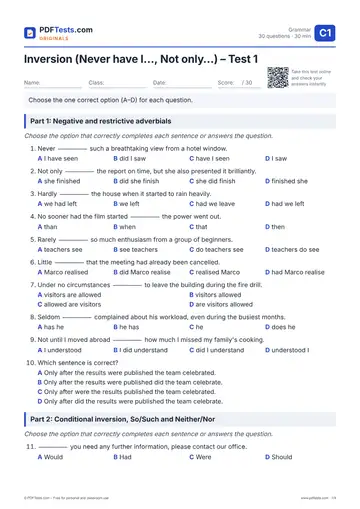
When a negative or restrictive adverbial is placed at the start of a sentence, the subject and auxiliary swap places, as in a question. This is formal and dramatic, typical of speeches, essays and storytelling. Our inversion guide covers every pattern in detail.
| Opening adverbial | Example |
|---|---|
| Never / Rarely / Seldom | Never have I seen such chaos. |
| Not only… but also | Not only did she win, but she also broke the record. |
| Little | Little did they know what was coming. |
| Only then / Only when / Only after | Only then did I understand. |
| Not until | Not until the next day did we hear the news. |
| Under no circumstances / On no account | Under no circumstances should you open this file. |
| Hardly… when / No sooner… than | No sooner had we arrived than it started to rain. |
If there is no auxiliary, add do/does/did: She rarely complains → Rarely does she complain. With only when, not until and only after, the inversion happens in the main clause, not the time clause: Only when the results came out did we relax.
4. Fronting
Fronting means moving an element that normally comes later to the beginning of the sentence. It creates emphasis, contrast or a smooth link with what came before.
- Object fronting (often contrastive): His first novel I loved. His second I couldn’t finish. / That I simply can’t accept.
- Adjective/adverb + as/though (concessive): Strange as it may seem, I enjoy exams. / Much as I admire her, I disagree.
- Place adverbials with inversion of a full verb, typical of descriptive writing: In the corner sat an old man. / Here comes the bus.
- Fixed emphatic openings: Gone are the days when phones were just for calls.
Fronting with pronoun subjects does not usually invert: Here it comes, not Here comes it.
5. Intensifying words and phrases
Some emphasis comes from vocabulary rather than word order.
| Intensifier | Use | Example |
|---|---|---|
| the very | exactness, “precisely this” | That’s the very book I was looking for. |
| on earth / ever | surprise or annoyance in questions | What on earth are you doing? / Why ever did you say that? |
| at all / whatsoever | strengthen negatives (after the noun or at the end) | I have no interest whatsoever. / It didn’t help at all. |
| Reflexive pronoun | “that person/thing, not another” | I spoke to the CEO herself. / The idea itself is good. |
| so / such | strong degree | It was such a relief. / She’s so talented. |
| by far / easily | superlatives | This is by far the best option. |
| far / much / a lot | comparatives | It’s far more expensive than I thought. |
| Repetition | continuing or growing action | We waited and waited. / It got worse and worse. |
Remember that so comes before an adjective or adverb, and such (a) before a noun phrase; our guide to so, such, too and enough revises this. With extreme adjectives (exhausted, furious), use absolutely or completely, not very.
Choosing the right structure
These devices are not interchangeable. Ask what effect you want:
- Correcting a misunderstanding in conversation: emphatic do or an it-cleft. “Did Sam book it?” “No, it was Jo who booked it.”
- Building up to a key point in a presentation: a wh-cleft. What we need to focus on is customer retention.
- Formal, rhetorical writing (essays, speeches): negative inversion. Not only does the policy cost more, it also fails to work.
- Strong feeling in informal speech: intensifiers and emphatic do. I do wish you’d tell me these things.
Avoid stacking several devices in one sentence. Never did I ever really do want… is not emphatic; it is confusing. One well-chosen structure is more powerful than three.
Common mistakes
- ✗ She does be very busy. → ✓ She is very busy. (stressed) — Be never takes emphatic do except in imperatives.
- ✗ I did went to the meeting. → ✓ I did go to the meeting. — After emphatic do, use the base form.
- ✗ He does works late. → ✓ He does work late. — The -s goes on does, not on the main verb.
- ✗ Never I have seen such a view. → ✓ Never have I seen such a view. — Negative adverbials at the start require inversion.
- ✗ Not only she speaks French, but… → ✓ Not only does she speak French, but… — Add do/does/did when there is no auxiliary.
- ✗ Only when I got home I realised. → ✓ Only when I got home did I realise. — Invert the main clause, not the time clause.
- ✗ What I need it’s a break. → ✓ What I need is a break. — The wh-clause is the subject; don’t add it.
- ✗ What did she was resign. → ✓ What she did was resign. — Wh-clefts use statement word order.
- ✗ It was my brother which told me. → ✓ It was my brother who/that told me. — Use who or that for people.
- ✗ I have whatsoever no idea. → ✓ I have no idea whatsoever. — Whatsoever follows the noun.
Quick check
Rewrite or correct each sentence.
- “You never listen to me.” “That’s not true – I ___ listen.” (emphatic do)
- I need a strong coffee. → Start with What…
- Correct the error: Little we knew that the shop had closed.
- Lena designed the logo, not Mark. → Start with It was…
- Correct the error: Under no circumstances you should share your password.
Answers
- I do listen.
- What I need is a strong coffee.
- Little did we know that the shop had closed.
- It was Lena who/that designed the logo, not Mark.
- Under no circumstances should you share your password.
Next step
Now put these patterns to work: test yourself with our C1 Emphatic Structures test, and note which devices you miss most often. If clefts cause the most trouble, follow up with the C1 Cleft Sentences test. Then try writing a short opinion paragraph that uses one cleft, one inversion and one emphatic do, and read it aloud to check that the emphasis falls where you intend.
Was this page helpful?
What was the problem?
Thank you for your feedback!