PDFTests Originals

Use of English C2 – Worksheet 1

C2 Proficiency WorksheetEnglish

This C2 Use of English worksheet offers exam-style practice in four task types: an open cloze, word formation, key word transformations and a collocation cloze. It is for advanced learners preparing for proficiency-level exams who want to sharpen their control of complex grammar, word building and idiomatic language.
items
32
Time
45 min
PDF
5 pages
Answer key
Included
  • 100% free
  • No sign-up or email
  • Print-ready A4 PDF
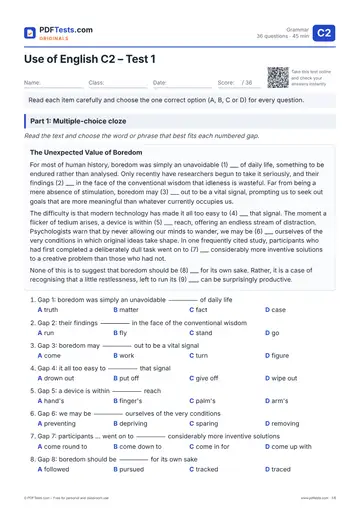
Preview of page 1 of Use of English C2 – Worksheet 1 Open PDF
Use of English B1–C2 · all exam-style tests, task types and tips

Do the worksheet online

Type your answers, then press “Check my answers”. Alternative correct answers are accepted.

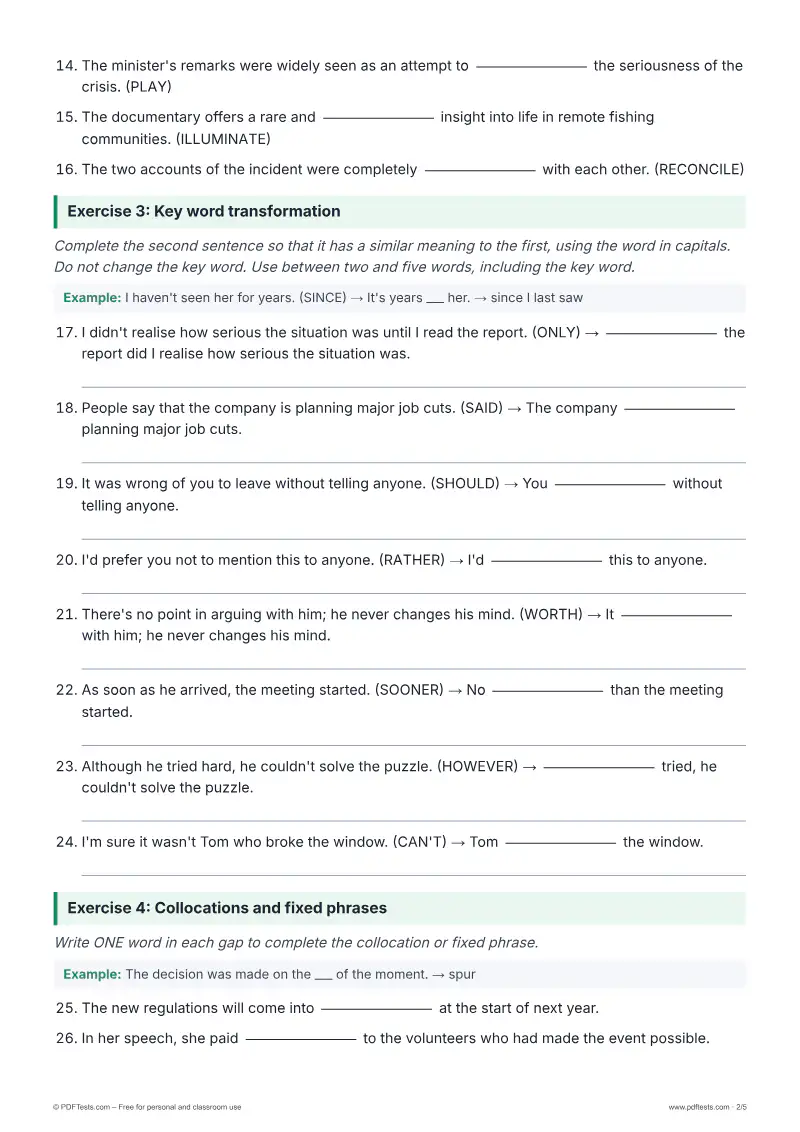
Exercise 1: Open cloze

Read the connected sentences about urban meadows and write ONE word in each gap.

Example: She is one of the most talented musicians I have ___ met. → ever

  1. Few urban planners would have predicted, little as twenty years ago, that wild meadows might one day replace neat lawns in city parks.

  2. Yet that is precisely has happened in dozens of cities across the continent.

  3. though the idea initially met with fierce resistance, residents have gradually warmed to it.

  4. Far being untidy, the meadows are now regarded as havens for insects and birds.

  5. Not do they support biodiversity, but they also require far less maintenance than traditional lawns.

  6. Had it been for a handful of determined volunteers, the first projects would never have got off the ground.

  7. the success of these schemes, some councils remain reluctant to abandon their mowing schedules.

  8. It remains to be seen the trend will last, but for now the bees, at least, seem delighted.

Exercise 2: Word formation

Use the word in capitals to form a word that fits the gap.

Example: The ___ of the bridge took three years. (CONSTRUCT) → construction

  1. The council's decision to close the library was met with widespread and angry protests from local residents. (APPROVE)

  2. Her stubborn to compromise eventually cost her the leadership. (WILLING)

  3. The novel's ending is deliberately , leaving readers to draw their own conclusions. (AMBIGUITY)

  4. Despite his outward , he was in fact deeply anxious about the outcome. (COMPOSE)

  5. The scheme proved expensive and was abandoned within a year. (PROHIBIT)

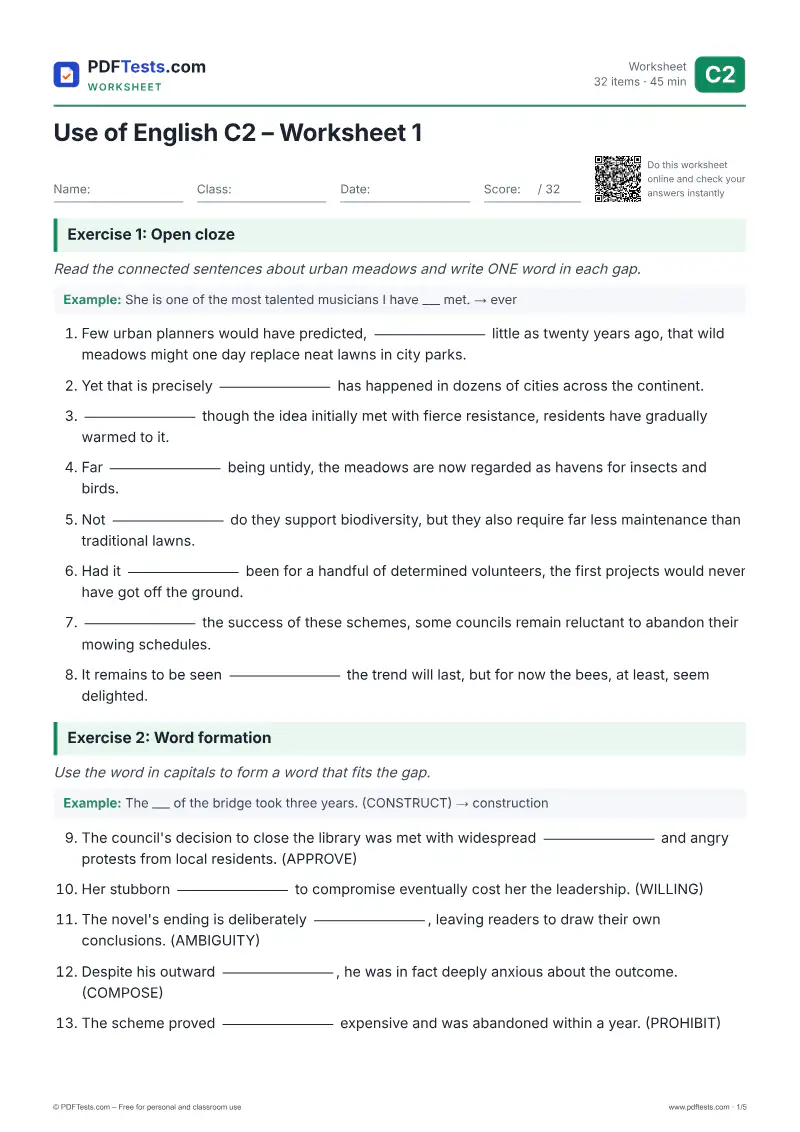
  6. The minister's remarks were widely seen as an attempt to the seriousness of the crisis. (PLAY)

  7. The documentary offers a rare and insight into life in remote fishing communities. (ILLUMINATE)

  8. The two accounts of the incident were completely with each other. (RECONCILE)

Exercise 3: Key word transformation

Complete the second sentence so that it has a similar meaning to the first, using the word in capitals. Do not change the key word. Use between two and five words, including the key word.

Example: I haven't seen her for years. (SINCE) → It's years ___ her. → since I last saw

  1. I didn't realise how serious the situation was until I read the report. (ONLY) → ___ the report did I realise how serious the situation was.

  2. People say that the company is planning major job cuts. (SAID) → The company ___ planning major job cuts.

  3. It was wrong of you to leave without telling anyone. (SHOULD) → You ___ without telling anyone.

  4. I'd prefer you not to mention this to anyone. (RATHER) → I'd ___ this to anyone.

  5. There's no point in arguing with him; he never changes his mind. (WORTH) → It ___ with him; he never changes his mind.

  6. As soon as he arrived, the meeting started. (SOONER) → No ___ than the meeting started.

  7. Although he tried hard, he couldn't solve the puzzle. (HOWEVER) → ___ tried, he couldn't solve the puzzle.

  8. I'm sure it wasn't Tom who broke the window. (CAN'T) → Tom ___ the window.

Exercise 4: Collocations and fixed phrases

Write ONE word in each gap to complete the collocation or fixed phrase.

Example: The decision was made on the ___ of the moment. → spur

  1. The new regulations will come into at the start of next year.

  2. In her speech, she paid to the volunteers who had made the event possible.

  3. The proposal was rejected out of without any proper discussion.

  4. His explanation simply doesn't hold under close scrutiny.

  5. Given how strong the home side were, the team's victory was a foregone .

  6. Their research has thrown new on the origins of the disease.

  7. Several ministers are said to be at over the budget.

  8. The negotiations were conducted behind closed , so few details have emerged.

Was this page helpful?

Report a mistake

Spotted a wrong answer, a typo or an unclear explanation? Tell us and we will fix it.

Preview

About this test

C2 Use of English worksheet: open cloze, word formation, key word transformations and collocations, with answers for checking.

Topics covered

Open clozeWord formationKey word transformationInversionCollocations and fixed phrasesAdvanced grammar

Notes for teachers

Set the exercises under timed conditions (about 10 minutes each) to simulate exam pressure, then have students compare answers in pairs before checking. Typical errors include missing negative prefixes in word formation, going over the five-word limit in transformations, and forgetting the auxiliary after negative adverbials such as 'Only when' or 'No sooner'. As a follow-up, ask students to write their own short open-cloze text or transformation items for a partner to solve.

All English C2 tests →