PDFTests Originals

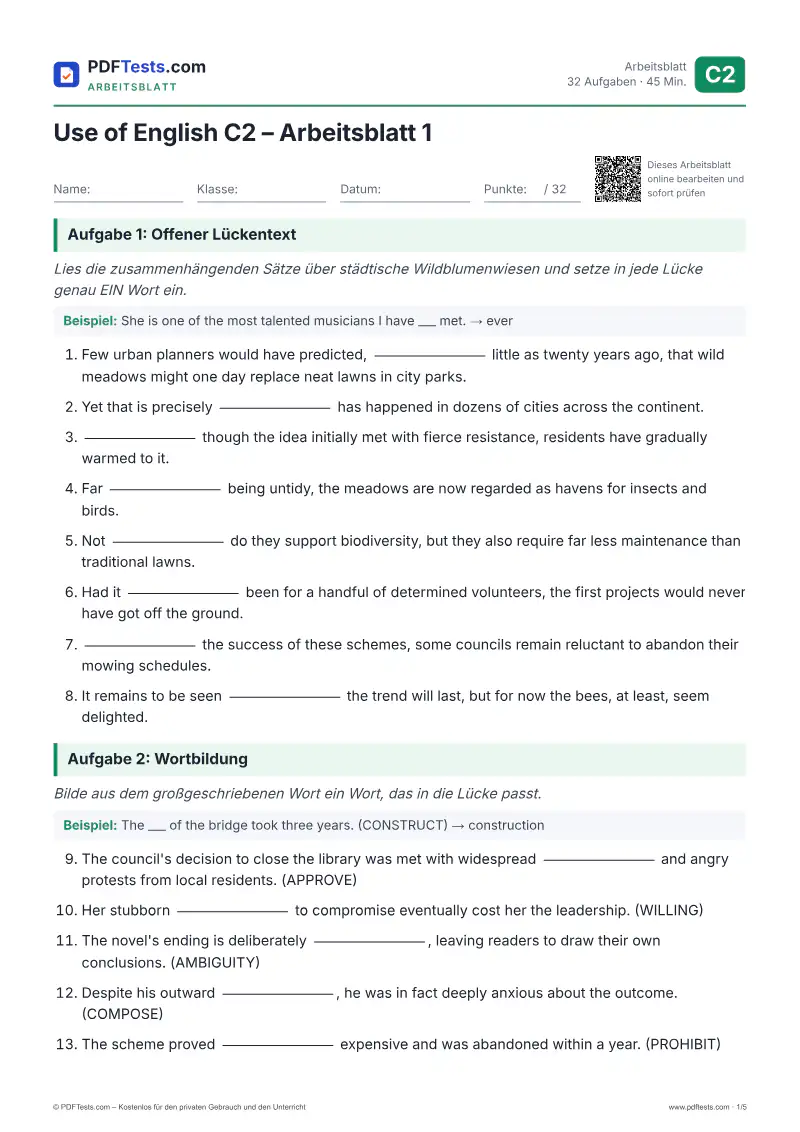
Use of English C2 – Arbeitsblatt 1

C2 Kompetente Sprachverwendung ArbeitsblattEnglisch

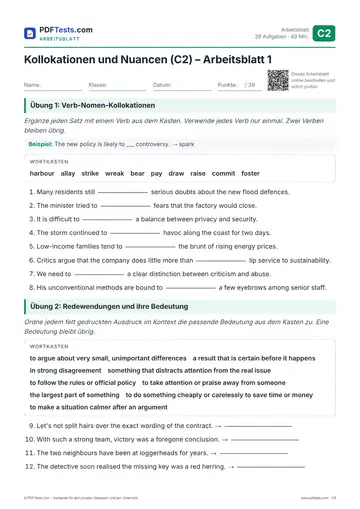
Dieses Arbeitsblatt zu Use of English auf Niveau C2 bietet prüfungsnahes Training in vier Aufgabentypen: einen offenen Lückentext, Wortbildung, Satzumformungen mit Schlüsselwort und einen Lückentext zu Kollokationen. Es richtet sich an fortgeschrittene Lernende, die sich auf Prüfungen auf Proficiency-Niveau vorbereiten und ihre Sicherheit bei komplexer Grammatik, Wortbildung und idiomatischer Sprache weiter ausbauen möchten.
Aufgaben
32
Zeit
45 Min.
PDF
5 Seiten
Lösungen
Enthalten
  • 100 % kostenlos
  • Ohne Anmeldung
  • Druckfertiges A4-PDF
Vorschau von Seite 1: Use of English C2 – Arbeitsblatt 1 PDF öffnen
Use of English B1–C2 · alle Tests im Prüfungsformat, Aufgabentypen und Tipps

Arbeitsblatt online bearbeiten

Tippen Sie Ihre Antworten ein und klicken Sie auf „Antworten prüfen“. Alternative richtige Antworten werden akzeptiert.

Aufgabe 1: Offener Lückentext

Lies die zusammenhängenden Sätze über städtische Wildblumenwiesen und setze in jede Lücke genau EIN Wort ein.

Beispiel: She is one of the most talented musicians I have ___ met. → ever

  1. Few urban planners would have predicted, little as twenty years ago, that wild meadows might one day replace neat lawns in city parks.

  2. Yet that is precisely has happened in dozens of cities across the continent.

  3. though the idea initially met with fierce resistance, residents have gradually warmed to it.

  4. Far being untidy, the meadows are now regarded as havens for insects and birds.

  5. Not do they support biodiversity, but they also require far less maintenance than traditional lawns.

  6. Had it been for a handful of determined volunteers, the first projects would never have got off the ground.

  7. the success of these schemes, some councils remain reluctant to abandon their mowing schedules.

  8. It remains to be seen the trend will last, but for now the bees, at least, seem delighted.

Aufgabe 2: Wortbildung

Bilde aus dem großgeschriebenen Wort ein Wort, das in die Lücke passt.

Beispiel: The ___ of the bridge took three years. (CONSTRUCT) → construction

  1. The council's decision to close the library was met with widespread and angry protests from local residents. (APPROVE)

  2. Her stubborn to compromise eventually cost her the leadership. (WILLING)

  3. The novel's ending is deliberately , leaving readers to draw their own conclusions. (AMBIGUITY)

  4. Despite his outward , he was in fact deeply anxious about the outcome. (COMPOSE)

  5. The scheme proved expensive and was abandoned within a year. (PROHIBIT)

  6. The minister's remarks were widely seen as an attempt to the seriousness of the crisis. (PLAY)

  7. The documentary offers a rare and insight into life in remote fishing communities. (ILLUMINATE)

  8. The two accounts of the incident were completely with each other. (RECONCILE)

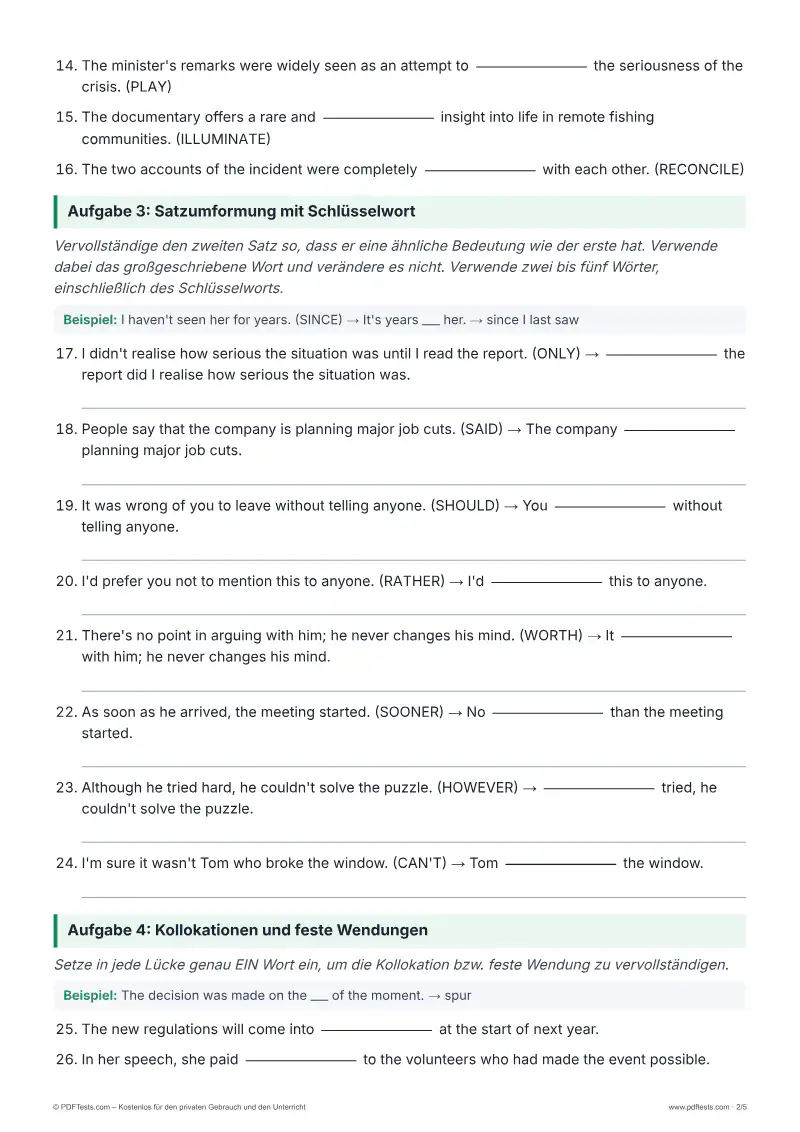
Aufgabe 3: Satzumformung mit Schlüsselwort

Vervollständige den zweiten Satz so, dass er eine ähnliche Bedeutung wie der erste hat. Verwende dabei das großgeschriebene Wort und verändere es nicht. Verwende zwei bis fünf Wörter, einschließlich des Schlüsselworts.

Beispiel: I haven't seen her for years. (SINCE) → It's years ___ her. → since I last saw

  1. I didn't realise how serious the situation was until I read the report. (ONLY) → ___ the report did I realise how serious the situation was.

  2. People say that the company is planning major job cuts. (SAID) → The company ___ planning major job cuts.

  3. It was wrong of you to leave without telling anyone. (SHOULD) → You ___ without telling anyone.

  4. I'd prefer you not to mention this to anyone. (RATHER) → I'd ___ this to anyone.

  5. There's no point in arguing with him; he never changes his mind. (WORTH) → It ___ with him; he never changes his mind.

  6. As soon as he arrived, the meeting started. (SOONER) → No ___ than the meeting started.

  7. Although he tried hard, he couldn't solve the puzzle. (HOWEVER) → ___ tried, he couldn't solve the puzzle.

  8. I'm sure it wasn't Tom who broke the window. (CAN'T) → Tom ___ the window.

Aufgabe 4: Kollokationen und feste Wendungen

Setze in jede Lücke genau EIN Wort ein, um die Kollokation bzw. feste Wendung zu vervollständigen.

Beispiel: The decision was made on the ___ of the moment. → spur

  1. The new regulations will come into at the start of next year.

  2. In her speech, she paid to the volunteers who had made the event possible.

  3. The proposal was rejected out of without any proper discussion.

  4. His explanation simply doesn't hold under close scrutiny.

  5. Given how strong the home side were, the team's victory was a foregone .

  6. Their research has thrown new on the origins of the disease.

  7. Several ministers are said to be at over the budget.

  8. The negotiations were conducted behind closed , so few details have emerged.

War diese Seite hilfreich?

Fehler melden

Falsche Lösung, Tippfehler oder unklare Erklärung? Schreiben Sie uns, wir korrigieren es.

Vorschau

Über diesen Test

Arbeitsblatt Englisch C2 als PDF: Use of English mit offenem Lückentext, Wortbildung, Satzumformungen und Kollokationen – mit Lösungen.

Themen

Offener LückentextWortbildungSatzumformung mit SchlüsselwortInversionKollokationen und feste WendungenFortgeschrittene Grammatik

Hinweise für Lehrkräfte

Lassen Sie die Aufgaben unter Zeitvorgabe bearbeiten (etwa 10 Minuten pro Aufgabe), um die Prüfungssituation zu simulieren, und die Lernenden ihre Antworten anschließend zu zweit vergleichen, bevor die Lösungen kontrolliert werden. Typische Fehler sind fehlende Negationspräfixe bei der Wortbildung, das Überschreiten der Grenze von fünf Wörtern bei den Satzumformungen sowie das vergessene Hilfsverb nach verneinenden Adverbialen wie 'Only when' oder 'No sooner'. Als Anschlussaufgabe können die Lernenden einen eigenen kurzen offenen Lückentext oder eigene Umformungsaufgaben verfassen, die dann ein Partner bzw. eine Partnerin löst.

Alle Englisch-Tests C2 →