PDFTests Originals

Use of English C2 – Test 2

C2 Proficiency GrammarEnglish

This C2 Use of English test challenges advanced learners with 36 exam-style multiple-choice items across four parts: a lexical cloze, a grammatical cloze, word formation and key word transformations. It suits students preparing for proficiency-level exams and teachers who need a reliable, printable practice paper.

Questions
36
Time
45 min
PDF
6 pages
Answer key
Included
  • 100% free
  • No sign-up or email
  • Print-ready A4 PDF
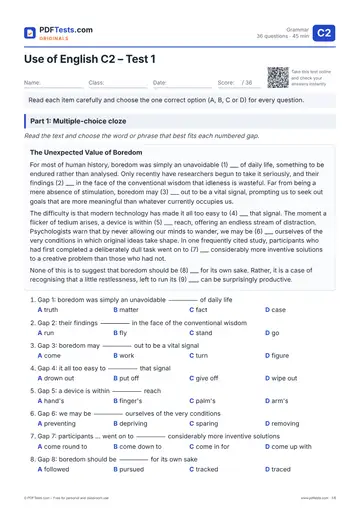
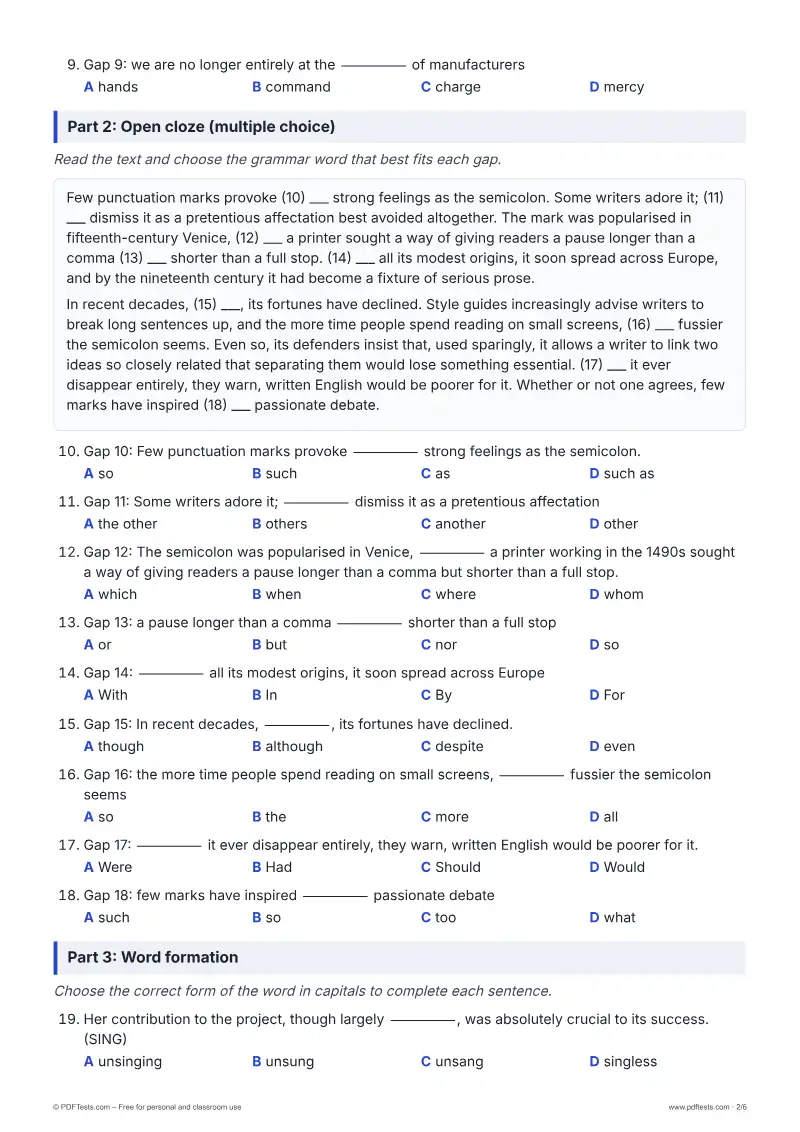
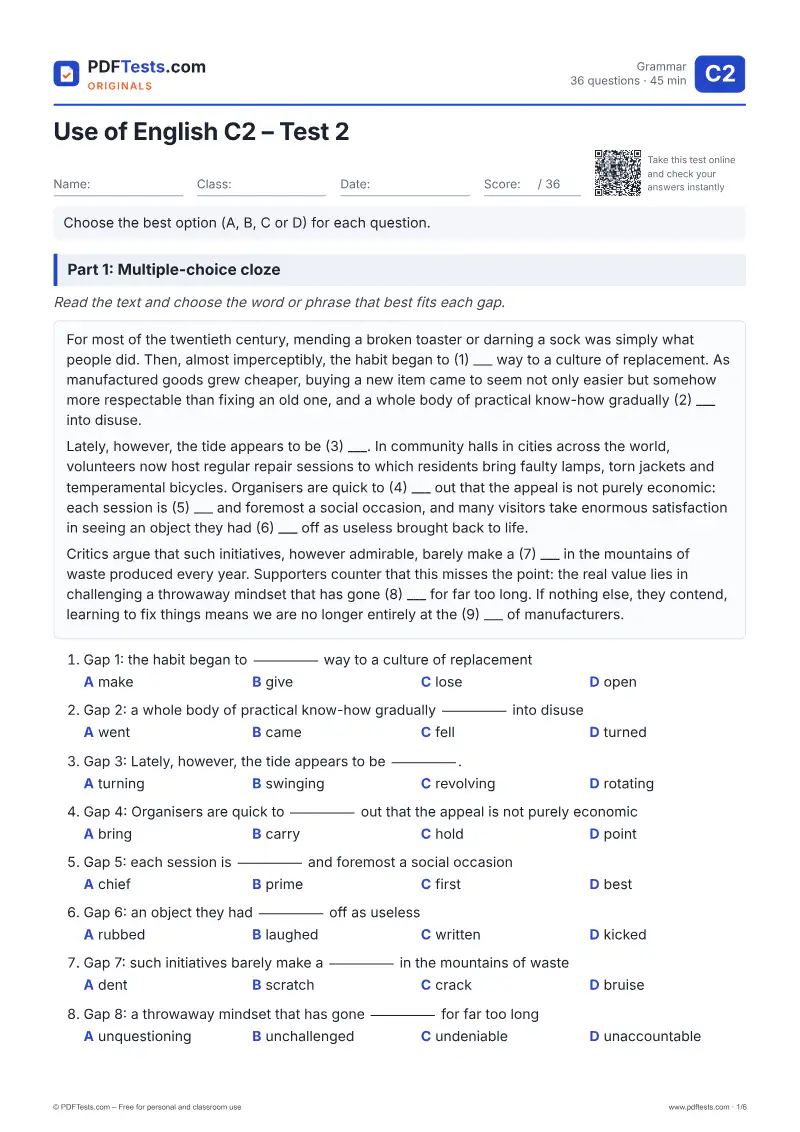
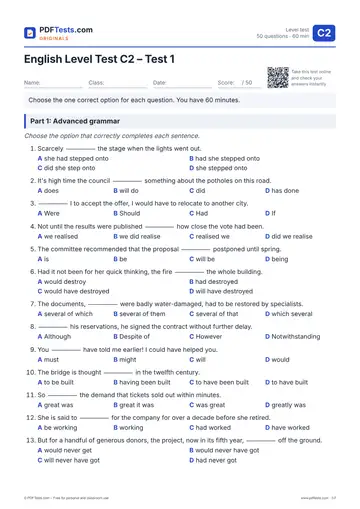
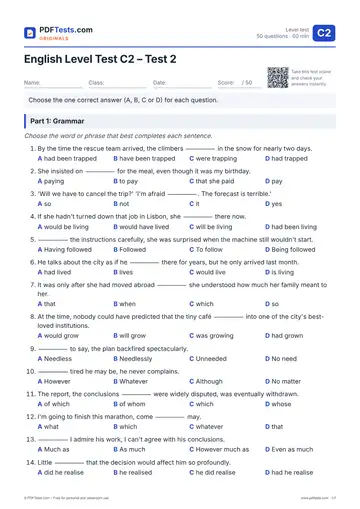
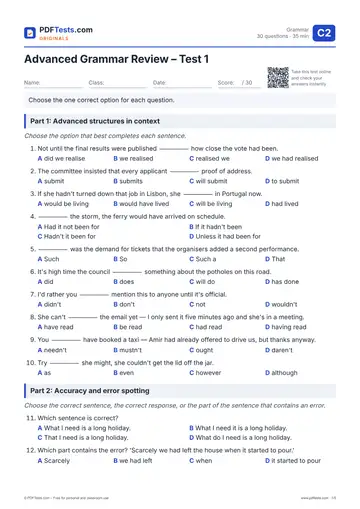
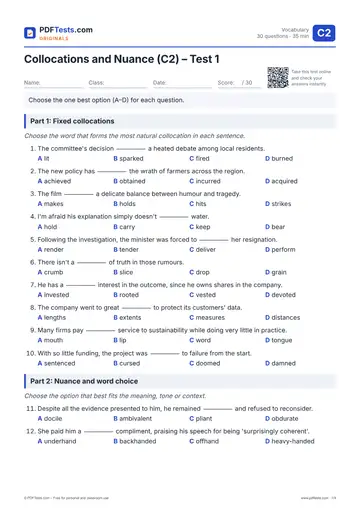
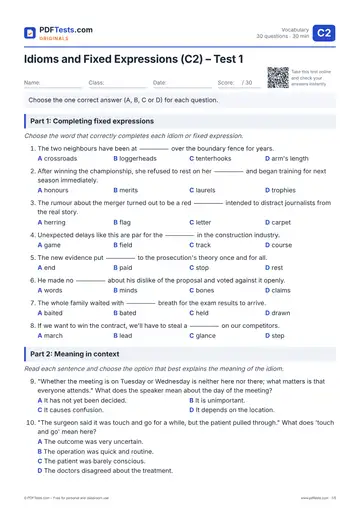
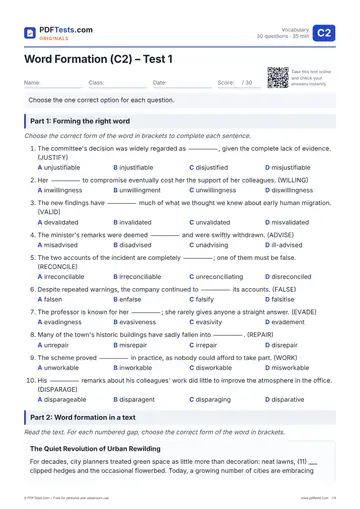
Preview of page 1 of Use of English C2 – Test 2 Open PDF
Use of English B1–C2 · all exam-style tests, task types and tips

Take the test online

Choose the best option (A, B, C or D) for each question. Choose your answers, then press “Check my answers”.

Part 1: Multiple-choice cloze

Read the text and choose the word or phrase that best fits each gap.

For most of the twentieth century, mending a broken toaster or darning a sock was simply what people did. Then, almost imperceptibly, the habit began to (1) ___ way to a culture of replacement. As manufactured goods grew cheaper, buying a new item came to seem not only easier but somehow more respectable than fixing an old one, and a whole body of practical know-how gradually (2) ___ into disuse.

Lately, however, the tide appears to be (3) ___. In community halls in cities across the world, volunteers now host regular repair sessions to which residents bring faulty lamps, torn jackets and temperamental bicycles. Organisers are quick to (4) ___ out that the appeal is not purely economic: each session is (5) ___ and foremost a social occasion, and many visitors take enormous satisfaction in seeing an object they had (6) ___ off as useless brought back to life.

Critics argue that such initiatives, however admirable, barely make a (7) ___ in the mountains of waste produced every year. Supporters counter that this misses the point: the real value lies in challenging a throwaway mindset that has gone (8) ___ for far too long. If nothing else, they contend, learning to fix things means we are no longer entirely at the (9) ___ of manufacturers.

  1. Gap 1: the habit began to _____ way to a culture of replacement

  2. Gap 2: a whole body of practical know-how gradually _____ into disuse

  3. Gap 3: Lately, however, the tide appears to be _____.

  4. Gap 4: Organisers are quick to _____ out that the appeal is not purely economic

  5. Gap 5: each session is _____ and foremost a social occasion

  6. Gap 6: an object they had _____ off as useless

  7. Gap 7: such initiatives barely make a _____ in the mountains of waste

  8. Gap 8: a throwaway mindset that has gone _____ for far too long

  9. Gap 9: we are no longer entirely at the _____ of manufacturers

Part 2: Open cloze (multiple choice)

Read the text and choose the grammar word that best fits each gap.

Few punctuation marks provoke (10) ___ strong feelings as the semicolon. Some writers adore it; (11) ___ dismiss it as a pretentious affectation best avoided altogether. The mark was popularised in fifteenth-century Venice, (12) ___ a printer sought a way of giving readers a pause longer than a comma (13) ___ shorter than a full stop. (14) ___ all its modest origins, it soon spread across Europe, and by the nineteenth century it had become a fixture of serious prose.

In recent decades, (15) ___, its fortunes have declined. Style guides increasingly advise writers to break long sentences up, and the more time people spend reading on small screens, (16) ___ fussier the semicolon seems. Even so, its defenders insist that, used sparingly, it allows a writer to link two ideas so closely related that separating them would lose something essential. (17) ___ it ever disappear entirely, they warn, written English would be poorer for it. Whether or not one agrees, few marks have inspired (18) ___ passionate debate.

  1. Gap 10: Few punctuation marks provoke _____ strong feelings as the semicolon.

  2. Gap 11: Some writers adore it; _____ dismiss it as a pretentious affectation

  3. Gap 12: The semicolon was popularised in Venice, _____ a printer working in the 1490s sought a way of giving readers a pause longer than a comma but shorter than a full stop.

  4. Gap 13: a pause longer than a comma _____ shorter than a full stop

  5. Gap 14: _____ all its modest origins, it soon spread across Europe

  6. Gap 15: In recent decades, _____, its fortunes have declined.

  7. Gap 16: the more time people spend reading on small screens, _____ fussier the semicolon seems

  8. Gap 17: _____ it ever disappear entirely, they warn, written English would be poorer for it.

  9. Gap 18: few marks have inspired _____ passionate debate

Part 3: Word formation

Choose the correct form of the word in capitals to complete each sentence.

  1. Her contribution to the project, though largely _____, was absolutely crucial to its success. (SING)

  2. The two parties remain _____ opposed on the question of funding. (DIAMETER)

  3. Rents in the city centre have become _____ high for most young people. (PROHIBIT)

  4. After weeks of fruitless discussion, the negotiations reached an _____ and talks were suspended. (PASS)

  5. The novelist has an _____ ability to capture the rhythms of everyday speech. (CANNY)

  6. The difference between the two versions is barely _____ to the untrained eye. (DISCERN)

  7. She argued her case with such _____ that even her fiercest critics were won over. (CONVINCE)

  8. The scheme was _____ from the outset, so nobody was surprised when it collapsed. (CONCEIVE)

  9. Once signed, the agreement is _____ and cannot be withdrawn under any circumstances. (REVOKE)

Part 4: Key word transformations

Choose the sentence that has the same meaning as the first sentence, correctly uses the key word in capitals, and is grammatically correct.

  1. She had no idea that the police were watching her. (LITTLE)

  2. People say that the company is on the verge of bankruptcy. (REPUTED)

  3. Her performance was nowhere near as good as we had expected. (FELL)

  4. Everyone was surprised when he resigned. (CAME)

  5. I don't mind at all whether we eat in or go out. (DIFFERENCE)

  6. He has never really accepted that his career is over. (TERMS)

  7. There is absolutely no possibility of the project being finished by Friday. (QUESTION)

  8. The match was called off because the pitch was waterlogged. (ACCOUNT)

  9. I'm sure she didn't intend to upset anyone. (MEANT)

Was this page helpful?

Report a mistake

Spotted a wrong answer, a typo or an unclear explanation? Tell us and we will fix it.

Practise with a worksheet: Use of English C2 – Worksheet 1

Preview

About this test

This C2 Use of English test challenges advanced learners with 36 exam-style multiple-choice items across four parts: a lexical cloze, a grammatical cloze, word formation and key word transformations. It suits students preparing for proficiency-level exams and teachers who need a reliable, printable practice paper.

Topics covered

Collocations and fixed phrasesPhrasal verbsGrammar words in contextInversion and conditionalsWord formationKey word transformations

How to use this test

  1. Download the PDF and print it, or take the test online below.
  2. Answer every question without a dictionary or time pressure.
  3. Check your answers and note the topics you need to review.

Notes for teachers

Use the test as timed exam practice or work through it part by part in class. Parts 1 and 3 target near-miss collocations and prefix and suffix errors such as unrevokable or prohibitive for prohibitively. Parts 2 and 4 focus on inversion, comparative structures and fixed expressions where learners often drop an article or preposition. As a follow-up, have students write their own transformations using the key words from Part 4.