Inversion means putting an auxiliary verb before the subject, as in a question, even though the sentence is a statement: Never have I seen such a mess. At C1 you use it mainly after negative or restrictive words placed at the start of a sentence, and in formal conditionals. It adds emphasis or drama and is typical of formal writing, speeches and storytelling.
How inversion works
The basic rule is simple. Move the negative or limiting expression to the front, then use question word order: auxiliary + subject + main verb.
- I have never seen such a mess. → Never have I seen such a mess.
- She rarely complains. → Rarely does she complain.
The sentence is still a statement, so it ends with a full stop, not a question mark.
Form table
| Normal order | Inverted order | Auxiliary used |
|---|---|---|
| I am rarely late. | Rarely am I late. | be |
| We have seldom felt so welcome. | Seldom have we felt so welcome. | have (perfect) |
| You should never lie to her. | Never should you lie to her. | modal |
| He rarely goes out. | Rarely does he go out. | do / does + base form |
| They little knew the truth. | Little did they know the truth. | did + base form |
If the verb has no auxiliary (present simple or past simple), add do, does or did, and the main verb returns to its base form. This is exactly what happens in questions.
Inversion after negative and restrictive adverbials
Never, rarely, seldom, hardly ever, little
These frequency and degree words are the classic triggers.
- Seldom do we get a chance to speak to the CEO directly.
- Hardly ever does the train leave on time.
- Little did she realise that the job would change her life.
Little in this sense means ‘not at all’, and is almost always used with verbs of knowing: know, realise, suspect, imagine.
Not only… but (also)
Invert after Not only, but use normal order in the but clause.
- Not only did he forget the tickets, but he also lost his passport.
- Not only is the flat cheaper, it’s also closer to work.
Hardly / Scarcely / Barely… when and No sooner… than
These show that one event happened immediately after another. They are usually used with the past perfect in the inverted clause and the past simple in the second.
- Hardly had we sat down when the fire alarm went off.
- Scarcely had she finished her speech when the questions started.
- No sooner had I paid than I noticed the price was wrong.
Remember the pairs: hardly/scarcely/barely… when (sometimes before), but no sooner… than.
Only after, only when, only then, only if, not until
With these expressions, inversion happens in the main clause, not in the time clause that follows only or not until.
- Only when I got home did I realise my phone was missing.
- Only after the results were published did they admit the error.
- Not until the very end did the audience understand the plot.
- Only then did he apologise.
- Only if all members agree will the rule change.
Notice that I got home and the results were published keep normal word order.
Under no circumstances, on no account, at no time, in no way, nowhere
These phrases containing no are common in rules, warnings and formal statements.
- Under no circumstances should you share your password.
- On no account are visitors allowed beyond this point.
- At no time did the company inform customers of the risk.
- Nowhere is this problem more obvious than in big cities.
Not a (single)…, In vain
- Not a single word did he say during the meeting.
- Not once has she missed a deadline.
Inversion with so and such
To emphasise a degree, put so + adjective/adverb or such + be at the front, followed by a that clause.
- So tired was she that she fell asleep at her desk.
- So quickly did the news spread that the shop sold out by noon.
- Such was the demand that tickets were resold for triple the price.
With such, the verb is normally be, and the subject comes after it: Such was his anger that… (= His anger was so great that…).
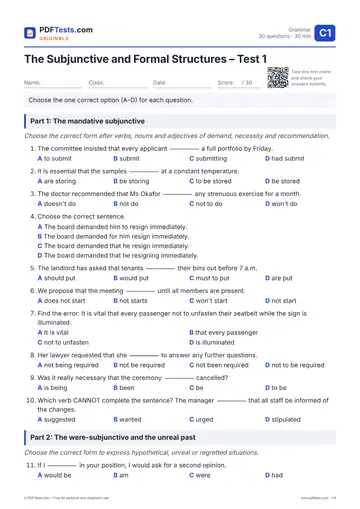
Conditional inversion: Had, Should, Were
In formal English you can drop if and invert instead. Only three auxiliaries are used this way.
| With if | Inverted | Type |
|---|---|---|
| If I had known, I would have called. | Had I known, I would have called. | third conditional |
| If you should need help, call me. | Should you need help, call me. | first conditional (unlikely) |
| If I were in your position, I’d refuse. | Were I in your position, I’d refuse. | second conditional |
| If he were to resign, … | Were he to resign, … | hypothetical future |
For the negative, place not after the subject and do not contract: Had I not seen it myself, I wouldn’t have believed it. For more ways to replace if, see our guide to alternatives to if.
Short responses: so, neither, nor
You already use inversion in everyday replies, even at lower levels.
- ‘I love jazz.’ ‘So do I.’
- ‘I can’t swim.’ ‘Neither can she.’
- He didn’t call, nor did he send a message.
Inversion after place and direction adverbials
After adverbials of place or movement, the whole verb (not an auxiliary) can come before a noun subject. This is common in descriptions and narratives.
- Here comes the bus.
- On the hill stood an old castle.
- Down came the rain.
- In walked the manager.
This type does not use do/did, and it does not happen with pronoun subjects: Here it comes, not Here comes it.
Inversion or normal order?
Learners often over-apply inversion. Use it only when the negative or restrictive element is at the start of the clause.
| Normal order (no inversion) | Inversion |
|---|---|
| I have never been so embarrassed. | Never have I been so embarrassed. |
| She not only sings, she also dances. | Not only does she sing, she also dances. |
| I realised only when I got home. | Only when I got home did I realise. |
| Only Sarah knew the answer. | — |
In the last example, only modifies the subject Sarah, so there is no inversion. The same applies to Not long ago and Not far away, which are not negative in meaning: Not long ago, we moved to Leeds.
Register and effect
Inversion is mainly formal and written. In conversation it sounds dramatic or deliberate, which is why it appears in speeches, news reports and stories (Little did they know…). In neutral speech, normal word order is usually more natural. For other ways to add emphasis, compare inversion with cleft sentences and other emphatic structures.
Common mistakes
- ✗ Never I have seen such a view. → ✓ Never have I seen such a view. The auxiliary must come before the subject.
- ✗ Not only she speaks French, but also Arabic. → ✓ Not only does she speak French, but also Arabic. Present simple needs does + base form.
- ✗ Rarely did he complained. → ✓ Rarely did he complain. After did, use the base form.
- ✗ No sooner had we arrived when it started raining. → ✓ No sooner had we arrived than it started raining. No sooner pairs with than.
- ✗ Hardly had I left than she called. → ✓ Hardly had I left when she called. Hardly pairs with when.
- ✗ Only when did I get home I realised. → ✓ Only when I got home did I realise. Invert the main clause, not the time clause.
- ✗ If had I known, I’d have helped. → ✓ Had I known, I’d have helped. Drop if when you invert.
- ✗ Hadn’t I seen it, I wouldn’t believe it. → ✓ Had I not seen it, I wouldn’t believe it. Conditional inversion uses uncontracted not after the subject.
- ✗ Here comes he. → ✓ Here he comes. No inversion with pronoun subjects after place adverbials.
- ✗ Only my brother did know the code. → ✓ Only my brother knew the code. Only + subject does not trigger inversion.
Quick check
Rewrite each sentence starting with the words given.
- I have never tasted such good coffee. → Never…
- He didn’t thank us, and he also complained about the food. → Not only…
- If you should have any questions, please contact reception. → Should…
- As soon as we sat down, the lights went out. → No sooner…
- You must not leave the room under any circumstances. → Under no circumstances…
Answers
- Never have I tasted such good coffee.
- Not only did he not thank us, but he also complained about the food.
- Should you have any questions, please contact reception.
- No sooner had we sat down than the lights went out.
- Under no circumstances must you leave the room. (should you is also correct.)
Next step
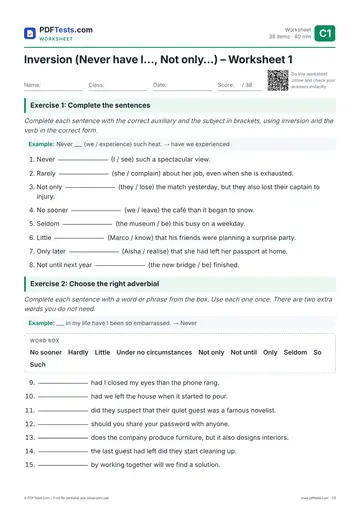
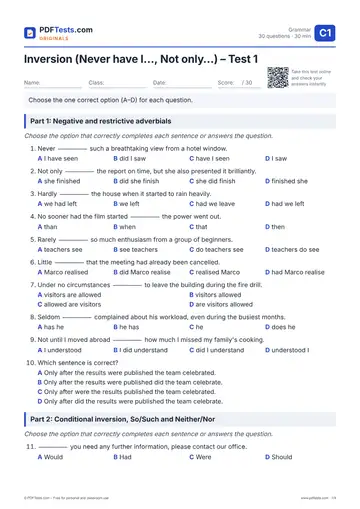
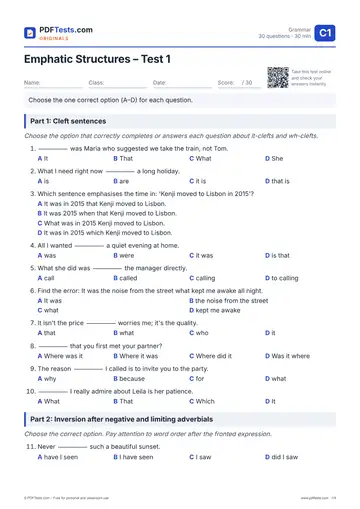
Now put the rules into practice: test yourself with our C1 Inversion test, which mixes negative adverbials, only expressions, so/such and conditional inversion. Pay special attention to items with only when and not until, where the inversion moves to the main clause, and to the no sooner… than / hardly… when pairs. If you score well, browse the full set of C1 English tests to work on related formal structures.
Was this page helpful?
What was the problem?
Thank you for your feedback!