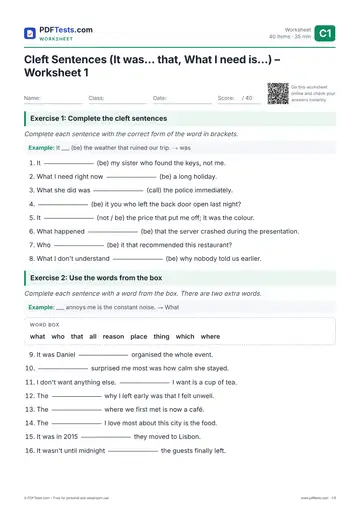
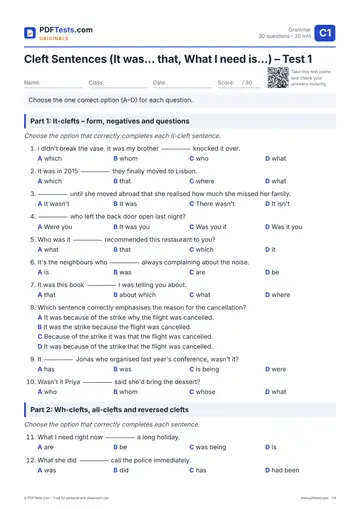
A cleft sentence splits one simple sentence into two clauses so that one part is pushed into focus. The two main types are it-clefts (It was Sara who found the mistake.) and wh-clefts (What I need is a long holiday.). We use them to emphasise new or important information, to correct someone, or to build up to a key point in speaking and writing.
How a cleft sentence works
Start with a neutral sentence:
- Sara found the mistake in the report yesterday.
This sentence gives no special weight to any part. A cleft sentence picks one element and highlights it:
- It was Sara who found the mistake in the report yesterday. (not someone else)
- It was yesterday that Sara found the mistake. (not last week)
- What Sara found yesterday was a mistake in the report. (the thing she found)
The information stays the same. What changes is the focus, and with it the message the listener takes away.
It-clefts
Form
| Part | Structure | Example |
|---|---|---|
| Affirmative | It + be + focus + that/who + rest of clause | It was the noise that woke me up. |
| Negative | It + be + not + focus + that/who + rest | It wasn’t the noise that woke me up. |
| Yes/no question | Be + it + focus + that/who + rest? | Was it the noise that woke you up? |
| Wh-question | Wh-word + be + it + that + rest? | What was it that woke you up? |
The verb be normally matches the time of the situation: It is the cost that worries me / It was the cost that worried me. You can also use modals: It might be the battery that’s causing the problem.
What can be focused
You can put almost any noun phrase, prepositional phrase or adverbial into focus:
- Subject: It was my brother who booked the tickets.
- Object: It’s the ending (that) I didn’t understand.
- Time: It was in 2019 that the company went public.
- Place: It was at the airport that I realised I’d lost my passport.
- Reason: It was because of the strike that the meeting was cancelled.
You cannot normally focus the main verb with an it-cleft. For actions, use a wh-cleft instead (see below).
That, who or nothing
- Use that after any focus: It was the manager that complained.
- Use who when the focus is a person: It was the manager who complained.
- You can omit that when the focus is the object of the second clause: It was this book (that) I wanted. Do not omit it when the focus is the subject: It was the manager who complained, not It was the manager complained (this is heard in very casual speech but is not standard).
- Avoid which, where and when in careful English: It was at the station that I met her, not where.
In informal speech, an object pronoun is normal in the focus position: It was me who called. In very formal writing, It was I who called is also possible.
Typical uses
Correction and contrast. It-clefts are ideal for saying X, not Y:
- It wasn’t Tom who broke the printer – it was Lucy.
- It’s not the price that bothers me; it’s the quality.
It was not until… that… This fixed pattern stresses that something happened late:
- It was not until she moved abroad that she started to appreciate her hometown.
It’s not that… (it’s just that…) This softens a refusal or explanation:
- It’s not that I don’t like your idea. It’s just that we don’t have the budget.
Wh-clefts (pseudo-clefts)
Form
| Part | Structure | Example |
|---|---|---|
| Basic | What + clause + be + focus | What I need is some fresh air. |
| Negative | What + clause + be + not + focus | What I need isn’t more advice. |
| Reversed | Focus + be + what + clause | Some fresh air is what I need. |
The what-clause contains information the listener already knows or can easily accept. The part after be is the new, important information, so it carries the main stress.
The verb be is usually singular because the what-clause is the subject: What we need is more volunteers. A plural verb (are) also occurs, especially in speech, but singular is the safe choice.
Focusing an action
To emphasise what someone did, use what + subject + do/does/did + be + (to) infinitive:
- What I did was call the bank immediately.
- What you should do is talk to her directly.
- What we’re going to do is wait and see.
The infinitive can be with or without to; the bare form is more common in conversation.
To focus a whole event, use what happened was (that)…:
- What happened was (that) the server crashed during the update.
Other wh-clef heads
What is the most common opener, but other noun phrases work the same way:
| Opener | Example |
|---|---|
| All (= the only thing) | All I want is a quiet weekend. |
| The thing (that) | The thing that annoys me is the constant noise. |
| The reason (why) | The reason (why) I left is that I wasn’t learning anything. |
| The person who | The person who helped me most was my first manager. |
| The place where | The place where we stayed was a converted farmhouse. |
| The day/time when | The day (when) everything changed was 4 March. |
| One thing | One thing I’ve learnt is never to sign anything in a hurry. |
Note that all I want means the only thing I want, so it adds a limiting meaning, not just emphasis.
Reversed wh-clefts in speech
Reversed wh-clefts with that are very common in conversation to sum up or agree:
- That’s what I mean.
- That’s why I didn’t call you.
- That’s where we went wrong.
- Patience is what this job really requires.
Typical uses
Wh-clefts are useful for building up to a point, for signposting in presentations and essays, and for giving advice firmly but politely:
- What this data shows is a steady decline in sales.
- What concerns me most is the lack of planning.
- What you need to remember is that the deadline is fixed.
It-cleft or wh-cleft?
| It-cleft | Wh-cleft | |
|---|---|---|
| Focus position | Early, after It + be | Late, after be (end focus) |
| Best for | Correcting, contrasting, identifying who/when/where | Building up, introducing new ideas, focusing actions |
| Can focus the verb? | No | Yes (What I did was…) |
| Example | It was the design that won the award. | What won the award was the design. |
Compare:
- It was the design that won the award – suggests a contrast: the design, not the price or the marketing.
- What won the award was the design – leads the listener towards the answer and gives it at the end.
Cleft sentences are one of several ways to add emphasis. You can see how they fit alongside fronting, auxiliary do and emphatic adverbs in our guide to emphatic structures, and compare them with the more formal option of inversion after negative adverbials. Because the second half of an it-cleft behaves like a relative clause, it also helps to review relative clauses with who, which and that.
Common mistakes
- ✗ What I need it is a break. → ✓ What I need is a break. The what-clause is already the subject; do not add it.
- ✗ That I need is a break. → ✓ What I need is a break. Wh-clefts begin with what (or all, the thing that), not that.
- ✗ It’s my sister who she lives in Rome. → ✓ It’s my sister who lives in Rome. Do not repeat the subject with a pronoun.
- ✗ It was in Paris where we first met. → ✓ It was in Paris that we first met. With a prepositional phrase in focus, use that.
- ✗ It was the director which approved it. → ✓ It was the director who/that approved it. Use who or that for people, not which.
- ✗ What surprised me were his reaction. → ✓ What surprised me was his reaction. The verb agrees with the singular what-clause and the singular focus.
- ✗ What I did was I phoned the police. → ✓ What I did was (to) phone the police. After What… did was, use an infinitive.
- ✗ It was until midnight that he arrived. → ✓ It was not until midnight that he arrived. The fixed pattern is It was not until… that….
- ✗ The reason I’m late is because the train broke down. → ✓ The reason I’m late is that the train broke down. In formal English, the reason… is that avoids repeating the idea of cause.
- ✗ It was yesterday when I sent the email. → ✓ It was yesterday that I sent the email. That is the standard linking word after a time expression in focus.
Quick check
Rewrite or complete each sentence using the structure in brackets.
- Mia designed the logo. (Focus on Mia: It…)
- I need ________ is a strong coffee. (one word)
- He didn’t realise his mistake until the next morning. (It was not until…)
- She resigned. (Focus on the action: What she…)
- Correct the error: It was at this café where I wrote my first novel.
Answers
- It was Mia who/that designed the logo.
- What I need is a strong coffee.
- It was not until the next morning that he realised his mistake.
- What she did was (to) resign.
- It was at this café that I wrote my first novel.
Next step
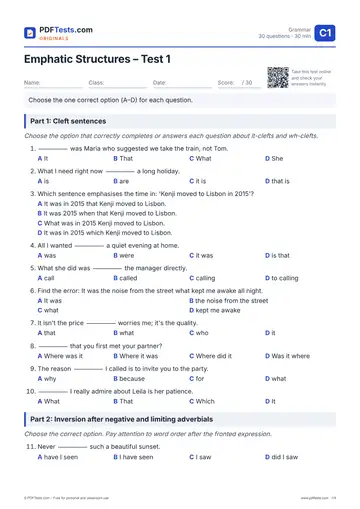
Now put the rules into practice with our C1 Cleft Sentences test, which mixes it-clefts, wh-clefts and sentence transformations of the kind found in advanced exams. When you are confident, try the C1 Emphatic Structures test to practise choosing between clefts and other ways of adding emphasis, and use any errors to decide which section of this guide to review.
Practise this topic: Cleft Sentences (It was… that, What I need is…)
Was this page helpful?
What was the problem?
Thank you for your feedback!