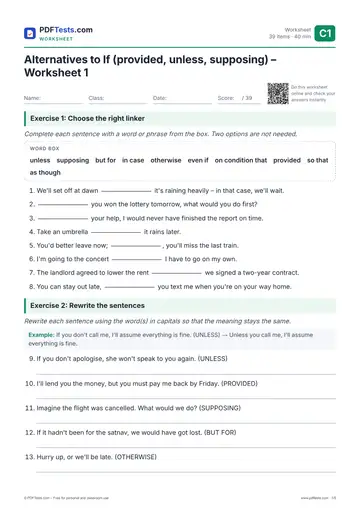
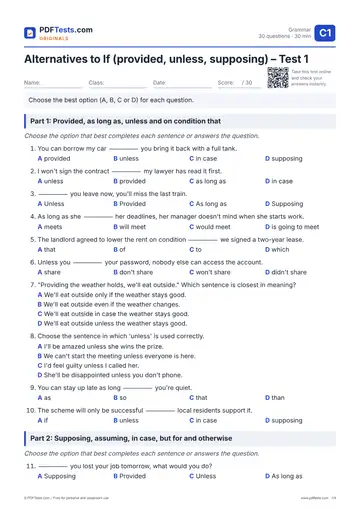
Alternatives to if are words and phrases such as unless, provided (that), as long as and supposing. They introduce a condition with a more precise meaning than if. At C1 you are expected to choose between them accurately. Unless means “except if”, provided stresses a requirement, and supposing asks someone to imagine a situation.
Most of these expressions follow the same tense patterns as ordinary conditionals. If you need a refresher, start with our guide to the first and second conditional.
The main alternatives at a glance
| Expression | Meaning | Register | Example |
|---|---|---|---|
| unless | except if | neutral | I won’t call unless there’s a problem. |
| provided / providing (that) | only if this requirement is met | neutral–formal | You can borrow it provided you return it by Friday. |
| as long as / so long as | only if | neutral, spoken | As long as you’re honest with me, I’ll help. |
| on condition that | only if (an official requirement) | formal | The loan was approved on condition that it was repaid within a year. |
| supposing / suppose | imagine that | neutral, spoken | Supposing the flight’s cancelled, what then? |
| assuming (that) | if we accept this is true | neutral | Assuming the figures are correct, we’ve made a profit. |
| what if | imagine that | informal | What if nobody turns up? |
| in the event that / of | if something unlikely happens | formal | In the event of a fire, use the stairs. |
| even if | whether or not this happens | neutral | Even if it rains, we’re going. |
| but for / without + noun | if it weren’t / hadn’t been for | formal / neutral | But for the delay, we’d have won. |
Unless
Unless means “except if”. It introduces the one situation in which the main clause would not be true.
- We’ll eat outside unless it rains. (= if it doesn’t rain)
- Unless you book in advance, you won’t get a table.
- Don’t contact me unless it’s urgent.
Like if, it takes a present tense when the meaning is future. Do not use will after it.
The fixed phrase unless otherwise stated is common in formal writing: All prices include VAT unless otherwise stated.
Unless vs if not
Unless and if… not are often interchangeable, but not always.
Use if… not when the main clause is a reaction to, or a consequence of, the negative condition:
- I’ll be really disappointed if she doesn’t come. (not
unless she comes) - I’d be surprised if he didn’t get the job.
Use if… not in most questions about consequences:
- What will you do if you don’t get a place at university?
Avoid unless when talking about past events that are contrary to fact:
- If she hadn’t warned us, we would have walked into a trap. (not
Unless she had warned us)
Provided, providing, as long as, on condition that
These expressions emphasise that the condition is a requirement: the result happens only if this is true. They are typical in permission, promises, agreements and negotiations.
- Provided (that) you have a valid ticket, you can travel on any train.
- Providing the weather holds, the concert will go ahead.
- You can use my laptop as long as you don’t install anything.
- So long as we leave by nine, we’ll miss the traffic.
- The witness agreed to speak on condition that her name was not published.
That is optional after provided, providing and assuming. Provided is slightly more formal than providing. As long as and so long as are the most conversational. On condition that belongs to contracts, reports and official language.
Desirable conditions only
Because they present the condition as something needed, these expressions sound odd with unwanted outcomes:
- ✓ If the bridge collapses, traffic will be diverted.
- ✗ Provided the bridge collapses, traffic will be diverted.
They also work in unreal conditionals: I’d lend you the money, provided you paid it back next month.
Supposing, suppose, assuming, what if
Supposing and suppose
Supposing and suppose ask the listener to imagine a situation. They are often followed by a question, or they form a question on their own.
- Supposing you lost your passport abroad, what would you do?
- Suppose the client says no. Do we have a plan B?
- Supposing you’d missed that train. What would you have done?
As with if, the tense shows how real the situation is. A present tense suggests a real possibility. A past tense suggests something less likely. The past perfect refers to an imagined past.
Suppose can also introduce a suggestion: Suppose we meet at seven instead?
Assuming (that)
Assuming treats the condition as probably true and builds on it:
- Assuming the train’s on time, we’ll arrive by six.
- Assuming that the survey is representative, most customers are satisfied.
What if
What if is informal. It can express worry or make a suggestion:
- What if the battery runs out halfway?
- What if we tried a completely different approach?
In case: a precaution, not a condition
Learners often confuse in case with if, but they mean different things. In case describes something we do beforehand, because a situation might happen.
- Take an umbrella in case it rains. (= because it might rain; take it now)
- Take an umbrella if it rains. (= only take it when it is actually raining)
- I’ll save a copy in case the file gets corrupted.
Do not use will after in case. In past contexts, should or the past simple can follow: I wrote her number down in case I needed it.
Note that in case of + noun does mean “if there is”. It appears mainly on signs and in instructions: In case of emergency, break the glass.
Other conditional expressions
Even if and only if
Even if means the result will not change, whatever happens:
- Even if you apologise, she won’t forgive you.
Do not confuse it with even though, which refers to a fact: Even though he apologised, she didn’t forgive him.
Only if restricts the result to one condition. When only if begins the sentence, the main clause is inverted:
- The rule will change only if all members agree.
- Only if all members agree will the rule change.
For more on this pattern, see our guide to inversion.
But for, without, if it weren’t for
These are followed by a noun phrase, not a clause. They usually appear in unreal conditionals.
- But for the rescue team, they would have died.
- Without your support, I couldn’t do this job.
- If it hadn’t been for the traffic, we’d have been on time.
Otherwise and or (else)
These mean “if not” and refer back to the previous clause:
- Leave now, otherwise you’ll miss the bus.
- Hurry up, or (else) we’ll be late.
- I had a map. Otherwise, I would have got lost.
Whether or not
Whether or not means the result is the same in both cases:
- I’m going whether or not you come. / I’m going whether you come or not.
In the event that / in the event of
These are formal and suggest the situation is unlikely:
- In the event that the speaker is delayed, the session will begin at 3 p.m.
- In the event of cancellation, a full refund will be given.
Inverted conditionals
Formal English can drop if and invert the subject and auxiliary:
- Should you need any help, call reception. (= If you need)
- Were the company to fail, hundreds of jobs would go. (= If the company failed)
- Had we known, we would have acted sooner. (= If we had known)
Tense patterns
The tenses after these expressions follow the normal conditional patterns.
| Situation | Condition clause | Main clause | Example |
|---|---|---|---|
| Real / likely future | present simple | will, can, imperative | Provided you book early, you’ll get a seat. |
| Unreal present / future | past simple / were | would, could, might | Supposing you won, what would you do? |
| Unreal past | past perfect | would have + past participle | Supposing you’d failed, what would you have done? |
| Noun phrase | but for / without + noun | would (have) | Without your help, we would have failed. |
You can also mix time references, as in mixed conditionals: Supposing you’d taken that job, would you be happier now?
Common mistakes
- ✗ Unless you will hurry, we’ll be late. → ✓ Unless you hurry, we’ll be late. — No will after conditional conjunctions referring to the future.
- ✗ Unless you don’t pay, they’ll cut you off. → ✓ Unless you pay / If you don’t pay, they’ll cut you off. — Unless already contains the negative.
- ✗ I’ll be upset unless you come. → ✓ I’ll be upset if you don’t come. — The main clause is a reaction to the negative condition.
- ✗ Take a jumper if it gets cold later. → ✓ Take a jumper in case it gets cold later. — You take it now as a precaution.
- ✗ Provided the server crashes, we’ll lose data. → ✓ If the server crashes, we’ll lose data. — Provided introduces a requirement, not an unwanted event.
- ✗ But for he helped us, we’d have failed. → ✓ But for his help, we’d have failed. — But for takes a noun phrase, not a clause.
- ✗ Even though it rains tomorrow, we’ll go. → ✓ Even if it rains tomorrow, we’ll go. — Even though is for facts; even if is for possibilities.
- ✗ Only if you ask nicely she will help. → ✓ Only if you ask nicely will she help. — A fronted only if needs inversion in the main clause.
Quick check
Complete or correct each sentence.
- We’ll start without you ______ you get here by eight.
- Pack some snacks ______ the café on the train is closed.
- You can stay out late ______ you text me to say where you are.
- ______ the plane had been delayed. What would you have done?
- Correct the error: Unless the storm, we would have arrived on time.
Answers
- unless (= if you don’t get here by eight)
- in case (a precaution: you pack them now)
- provided (that) / providing / as long as / so long as
- Supposing / Suppose
- But for the storm / Without the storm / If it hadn’t been for the storm, we would have arrived on time.
Next step
Now put these distinctions into practice with our C1 Alternatives to If test. It checks unless, provided, supposing, in case and the tense patterns that follow them. If the unreal past patterns caused you trouble, revise them with the B2 Third and Mixed Conditionals test. Then explore the other advanced structures in our C1 English tests.
Practise this topic: Alternatives to If
Was this page helpful?
What was the problem?
Thank you for your feedback!