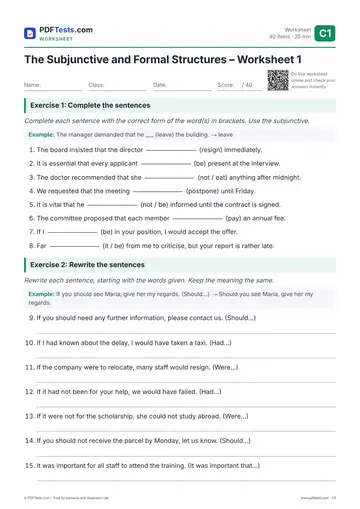
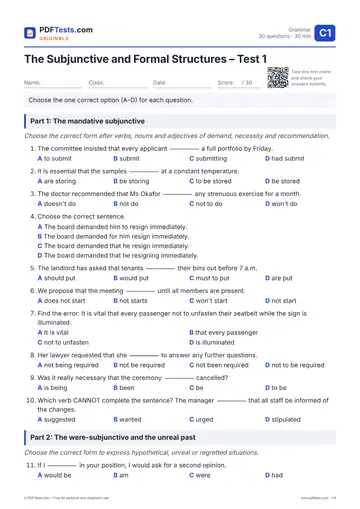
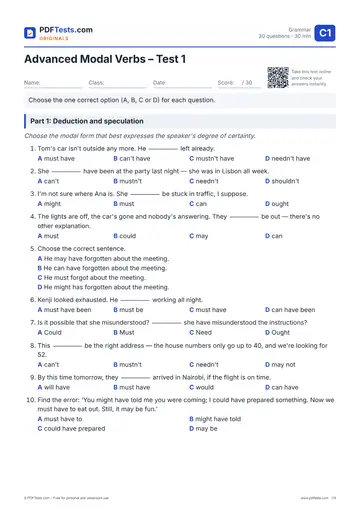
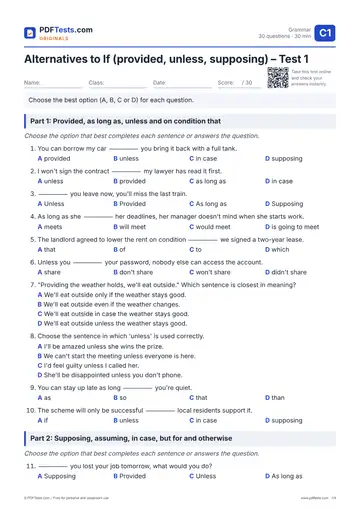
The English subjunctive is a verb form that shows something is required, desired or imagined rather than stated as fact. It appears in formal structures such as The court ordered that he be released and If I were in charge…. At C1 you need it for formal writing, reports, academic English and exam tasks, and you need to recognise it in fixed expressions.
What the subjunctive looks like
English has no special subjunctive endings. Instead, it uses forms you already know in unexpected places:
- The present (mandative) subjunctive uses the base form of the verb for every person: that she go, that he be, that they not attend.
- The were-subjunctive uses were for all persons in unreal situations: if I were, as if she were.
- Formulaic subjunctives survive in fixed expressions: God save the King, Be that as it may, Come what may.
The key sign of the present subjunctive is what is missing: no third-person -s, no do/does, no tense change.
The mandative subjunctive (demands, suggestions, necessity)
Use the base form in a that-clause after words expressing a demand, recommendation, proposal or necessity. It is standard in American English and in formal British English.
- The report recommends that the company review its safety procedures.
- She insisted that he be present at the meeting.
- We request that all phones be switched off.
- It is essential that every candidate arrive on time.
Trigger words
| Type | Common examples |
|---|---|
| Verbs | suggest, recommend, propose, insist, demand, request, require, urge, advise, ask, order, command |
| Nouns | suggestion, recommendation, proposal, requirement, demand, insistence, request, condition |
| Adjectives | essential, vital, crucial, important, imperative, necessary, advisable, desirable, urgent |
Nouns usually take that + subjunctive in apposition: The requirement that applicants hold a degree was dropped.
Form
| Clause type | Structure | Example |
|---|---|---|
| Affirmative | subject + base form | They demanded that he resign. |
| Negative | subject + not + base form | I suggest that she not mention the budget. |
| Passive | subject + be + past participle | It is vital that the data be stored securely. |
| Continuous (rare) | subject + be + -ing | It is important that you be waiting at the gate. |
Note the negative: not comes directly before the verb, with no do. that she doesn’t mention is not the subjunctive.
The tense of the main verb does not affect the subjunctive. Past or present, the base form stays the same:
- The doctor recommends that he rest.
- The doctor recommended that he rest.
The British alternatives: should and the indicative
British English often replaces the subjunctive with should + base form, which is equally correct and slightly less formal:
- The committee proposed that the deadline should be extended.
- It is vital that everyone should understand the risks.
In informal British English, speakers also use an ordinary tense (the indicative): I suggest that he talks to his manager. This is common in speech but avoid it in formal writing and exam answers, where the subjunctive or should is safer.
The were-subjunctive (unreal situations)
Use were for all persons, including I/he/she/it, when describing hypothetical or imagined situations.
| Structure | Example |
|---|---|
| If + were | If I were you, I’d accept the offer. |
| wish / if only + were | I wish she were here to see this. |
| as if / as though + were | He talks as if he were an expert. |
| suppose / imagine + were | Suppose the plan were rejected — what then? |
| were to + base form | If the rate were to rise, demand would fall. |
Was is widely used in informal speech (If I was you…), but were is expected in formal writing. The fixed phrase If I were you almost always keeps were. For more on these patterns, see our guides to the first and second conditional and wish and if only.
Were to for remote possibilities
Were to + base form makes a future condition sound more unlikely or more tactful:
- If the minister were to resign, there would be an election.
- If you were to reconsider, we would be very grateful.
Inverted conditionals
In formal English, if can be dropped and were, should or had moved to the front:
- Were it not for the funding, the project would collapse. (= If it were not for…)
- Were the company to expand, it would need new premises.
- Should you require assistance, please contact reception.
- Had it not been for her advice, I would have failed.
These structures are covered in detail in our guides to inversion and alternatives to if.
Other formal structures with unreal or subjunctive meaning
It’s (high/about) time + past simple
This uses a past form with present meaning to say something should already be happening:
- It’s high time the council repaired these roads.
- It’s about time we left.
The alternative It’s time for us to leave is neutral; the past-tense version adds criticism or urgency.
Would rather / would sooner + past simple
When the subject of the second clause is different, use a past form for present or future preference:
- I’d rather you didn’t smoke in here.
- She’d sooner we met next week.
Lest
Lest is formal and means “so that… not” or “for fear that”. It takes the subjunctive or should:
- He wrote everything down lest he forget the details.
- Keep the gate closed lest the dogs should escape.
Lest already contains the negative idea, so do not add not.
Concessive subjunctive: be it… or… / whether it be…
- Every citizen, be it a minister or a student, must obey the law.
- All forms of transport, whether it be rail or road, will be affected.
Fixed (formulaic) expressions
| Expression | Meaning / use |
|---|---|
| Be that as it may | Even so; despite that |
| Come what may | Whatever happens |
| Suffice it to say | I will only say that… |
| If need be | If necessary |
| So be it | I accept it, even reluctantly |
| Heaven forbid | I hope this never happens |
| Far be it from me to… | I don’t want to (seem to) criticise, but… |
| Long live the King | Formal wish or toast |
| As it were | So to speak |
- Be that as it may, the decision is final.
- Far be it from me to interfere, but are you sure about this?
Subjunctive or indicative? A key comparison
Some verbs, especially insist and suggest, have two meanings. The verb form after them shows which meaning you intend.
| Meaning | Verb form | Example |
|---|---|---|
| insist = demand | subjunctive | She insisted that he be paid. (She demanded it.) |
| insist = claim strongly | indicative | She insisted that he was innocent. (She claimed it.) |
| suggest = propose | subjunctive | The data suggest that we revise the model. |
| suggest = indicate | indicative | The data suggest that the model is flawed. |
Ask yourself: is this about what should happen (subjunctive) or what is true (indicative)?
Signal words at a glance
Watch for these cues in reading and exam tasks:
- recommend that, insist that, it is essential that, the requirement that → base form
- if, as if, wish, suppose, imagine + I/he/she/it → were in formal style
- it’s high time, would rather + different subject → past simple
- lest → base form or should
- Were…, Should…, Had… at the start of a sentence → inverted conditional
Common mistakes
- ✗ The board recommended that she attends the course. → ✓ …that she attend the course. — The mandative subjunctive has no -s in the third person.
- ✗ They insisted that he doesn’t leave. → ✓ …that he not leave. — The negative subjunctive uses not + base form, with no do.
- ✗ I suggest you to apply early. → ✓ I suggest (that) you apply early. — Suggest and recommend never take object + to-infinitive.
- ✗ It is vital that the forms are being signed. → ✓ …that the forms be signed. — The passive subjunctive is be + past participle.
- ✗ If I would be you, I’d complain. → ✓ If I were you… — Would does not go in the if-clause.
- ✗ It’s high time we go home. → ✓ It’s high time we went home. — It’s time + subject takes the past simple.
- ✗ I’d rather you don’t tell anyone. → ✓ I’d rather you didn’t tell anyone. — Would rather + different subject takes a past form.
- ✗ Take notes lest you don’t forget. → ✓ …lest you forget. — Lest is already negative.
- ✗ Were it not the weather, we’d go. → ✓ Were it not for the weather… — The fixed phrase needs for.
Quick check
Complete or correct each sentence.
- The committee proposed that the deadline ___ (extend) by a week.
- It is vital that she ___ (not / miss) the briefing.
- ___ it not for your support, I would give up.
- It’s high time the government ___ (take) action on housing.
- Correct the error: He suggested me to apply before Friday.
Answers
- be extended (or should be extended)
- not miss (or should not miss)
- Were
- took
- He suggested (that) I apply before Friday. (or …that I should apply…)
Next step
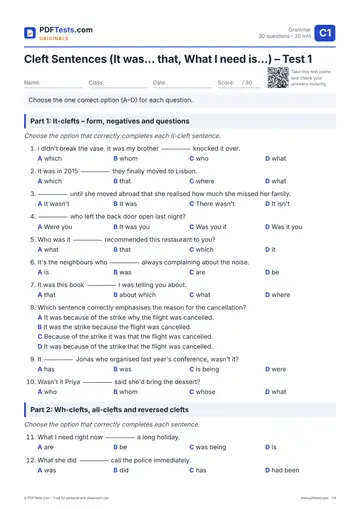
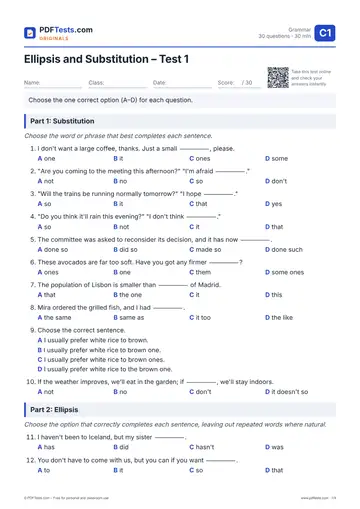
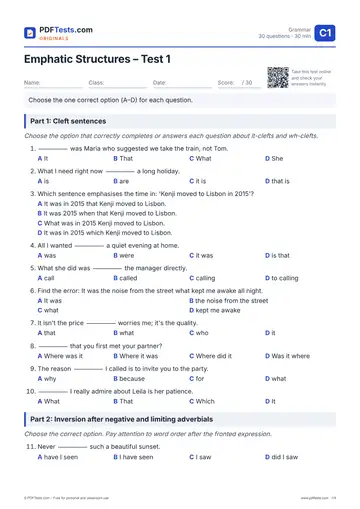
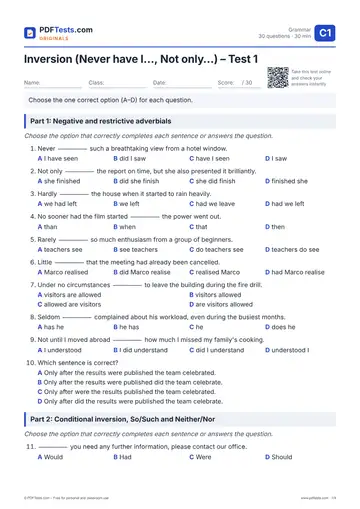
You now know the three forms of the subjunctive and the formal structures that go with them. Put them into practice with our C1 Subjunctive and Formal Structures test, which mixes mandative clauses, were-forms, inverted conditionals and fixed expressions. Pay special attention to negatives and passives, as these are where most errors occur, then revisit any section above where you lost marks.
Was this page helpful?
What was the problem?
Thank you for your feedback!