Advanced modal verbs are the C1-level uses of modals such as will, would, should, might and need, together with semi-modals like be bound to, be to and might as well. They express precise meanings that basic modals cannot: criticism, annoyance, unnecessary past actions, confident expectation and formal arrangements. You will meet them constantly in natural conversation, journalism and formal writing.
What changes at C1
At lower levels you learn one main meaning per modal. At C1 you need to handle three extra layers:
- Secondary meanings, such as will for habits or should for expectation.
- Combined forms, such as must have been doing or should have been told.
- Semi-modals, which are not true modals in form but work like them in meaning.
To review the basics first, see our guides to must, have to and should and modals of deduction in the past.
Form: modals with continuous, perfect and passive infinitives
Every modal is followed by a bare infinitive (no to), but that infinitive can take several forms.
| Form | Structure | Example |
|---|---|---|
| Simple | modal + verb | She might call later. |
| Continuous | modal + be + -ing | He must be working from home today. |
| Perfect | modal + have + past participle | They can’t have seen us. |
| Perfect continuous | modal + have been + -ing | You should have been revising, not gaming. |
| Passive | modal + be + past participle | The form must be signed by both parties. |
| Perfect passive | modal + have been + past participle | We should have been warned about the delays. |
Negatives add not after the modal: needn’t have, shouldn’t be, mightn’t have (the last is mainly British).
Questions invert the modal and subject: Could she have forgotten? Should we have been told?
Unnecessary actions: needn’t have vs didn’t need to
This is one of the most tested contrasts at C1.
- needn’t have + past participle: the action happened, but it was unnecessary. I needn’t have cooked so much – half the guests cancelled.
- didn’t need to + infinitive: there was no necessity. Usually the action did not happen, but context decides. I didn’t need to cook – we ordered pizza.
| Structure | Did the action happen? | Example |
|---|---|---|
| needn’t have done | Yes | You needn’t have paid for me. |
| didn’t need to do | Usually no | I didn’t need to pay – it was free. |
Criticism, regret and missed chances
Should have / ought to have say that a past action was wrong or that a good action was missed.
- You should have backed up your files.
- I ought to have replied sooner.
Might have / could have can express irritated criticism, with stress on the modal. This is a complaint, not a statement of possibility.
- You might have told me the meeting was cancelled.
- You could at least have called.
Could have also describes an unrealised possibility or ability.
- She could have been a professional pianist, but she chose medicine.
- That was reckless – you could have been killed.
Was/were to have + past participle is a formal way to describe a plan that did not happen.
- The minister was to have opened the bridge, but she fell ill.
Expectation and certainty about the future
- be bound to / be sure to / be certain to show strong confidence: It’s bound to rain on the day of the barbecue. She’s sure to get the job.
- should / ought to show reasonable expectation of a normal or welcome outcome: The parcel should arrive by Friday. That ought to be enough paint.
- be likely / unlikely to express probability: Prices are unlikely to fall this year.
Avoid should for unwelcome predictions. We should lose on Saturday sounds as if losing is a good idea. Say We’ll probably lose on Saturday.
Will and would for habits and behaviour
Will can describe characteristic, predictable behaviour in the present.
- She’ll sit for hours reading if you let her.
- Oil will float on water.
Stressed will (never contracted) shows annoyance at someone’s habit.
- He will leave his dirty mugs on my desk.
Would describes repeated past actions. Unlike used to, it cannot describe past states.
- Every summer we’d drive down to the coast.
Stressed would comments on a single past action that was typical of someone: “He forgot her birthday.” “He would.”
Won’t / wouldn’t express refusal – even for machines and objects.
- The car won’t start.
- He wouldn’t listen to a word I said.
Might as well / may as well
Use might as well or may as well + bare infinitive when there is no better option, or when the choice makes little difference.
- The last bus has gone, so we might as well walk.
- We may as well finish the report now – we’re here anyway.
With a perfect infinitive it says that a past action was pointless: The talk was so dull I might as well have stayed at home.
Be to and be supposed to
Be to + infinitive is formal. It is common in news reports and official instructions.
- Official arrangements: The president is to visit Japan next month.
- Orders: You are to report to reception at 9 a.m.
- Conditions: If we are to meet the deadline, we need more staff.
- Destiny (past): He left for Paris, a city he was never to see again.
Be supposed to expresses what is expected, arranged or generally believed – often when reality is different.
- I’m supposed to be on a diet.
- This restaurant is supposed to be excellent.
- You weren’t supposed to tell anyone.
Should and shall in formal and hypothetical uses
Putative should appears after adjectives and nouns of emotion or judgement, especially in British English.
- It’s strange that she should say that.
- I was surprised that he should resign so suddenly.
After verbs like suggest, insist and recommend, should is an alternative to the subjunctive: They insisted that we should leave. For the full picture, see our guide to the subjunctive and formal structures.
Should in conditions makes a possibility sound less likely or more polite.
- If you should need anything, just ask.
- Inverted (formal): Should you require further information, please contact us.
Shall survives in offers and suggestions (Shall I open the window?) and in legal documents to express obligation: The tenant shall pay rent on the first day of each month.
Need and dare as modal verbs
Need and dare can act as ordinary verbs (with do and to) or as modals (no do, no to, no -s). Modal use is mainly found in negatives and questions and sounds more formal.
| Ordinary verb | Modal verb |
|---|---|
| She doesn’t need to come. | She needn’t come. |
| Do we need to book? | Need we book? |
| He didn’t dare to ask. | He dared not ask. |
| – | How dare you speak to me like that? |
| – | I dare say you’re right. (= I suppose) |
Past ability: could vs was able to / managed to
Could describes general ability in the past: I could swim when I was five.
For success on one specific occasion, use was able to or managed to: The fire spread quickly, but everyone was able to escape.
Two exceptions: negative couldn’t works for single occasions (I couldn’t get a ticket), and so does could with sense verbs (I could smell smoke).
Common mistakes
- ✗ You needn’t to have worried. → ✓ You needn’t have worried. — Modal need takes a bare infinitive.
- ✗ I needn’t have gone, so I stayed at home. → ✓ I didn’t need to go, so I stayed at home. — Needn’t have means the action actually happened.
- ✗ After hours of searching, we could find the hotel. → ✓ After hours of searching, we managed to find the hotel. — Use managed to or was able to for one specific success.
- ✗ You should have came earlier. → ✓ You should have come earlier. — Have is followed by the past participle.
- ✗ He would be very shy as a child. → ✓ He used to be very shy as a child. — Would for past habits works with actions, not states.
- ✗ We haven’t trained, so we should lose on Saturday. → ✓ We haven’t trained, so we’ll probably lose on Saturday. — Should for expectation suits welcome or normal outcomes.
- ✗ It’s bound raining tomorrow. → ✓ It’s bound to rain tomorrow. — Be bound is followed by to + infinitive.
- ✗ We might as well to take a taxi. → ✓ We might as well take a taxi. — Might as well takes a bare infinitive.
Quick check
- Complete: I ___ (not need / buy) a new charger – I found my old one the next day.
- Complete with a form of be to: The Prime Minister ___ address the nation tonight.
- Complete: There’s nothing on TV, so we might ___ go to bed.
- Correct the sentence: Despite the snow, we could reach the summit.
- Rewrite using stressed will: My flatmate always plays loud music at midnight, and it annoys me.
Answers
- needn’t have bought (the action happened but was unnecessary)
- is to
- as well
- Despite the snow, we managed to / were able to reach the summit.
- My flatmate will play loud music at midnight.
Next step
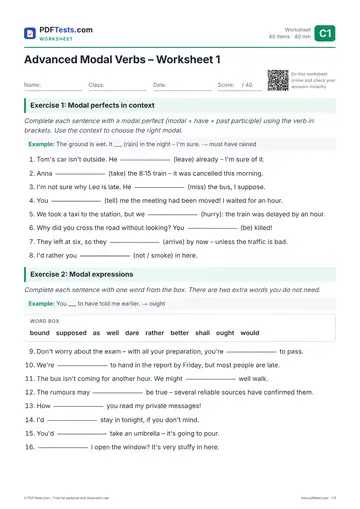
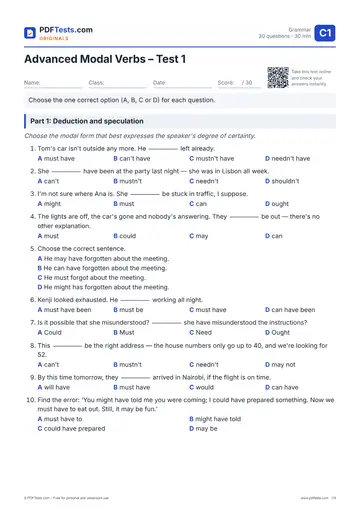
Now put these structures into practice: test yourself with our C1 Advanced Modal Verbs test, paying special attention to needn’t have vs didn’t need to and the perfect and passive forms. If the past forms still feel shaky, try the B2 Modals of Deduction in the Past test first, then explore more advanced grammar in our English C1 tests.
Practise this topic: Advanced Modal Verbs
Was this page helpful?
What was the problem?
Thank you for your feedback!