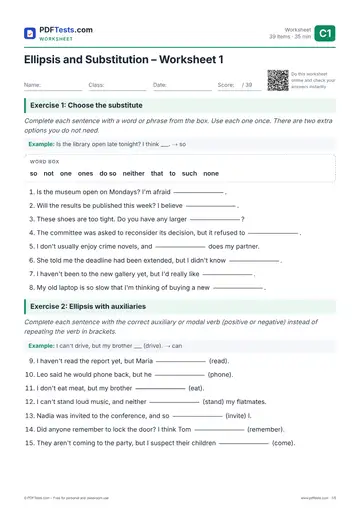
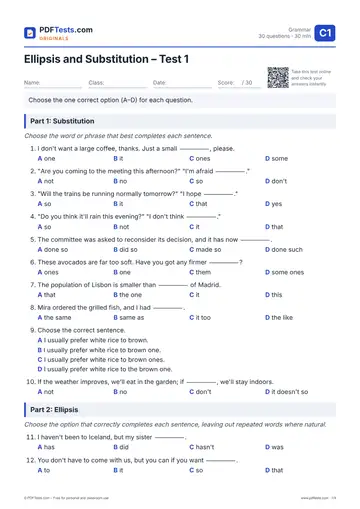
Ellipsis means leaving out words that the listener can recover from the context. Substitution means replacing a word or phrase with a short form such as one, do or so. Both help you avoid repetition. Fluent speakers use them constantly in conversation and in writing, and at C1 you are expected to use them naturally.
Why ellipsis and substitution matter
Compare these two replies:
- A: Are you coming to the meeting? B: Yes, I am coming to the meeting.
- A: Are you coming to the meeting? B: Yes, I am.
The first reply is grammatically correct but sounds robotic. The second is what a native speaker would say. The missing words, coming to the meeting, are clear from the question.
There are two main tools:
- Substitution: replace something with a substitute word. I need a new laptop. This one is too slow.
- Ellipsis: leave something out completely. She said she’d help, and she did.
Substitution
one and ones
Use one (singular) and ones (plural) to replace a countable noun that has already been mentioned.
- I don’t like this jacket. Have you got a darker one?
- The old phones were better than the new ones.
- Which mug is yours? The one with the chip in it.
One/ones usually needs something before or after it: an adjective, this/that, which, the … with/that …. You cannot use one for uncountable nouns.
- I prefer red wine to white. (not white one)
- We need some advice, and good advice is hard to find.
After possessives, use the possessive pronoun or the ’s form on its own:
- That’s not my umbrella. Mine is blue.
- My car is older than Jane’s.
do, do so, do it, do that
Do can replace a verb phrase, especially in British English after a modal or auxiliary.
- Will you call him tonight? I might (do).
- She hasn’t replied yet, but she will (do).
Do so is more formal and refers to a deliberate action. It is common in written English.
- Applicants who wish to withdraw may do so in writing.
- He was asked to resign, and he did so the following day.
Do it and do that refer to a specific, identifiable action. That adds emphasis or contrast.
- I meant to fix the shelf, but I never got round to doing it.
- You want me to apologise to him? I’m not doing that.
Do so and do it are not used with state verbs such as like, know or believe. Use ellipsis instead: She likes jazz and I do too.
so and not
So replaces a positive clause and not replaces a negative clause after verbs of thinking and expecting.
| Verb | Positive | Negative |
|---|---|---|
| think | I think so. | I don’t think so. |
| hope | I hope so. | I hope not. |
| be afraid | I’m afraid so. | I’m afraid not. |
| expect | I expect so. | I don’t expect so. / I expect not. |
| suppose | I suppose so. | I don’t suppose so. / I suppose not. |
| believe | I believe so. | I don’t believe so. / I believe not. |
| guess | I guess so. | I guess not. |
Notes:
- With think, expect, suppose and believe, the negative auxiliary form (I don’t think so) is more common. I think not sounds formal or old-fashioned.
- With hope and be afraid, only not is possible: I hope not, never I don’t hope so.
- So and not also follow if: Are you free on Friday? If so, let’s meet. If not, we’ll try next week.
- So can appear with say, tell and seem: Is the shop closed? It seems so. / Who says so?
so, neither and nor with auxiliaries
To agree with a statement, use so (positive) or neither/nor (negative) followed by inverted auxiliary + subject.
- I’ve been to Lisbon. So have I.
- She can’t drive. Neither can I. / Nor can I.
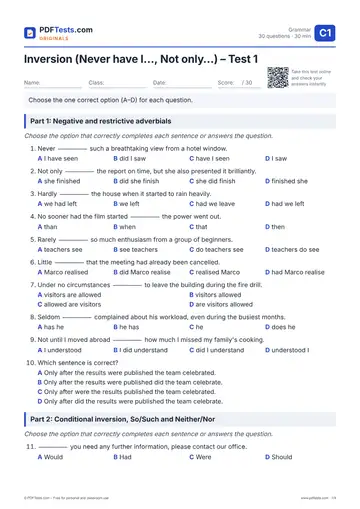
This inversion is a fixed pattern; for more inverted structures, see our guide to inversion after negative adverbials.
Ellipsis
After auxiliaries and modals
The most frequent type of ellipsis keeps the auxiliary or modal and drops what follows.
- Have you finished the report? Yes, I have.
- I can’t come tonight, but Sam can.
- She earns more than I do.
- He said he’d be on time, and he was.
The word you keep depends on the structure you are replacing:
| Full verb phrase | Ellipted form |
|---|---|
| present/past simple: works / worked | do/does/did |
| be as main verb or continuous: is working | am/is/are/was/were |
| perfect: has finished | have/has/had |
| modal: should go | should, can, might… |
| modal + be: should be ready | should be |
| modal + perfect: could have told | could have |
Two rules learners often miss:
- Keep be after a modal. Is the food ready? It should be. (not It should.)
- Keep have after a modal in past reference. Did she apologise? She should have.
Also, do not contract the auxiliary at the end of a clause: Yes, I have. (not Yes, I’ve.). Short answers and question tags follow the same auxiliary logic.
Ellipsis after to
After verbs followed by a to-infinitive, you can drop the verb phrase but keep to.
- Would you like to join us? I’d love to.
- I didn’t want to go, but I had to.
- You don’t have to stay if you don’t want to.
If the dropped verb is be or perfect have, keep it:
- She isn’t as confident as she used to be.
- I haven’t finished the essay, but I ought to have by now.
With want and like after if, you can drop to altogether: Come with us if you want. But after would like, would love, need and have, to is required.
Ellipsis in coordinated clauses
When two clauses are joined with and, but or or, you can omit repeated subjects, verbs and auxiliaries in the second clause.
- She opened the door and (she) walked in.
- I’ve read the book but (I) haven’t seen the film.
- They may have left or (they may have) gone to the station.
In more formal or written English, you can even drop the main verb in the middle of the second clause. This is sometimes called gapping.
- Anna ordered the fish and Marco (ordered) the pasta.
- The first group finished in an hour, the second (finished) in two.
Ellipsis in noun phrases
You can drop a noun after determiners, numbers, superlatives and possessives when it is obvious.
- I bought three tickets, but we only needed two.
- Of all the candidates, she was the most experienced.
- Some students passed; others didn’t.
Situational ellipsis in informal speech
In conversation and messages, speakers often drop the subject and auxiliary at the start of a sentence when the meaning is clear.
- (Have you) Seen my keys?
- (It) Sounds good to me.
- (I’m) Sorry, (I) can’t make it.
- (Do you) Want a coffee?
This is natural in speech and casual writing, but avoid it in formal essays and emails.
Short questions are another form of ellipsis: Someone called for you. Who? / Let’s leave early. Why? / I’m not going. Why not?
Substitution vs ellipsis: which to choose
Often both are possible, with small differences in register or emphasis.
| Situation | Substitution | Ellipsis |
|---|---|---|
| Repeating a countable noun | a red one | the red (formal or after superlatives) |
| Repeating a verb phrase | He did so (formal) | He did (neutral) |
| Repeating a clause after think, hope | I think so | not possible |
| Answering a yes/no question | not usual | Yes, I have. |
So vs it: so replaces a clause after verbs of thinking; it replaces a noun or a specific fact. Will it rain? I think so. but The rain? I hate it.
Do so vs do it: do so repeats the general action in formal style; do it points to a specific task. Report any errors. If you fail to do so, … vs Who broke the printer? Tom did it.
If you want to change the focus of a sentence rather than shorten it, cleft sentences are the tool to use.
Common mistakes
- ✗ I don’t hope so. → ✓ I hope not. — Hope takes not, not a negative auxiliary.
- ✗ Would you like to come? Yes, I’d love. → ✓ Yes, I’d love to. — Keep to after would love/like.
- ✗ Is it ready? It should. → ✓ It should be. — Keep be after a modal.
- ✗ Did he warn you? He should. → ✓ He should have. — Past reference needs have.
- ✗ Have you finished? Yes, I’ve. → ✓ Yes, I have. — No contraction at the end of a clause.
- ✗ I prefer red wine to white one. → ✓ I prefer red wine to white. — One replaces only countable nouns.
- ✗ These aren’t my ones. → ✓ These aren’t mine. — Use the possessive pronoun, not my + ones.
- ✗ He loves jazz and I do so too. → ✓ He loves jazz and so do I. — Do so is not used with state verbs.
- ✗ She can’t swim, and neither I can. → ✓ …and neither can I. — Invert after so/neither/nor.
Quick check
Complete each reply with one or two words.
- Is the train delayed? I’m afraid ___.
- Would you like to come with us? I’d love ___.
- Has she paid the invoice? She should ___ by now.
- I don’t like these shoes. Can I see the black ___?
- He promised he would call me, and he ___.
Answers
- so (or not, depending on the meaning)
- to
- have
- ones
- did
Next step
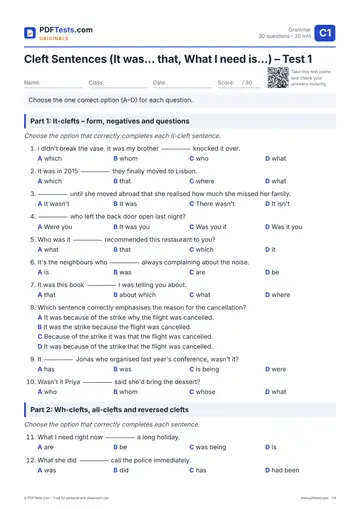
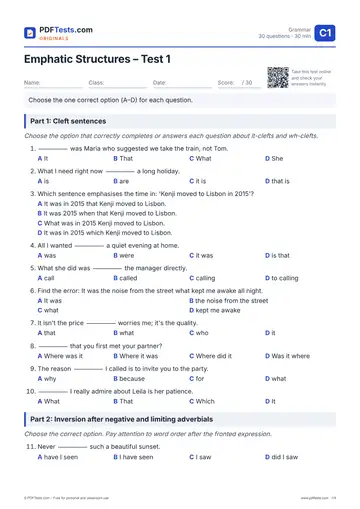
You now know the main patterns: one/ones, do (so), so/not, auxiliary ellipsis and ellipsis after to. The best way to make them automatic is to spot what can be left out in real sentences and practise choosing the right auxiliary. Test yourself with our C1 Ellipsis and Substitution test, then browse the other C1 English tests to practise related structures such as inversion, cleft sentences and emphasis.
Practise this topic: Ellipsis and Substitution
Was this page helpful?
What was the problem?
Thank you for your feedback!