PDFTests Originals

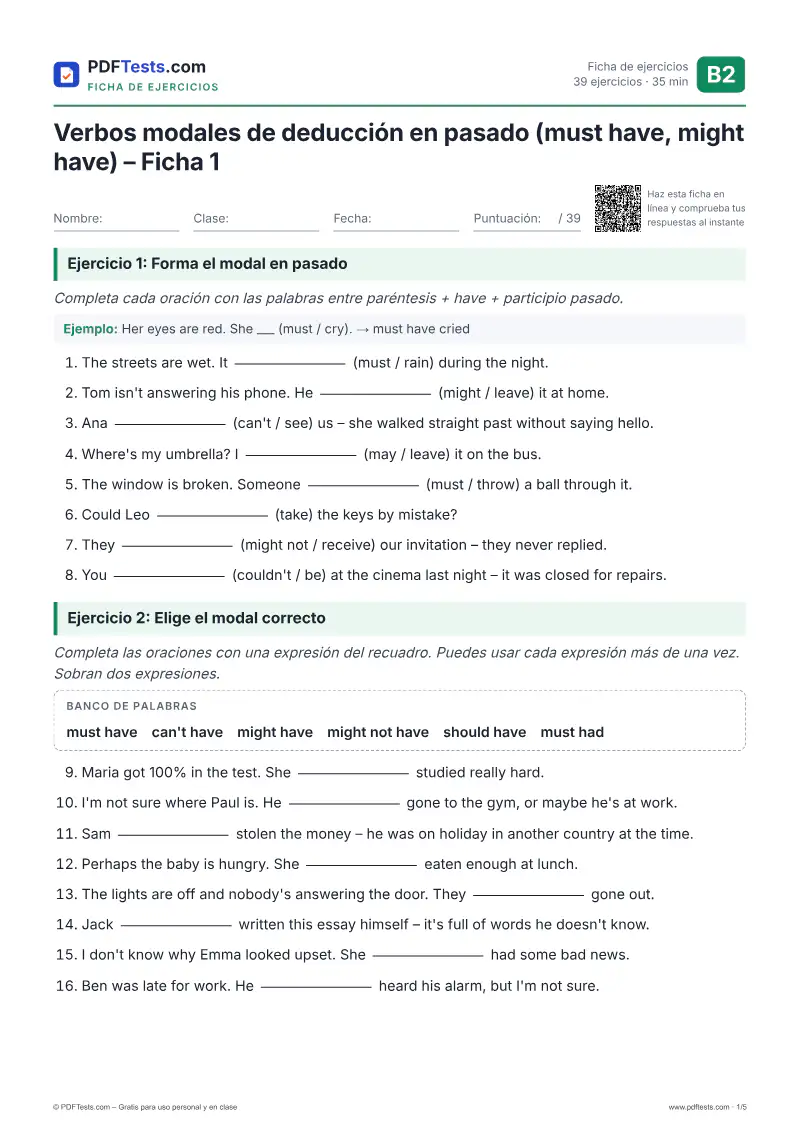
Verbos modales de deducción en pasado (must have, might have) – Ficha 1

B2 Intermedio alto FichaInglés

Esta ficha sirve para practicar los verbos modales de deducción en pasado (must have, might/may/could have, can't/couldn't have + participio pasado), que usamos para expresar el grado de certeza sobre hechos pasados. Trabaja la forma, el significado, la negación y las preguntas, y está pensada para alumnos de nivel B2, tanto en clase como en casa.
ejercicios
39
Tiempo
35 min
PDF
5 páginas
Soluciones
Incluidas
  • 100 % gratis
  • Sin registro
  • PDF A4 listo para imprimir
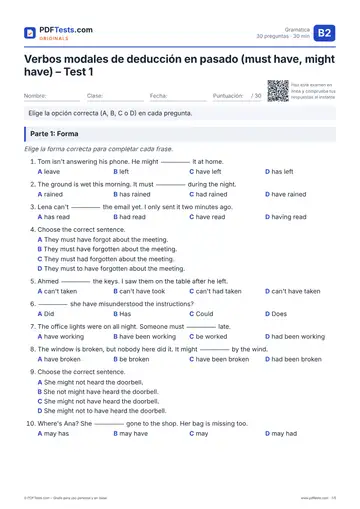
Vista previa de la página 1: Verbos modales de deducción en pasado (must have, might have) – Ficha 1 Abrir PDF

Haz la ficha en línea

Escribe tus respuestas y pulsa «Comprobar respuestas». Se aceptan otras respuestas correctas.

Ejercicio 1: Forma el modal en pasado

Completa cada oración con las palabras entre paréntesis + have + participio pasado.

Ejemplo: Her eyes are red. She ___ (must / cry). → must have cried

  1. The streets are wet. It (must / rain) during the night.

  2. Tom isn't answering his phone. He (might / leave) it at home.

  3. Ana (can't / see) us – she walked straight past without saying hello.

  4. Where's my umbrella? I (may / leave) it on the bus.

  5. The window is broken. Someone (must / throw) a ball through it.

  6. Could Leo (take) the keys by mistake?

  7. They (might not / receive) our invitation – they never replied.

  8. You (couldn't / be) at the cinema last night – it was closed for repairs.

Ejercicio 2: Elige el modal correcto

Completa las oraciones con una expresión del recuadro. Puedes usar cada expresión más de una vez. Sobran dos expresiones.

Banco de palabras must havecan't havemight havemight not haveshould havemust had

  1. Maria got 100% in the test. She studied really hard.

  2. I'm not sure where Paul is. He gone to the gym, or maybe he's at work.

  3. Sam stolen the money – he was on holiday in another country at the time.

  4. Perhaps the baby is hungry. She eaten enough at lunch.

  5. The lights are off and nobody's answering the door. They gone out.

  6. Jack written this essay himself – it's full of words he doesn't know.

  7. I don't know why Emma looked upset. She had some bad news.

  8. Ben was late for work. He heard his alarm, but I'm not sure.

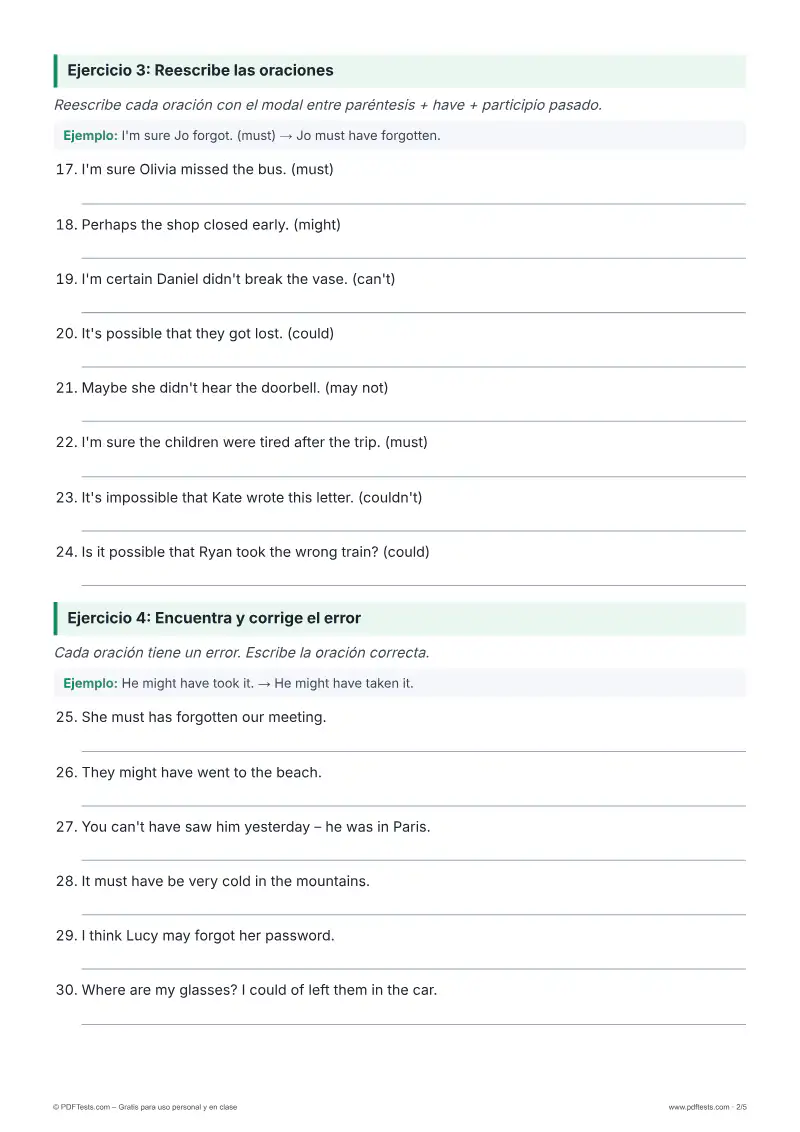
Ejercicio 3: Reescribe las oraciones

Reescribe cada oración con el modal entre paréntesis + have + participio pasado.

Ejemplo: I'm sure Jo forgot. (must) → Jo must have forgotten.

  1. I'm sure Olivia missed the bus. (must)

  2. Perhaps the shop closed early. (might)

  3. I'm certain Daniel didn't break the vase. (can't)

  4. It's possible that they got lost. (could)

  5. Maybe she didn't hear the doorbell. (may not)

  6. I'm sure the children were tired after the trip. (must)

  7. It's impossible that Kate wrote this letter. (couldn't)

  8. Is it possible that Ryan took the wrong train? (could)

Ejercicio 4: Encuentra y corrige el error

Cada oración tiene un error. Escribe la oración correcta.

Ejemplo: He might have took it. → He might have taken it.

  1. She must has forgotten our meeting.

  2. They might have went to the beach.

  3. You can't have saw him yesterday – he was in Paris.

  4. It must have be very cold in the mountains.

  5. I think Lucy may forgot her password.

  6. Where are my glasses? I could of left them in the car.

  7. Could he has taken my phone by mistake?

  8. The match must have finish late, because they didn't get home until midnight.

Ejercicio 5: Ordena las palabras

Ordena las palabras para formar oraciones o preguntas.

Ejemplo: have / he / must / left → He must have left.

  1. have / tired / she / must / been

  2. key / have / might / he / the / lost

  3. can't / they / the / have / message / read

  4. have / the / could / door / someone / opened / ?

  5. not / may / understood / have / the / question / she

  6. left / have / earlier / must / the / train

  7. been / couldn't / him / it / have

¿Te ha resultado útil esta página?

Informar de un error

¿Has visto una respuesta incorrecta, una errata o una explicación poco clara? Avísanos y lo corregiremos.

Vista previa

Sobre este examen

Ficha de inglés B2 en PDF sobre modales de deducción en pasado: must have, might have, may have, could have, can't have. Cinco ejercicios con soluciones.

Temas

Verbos modales de deducciónmust have / can't havemight / may / could haveParticipios pasadosEspecular sobre el pasado

Notas para el profesor

Para empezar, plantee una situación misteriosa (por ejemplo, un aula vacía) y pida a los alumnos que especulen sobre lo que ha pasado, clasificando sus ideas en «seguro», «posible» e «imposible». Entre los errores típicos están usar el pasado simple en lugar del participio pasado (might have went), escribir «could of» y usar mustn't have en lugar de can't have para expresar certeza negativa. Como actividad de ampliación, entregue a cada pareja una serie de pistas en imágenes y pídales que redacten una breve explicación del «crimen» con al menos cinco modales en pasado.

Todos los exámenes de Inglés B2 →