PDFTests Originals

Test de nivel de inglés B2 – Test 2

B2 Intermedio alto Prueba de nivelInglés

Este test de nivel B2 evalúa una amplia variedad de gramática y vocabulario de nivel intermedio alto, desde los tiempos verbales y los verbos modales hasta la formación de palabras, los phrasal verbs y las estructuras avanzadas. Termina con un texto breve y seis preguntas de comprensión lectora. Está pensado para docentes y para quienes estudian por su cuenta y quieren saber si un alumno domina con seguridad el nivel B2.
Preguntas
50
Tiempo
60 min
PDF
6 páginas
Soluciones
Incluidas
  • 100 % gratis
  • Sin registro
  • PDF A4 listo para imprimir
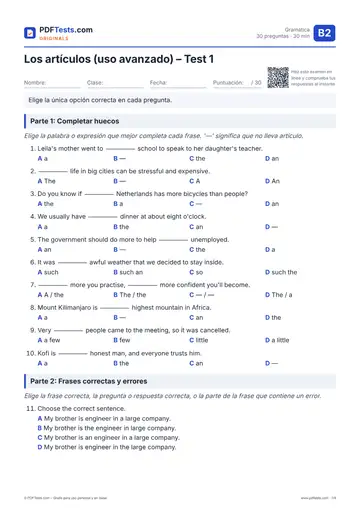
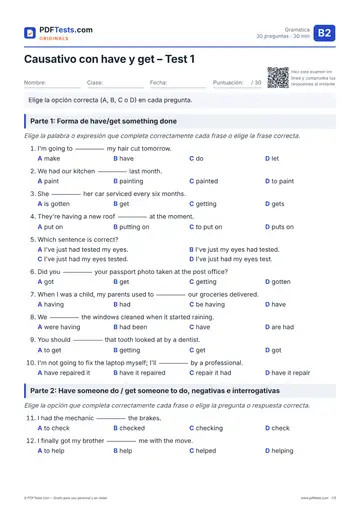
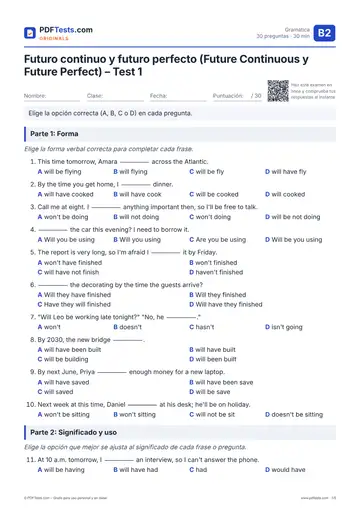
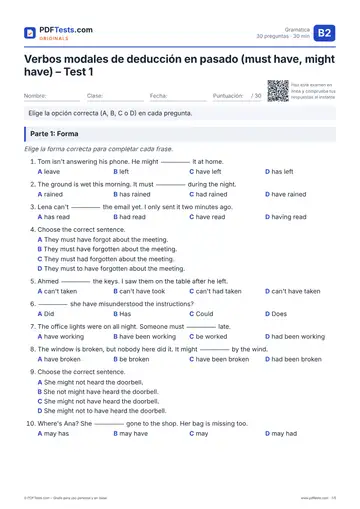
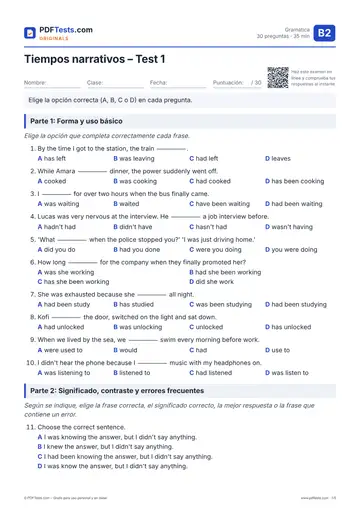
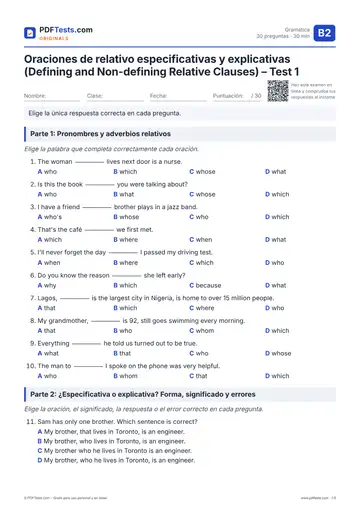
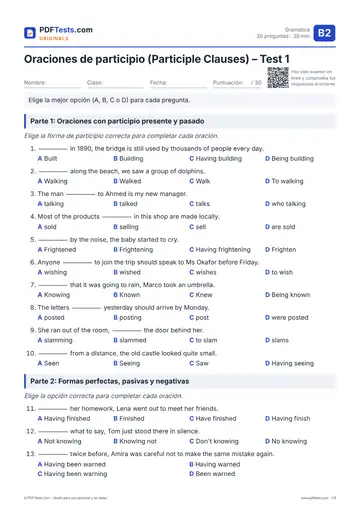
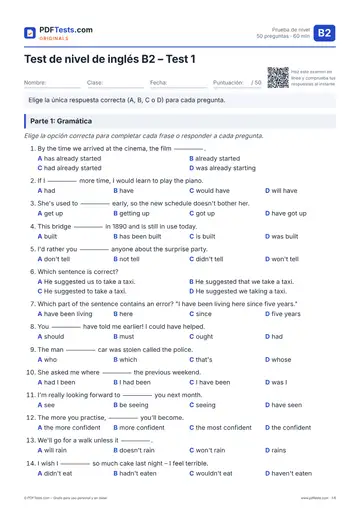
Vista previa de la página 1: Test de nivel de inglés B2 – Test 2 Abrir PDF

Haz el examen en línea

Elige la única respuesta correcta (A, B, C o D) para cada pregunta. Elige tus respuestas y pulsa «Comprobar respuestas».

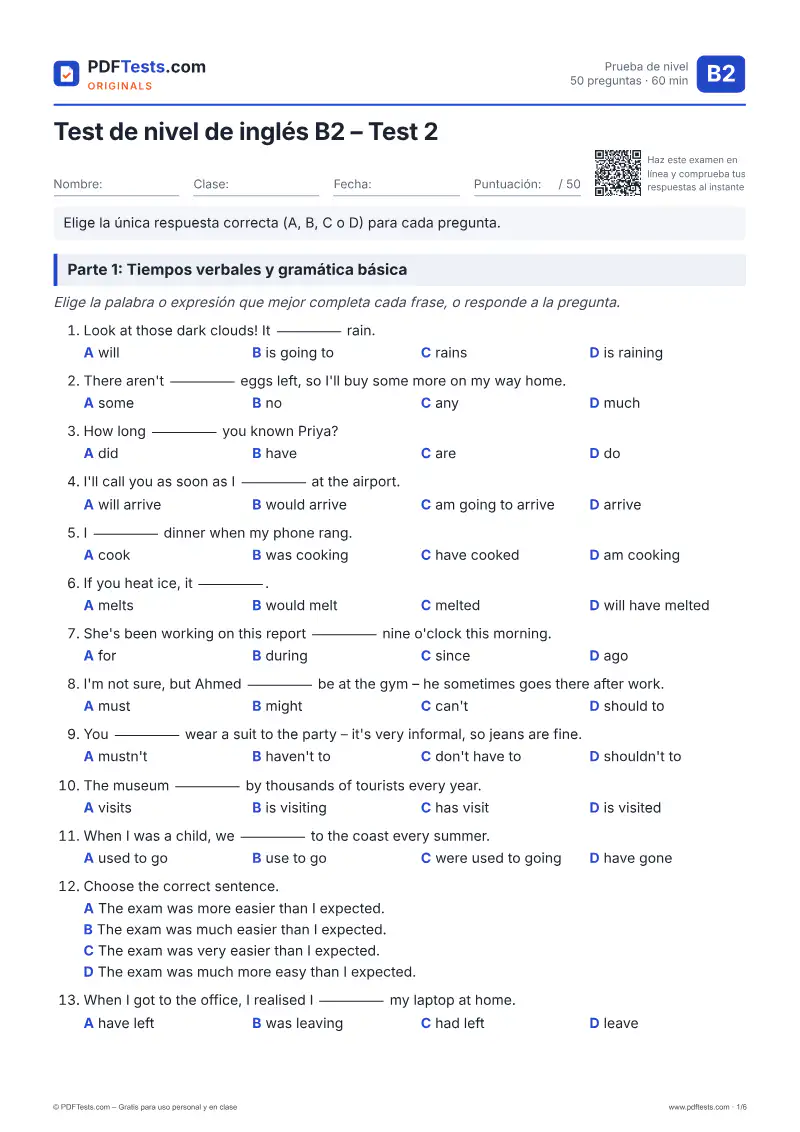
Parte 1: Tiempos verbales y gramática básica

Elige la palabra o expresión que mejor completa cada frase, o responde a la pregunta.

  1. Look at those dark clouds! It _____ rain.

  2. There aren't _____ eggs left, so I'll buy some more on my way home.

  3. How long _____ you known Priya?

  4. I'll call you as soon as I _____ at the airport.

  5. I _____ dinner when my phone rang.

  6. If you heat ice, it _____.

  7. She's been working on this report _____ nine o'clock this morning.

  8. I'm not sure, but Ahmed _____ be at the gym – he sometimes goes there after work.

  9. You _____ wear a suit to the party – it's very informal, so jeans are fine.

  10. The museum _____ by thousands of tourists every year.

  11. When I was a child, we _____ to the coast every summer.

  12. Choose the correct sentence.

  13. When I got to the office, I realised I _____ my laptop at home.

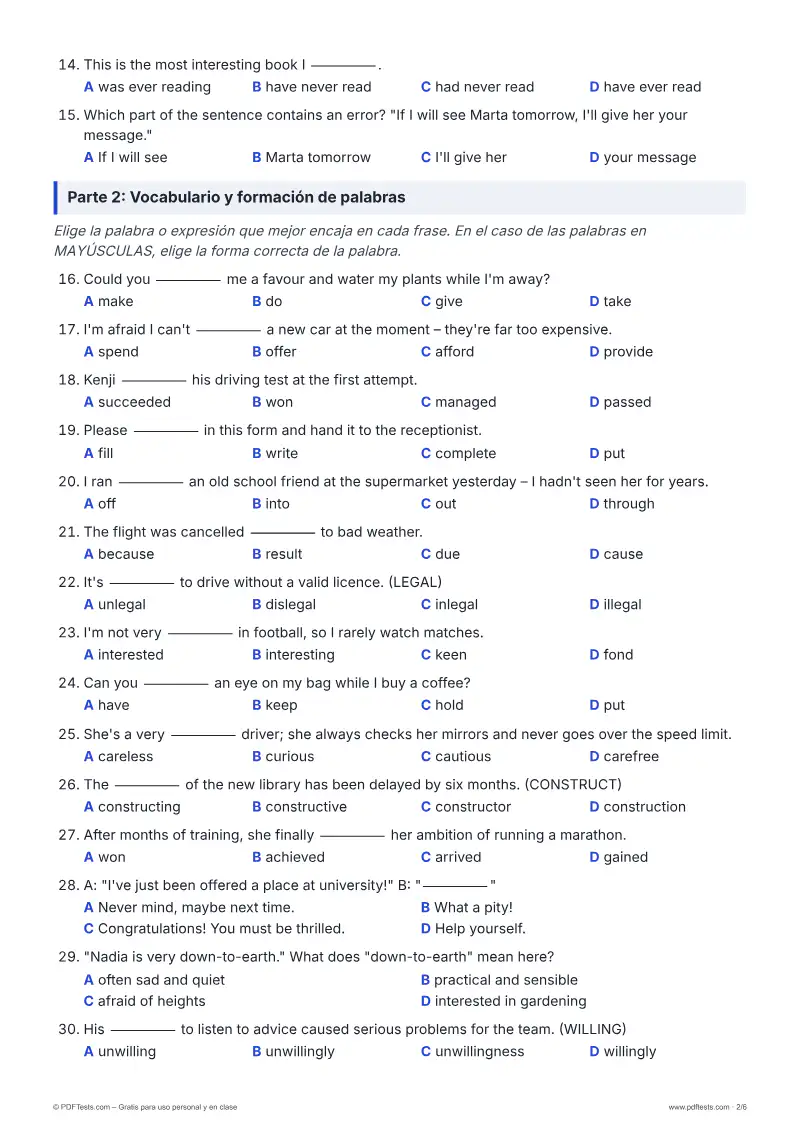
  14. This is the most interesting book I _____.

  15. Which part of the sentence contains an error? "If I will see Marta tomorrow, I'll give her your message."

Parte 2: Vocabulario y formación de palabras

Elige la palabra o expresión que mejor encaja en cada frase. En el caso de las palabras en MAYÚSCULAS, elige la forma correcta de la palabra.

  1. Could you _____ me a favour and water my plants while I'm away?

  2. I'm afraid I can't _____ a new car at the moment – they're far too expensive.

  3. Kenji _____ his driving test at the first attempt.

  4. Please _____ in this form and hand it to the receptionist.

  5. I ran _____ an old school friend at the supermarket yesterday – I hadn't seen her for years.

  6. The flight was cancelled _____ to bad weather.

  7. It's _____ to drive without a valid licence. (LEGAL)

  8. I'm not very _____ in football, so I rarely watch matches.

  9. Can you _____ an eye on my bag while I buy a coffee?

  10. She's a very _____ driver; she always checks her mirrors and never goes over the speed limit.

  11. The _____ of the new library has been delayed by six months. (CONSTRUCT)

  12. After months of training, she finally _____ her ambition of running a marathon.

  13. A: "I've just been offered a place at university!" B: "_____"

  14. "Nadia is very down-to-earth." What does "down-to-earth" mean here?

  15. His _____ to listen to advice caused serious problems for the team. (WILLING)

Parte 3: Estructuras gramaticales avanzadas

Elige la opción que completa correctamente cada frase, o responde a la pregunta.

  1. She suggested _____ a taxi because it was raining heavily.

  2. I remember _____ this film before, but I can't remember how it ends.

  3. He apologised _____ late for the meeting.

  4. I'm going to get my hair _____ before the wedding.

  5. The children _____ be playing in the garden – I can hear them laughing.

  6. I'll lend you my car _____ you promise to drive carefully.

  7. Which part of the sentence contains an error? "Despite of the rain, we really enjoyed our day at the beach."

  8. If it hadn't been for your advice, I _____ the wrong decision.

  9. It's no use _____ about it now – the decision has already been made.

  10. Ravi said, "I'll finish it tomorrow." Which is the correct reported version?

  11. I wish my neighbours _____ so much noise late at night – it's really annoying.

  12. _____ finished her homework, Aisha went out to meet her friends.

  13. The singer _____ to be planning a world tour next year.

  14. Under no circumstances _____ this door while the machine is running.

Parte 4: Comprensión lectora

Lee el texto y elige la mejor respuesta para cada pregunta.

A Summer Above the Clouds

Last summer, instead of looking for an office internship like most of my classmates, I spent three months working at a mountain hut high in the Alps. The hut offers meals and beds to hikers walking a long-distance trail, and it can only be reached on foot – a steep two-hour climb from the nearest village. Supplies arrive by helicopter once a fortnight, so nothing can be wasted.

I'll admit I had doubts before I went. I had never worked in a kitchen, and I wasn't sure how I would cope with sharing a tiny room with three other staff members. My parents, meanwhile, were worried that I was wasting a summer that could have helped my career.

The work was harder than I had imagined. We got up at five to prepare breakfast, and on busy days we served over a hundred dinners. But what surprised me most was how quickly the team became close. With no phone signal and no internet, we spent our free evenings playing cards, telling stories and watching the sun set over the glaciers. I had expected to feel isolated; in fact, I have rarely felt less lonely.

I also learned skills that no classroom could have taught me. When a storm cut off the water supply for two days, we had to find solutions together, quickly and calmly. Guests who arrived exhausted, wet or frustrated taught me a great deal about patience.

Back home, I was nervous about how employers would view my summer. To my relief, at my first job interview, the manager spent most of the time asking about the hut. She said that solving problems under pressure was exactly what she was looking for. I got the job – and I'm already planning to go back next summer, even if only for a few weeks.

  1. Why can nothing be wasted at the hut?

  2. What were the writer's parents worried about?

  3. What does the writer say about having no phone signal or internet?

  4. The phrase "cut off" in paragraph 4 is closest in meaning to:

  5. According to the writer, what did tired or frustrated guests teach her?

  6. What is the main message of the text?

Vista previa

Sobre este examen

Este test de nivel B2 evalúa una amplia variedad de gramática y vocabulario de nivel intermedio alto, desde los tiempos verbales y los verbos modales hasta la formación de palabras, los phrasal verbs y las estructuras avanzadas. Termina con un texto breve y seis preguntas de comprensión lectora. Está pensado para docentes y para quienes estudian por su cuenta y quieren saber si un alumno domina con seguridad el nivel B2.

Temas

Tiempos verbales y expresiones temporalesVerbos modales y deducciónOraciones condicionales y deseos (wish)Gerundio e infinitivoVoz pasiva y estructuras causativasFormación de palabras y colocacionesPhrasal verbs y expresiones idiomáticasComprensión lectora

Cómo usar este examen

  1. Descarga el PDF e imprímelo, o haz el examen en línea más abajo.
  2. Responde todas las preguntas sin diccionario y sin prisas.
  3. Comprueba tus respuestas y apunta los temas que debes repasar.

Notas para el profesor

Realice el test completo en una sola sesión de unos 60 minutos. Una puntuación de 38/50 o más indica que el alumno domina el nivel B2, mientras que entre 30 y 37 revela lagunas que conviene trabajar antes de avanzar. Las partes 1 a 3 se centran en errores típicos del nivel B2, como usar 'will' después de conjunciones temporales, decir 'despite of', emplear estructuras verbales incorrectas tras suggest/remember/apologise o confundir colocaciones parecidas. Repase las explicaciones con los alumnos y vuelva sobre los puntos débiles, por ejemplo pidiéndoles que escriban sus propias frases con las estructuras en las que se han equivocado.