PDFTests Originals

Comprensión lectora – Test 4

C1 Avanzado Comprensión lectoraInglés

Este test de comprensión lectora de nivel C1 incluye tres textos originales de géneros distintos: un artículo de revista sobre el valor del aburrimiento, un relato breve sobre la última emisión de una locutora de radio y una columna de consejos sobre el mundo laboral. Las 20 preguntas de opción múltiple evalúan la idea general, los detalles, la inferencia, la intención del autor y el vocabulario en contexto. Es ideal para estudiantes avanzados que preparan exámenes de nivel C1 y para profesores que buscan una prueba de lectura lista para usar.

Preguntas
20
Tiempo
40 min
PDF
8 páginas
Soluciones
Incluidas
  • 100 % gratis
  • Sin registro
  • PDF A4 listo para imprimir
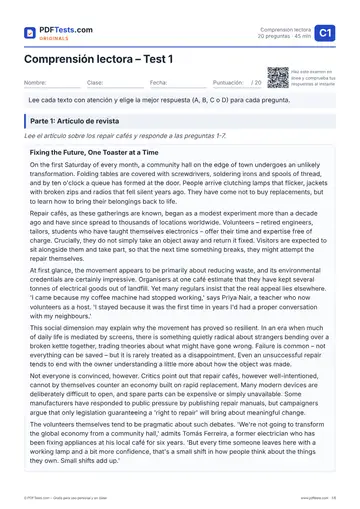
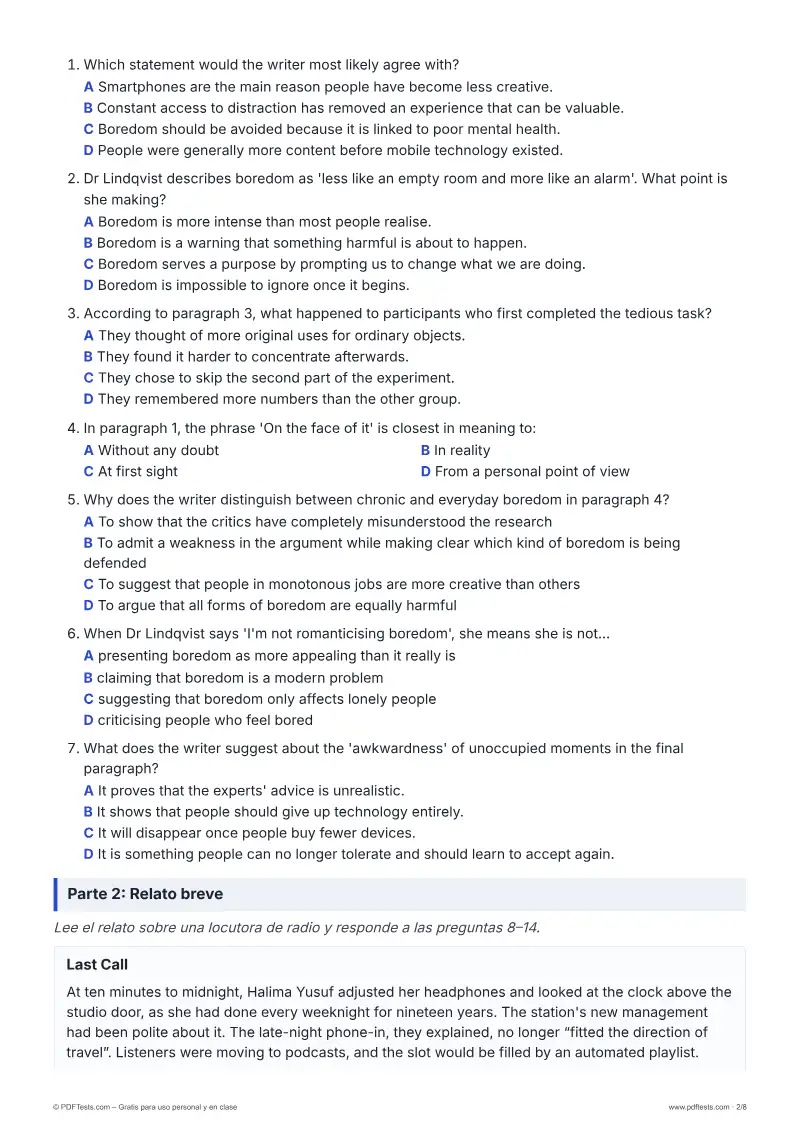
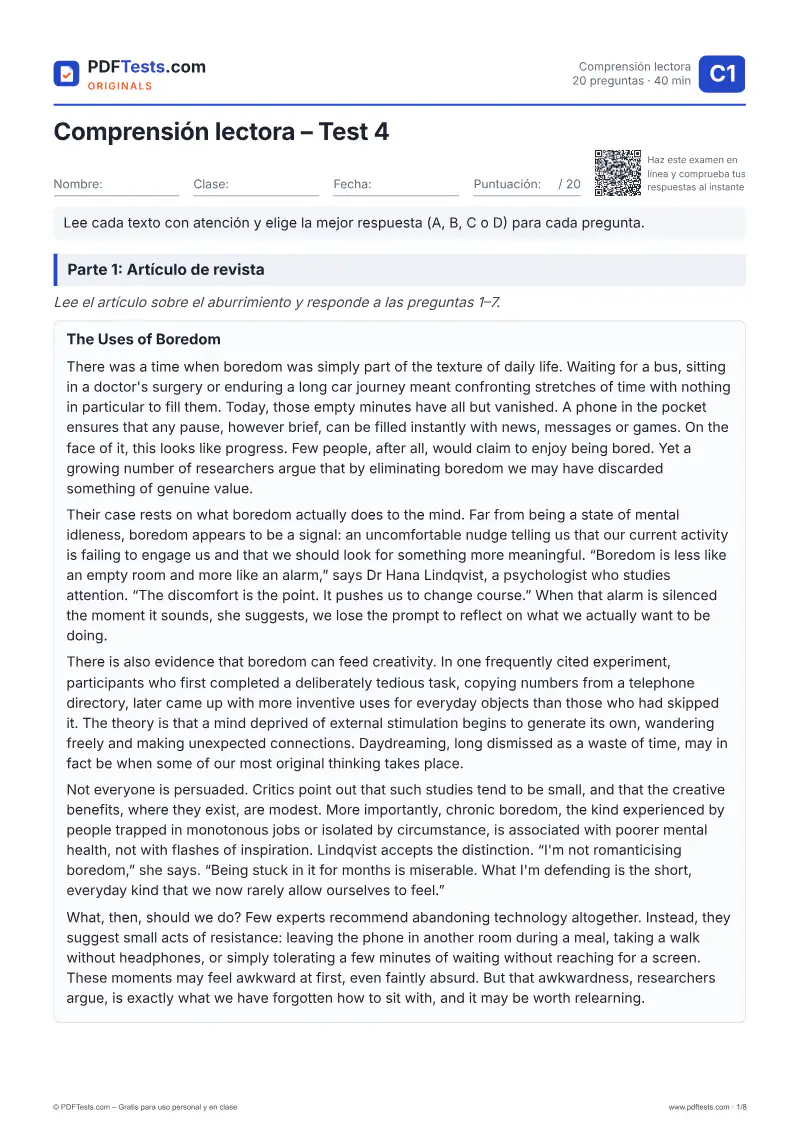
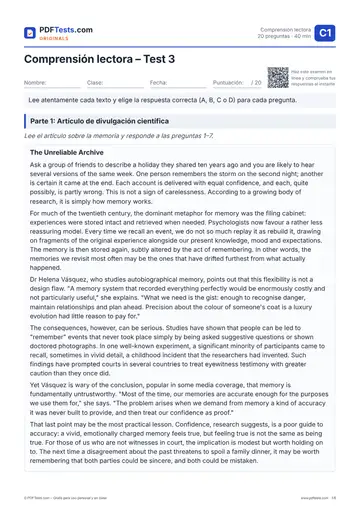
Vista previa de la página 1: Comprensión lectora – Test 4 Abrir PDF

Haz el examen en línea

Lee cada texto con atención y elige la mejor respuesta (A, B, C o D) para cada pregunta. Elige tus respuestas y pulsa «Comprobar respuestas».

Parte 1: Artículo de revista

Lee el artículo sobre el aburrimiento y responde a las preguntas 1–7.

The Uses of Boredom

There was a time when boredom was simply part of the texture of daily life. Waiting for a bus, sitting in a doctor's surgery or enduring a long car journey meant confronting stretches of time with nothing in particular to fill them. Today, those empty minutes have all but vanished. A phone in the pocket ensures that any pause, however brief, can be filled instantly with news, messages or games. On the face of it, this looks like progress. Few people, after all, would claim to enjoy being bored. Yet a growing number of researchers argue that by eliminating boredom we may have discarded something of genuine value.

Their case rests on what boredom actually does to the mind. Far from being a state of mental idleness, boredom appears to be a signal: an uncomfortable nudge telling us that our current activity is failing to engage us and that we should look for something more meaningful. “Boredom is less like an empty room and more like an alarm,” says Dr Hana Lindqvist, a psychologist who studies attention. “The discomfort is the point. It pushes us to change course.” When that alarm is silenced the moment it sounds, she suggests, we lose the prompt to reflect on what we actually want to be doing.

There is also evidence that boredom can feed creativity. In one frequently cited experiment, participants who first completed a deliberately tedious task, copying numbers from a telephone directory, later came up with more inventive uses for everyday objects than those who had skipped it. The theory is that a mind deprived of external stimulation begins to generate its own, wandering freely and making unexpected connections. Daydreaming, long dismissed as a waste of time, may in fact be when some of our most original thinking takes place.

Not everyone is persuaded. Critics point out that such studies tend to be small, and that the creative benefits, where they exist, are modest. More importantly, chronic boredom, the kind experienced by people trapped in monotonous jobs or isolated by circumstance, is associated with poorer mental health, not with flashes of inspiration. Lindqvist accepts the distinction. “I'm not romanticising boredom,” she says. “Being stuck in it for months is miserable. What I'm defending is the short, everyday kind that we now rarely allow ourselves to feel.”

What, then, should we do? Few experts recommend abandoning technology altogether. Instead, they suggest small acts of resistance: leaving the phone in another room during a meal, taking a walk without headphones, or simply tolerating a few minutes of waiting without reaching for a screen. These moments may feel awkward at first, even faintly absurd. But that awkwardness, researchers argue, is exactly what we have forgotten how to sit with, and it may be worth relearning.

  1. Which statement would the writer most likely agree with?

  2. Dr Lindqvist describes boredom as 'less like an empty room and more like an alarm'. What point is she making?

  3. According to paragraph 3, what happened to participants who first completed the tedious task?

  4. In paragraph 1, the phrase 'On the face of it' is closest in meaning to:

  5. Why does the writer distinguish between chronic and everyday boredom in paragraph 4?

  6. When Dr Lindqvist says 'I'm not romanticising boredom', she means she is not…

  7. What does the writer suggest about the 'awkwardness' of unoccupied moments in the final paragraph?

Parte 2: Relato breve

Lee el relato sobre una locutora de radio y responde a las preguntas 8–14.

Last Call

At ten minutes to midnight, Halima Yusuf adjusted her headphones and looked at the clock above the studio door, as she had done every weeknight for nineteen years. The station's new management had been polite about it. The late-night phone-in, they explained, no longer “fitted the direction of travel”. Listeners were moving to podcasts, and the slot would be filled by an automated playlist. Halima had nodded throughout the meeting, said she understood, and gone home to sit in her car outside her flat for forty minutes without turning off the engine.

Tonight was the final programme, and she had promised herself she would not make a fuss. No speeches, no farewells read from a card. Just the show as it had always been: the lines open, the lamp on the desk turned low, and whoever happened to be awake.

The first caller was a lorry driver parked somewhere on the coast road, who wanted to talk about the fog. The second was a student revising for an exam she was certain she would fail. Halima reassured her, as she had reassured hundreds of others, that certainty at two in the morning was rarely reliable. Then the switchboard lit up in a way she had not seen for years.

They did not mention that it was the last night, not at first. A nurse rang to say that the programme had kept her company through a decade of night shifts. A man called Rafael explained, with some embarrassment, that he had first phoned in at seventeen, after an argument with his father, and that Halima had said something he still remembered, although he would not repeat it on air. Halima did not remember saying it. She suspected that was often the way.

By half past three, her producer, Callum, had stopped trying to keep to the running order. He simply pointed at the board and held up his fingers: four more waiting, six, nine. Halima had prepared herself for silence, for a show that ended not with a bang but with nobody listening. She had not prepared for this.

At five to four, she faded down the final song and looked at the microphone for longer than was strictly professional. Dead air, her first editor used to call it, the worst sin in radio. She let it run for three full seconds.

“Thank you for staying up with me,” she said at last. It was what she said every night. Behind the glass, Callum put his head in his hands.

Then she switched off the lamp, and for the first time in nineteen years she did not know what time it was.

  1. How did Halima respond when she was told that her programme was ending?

  2. Why is the phrase 'fitted the direction of travel' placed in quotation marks?

  3. What had Halima expected the final programme to be like?

  4. Halima does not remember what she said to Rafael and 'suspected that was often the way'. This suggests she believes that…

  5. What does Callum's behaviour at half past three show?

  6. Why is it significant that Halima lets 'dead air' run for three seconds?

  7. What does the final sentence of the story imply?

Parte 3: Columna de consejos

Lee la carta y la respuesta de una columna de consejos sobre el trabajo y responde a las preguntas 15–20.

Ask Marta: Workplace Dilemmas

Dear Marta,

Last month I was promoted to team leader, which means I now manage the five people I used to sit alongside as an equal. Two of them are close friends, and one applied for the same role and didn't get it. Since the announcement, conversations stop when I walk into the kitchen, and I've been left off a lunch invitation for the first time in four years. I'm starting to wonder whether I should have turned the job down. How do I get my team back?

Jonah

Dear Jonah,

First, a word of reassurance: what you are describing is not a sign that you made the wrong decision. It is a sign that something has changed, and that everyone, including you, is still adjusting. Promotion from within a team is one of the most awkward transitions in working life precisely because nobody's role is quite what it was, and nobody has yet agreed on what it has become.

That said, I'd gently challenge the way you've framed your question. You ask how to get your team 'back', but the team you had no longer exists. You cannot go back to being one of the group while also being responsible for their workloads, their appraisals and, occasionally, their disappointments. Trying to do both is the most common mistake new managers make, and it tends to satisfy no one. Your colleagues need to know where they stand with you, and that is difficult if you keep changing hats.

So rather than trying to restore the old arrangement, aim to build a new one. Arrange a short one-to-one conversation with each person in the next fortnight. Ask what they need from you, what frustrated them about the previous manager and what they would like to stay the same. Then, and this is the part people skip, act visibly on at least some of what you hear. Trust in a new leader is earned less through warmth than through consistency.

Your colleague who applied for the role deserves particular care. Acknowledge, privately and without condescension, that the outcome must have been disappointing, and ask about their ambitions. Resist the temptation either to overcompensate with special treatment or to avoid them altogether; both will be noticed.

As for your friends, the friendships can survive, but they will need new boundaries. You may have to accept that some conversations are no longer appropriate, and that your friends may occasionally need to complain about work without you there. That is not betrayal; it is a healthy sign that people feel able to speak freely.

Finally, about that lunch. It stings, I know. But try not to read too much into a single invitation. Give it a few months before you draw any conclusions. Many people find that once the novelty fades, the atmosphere settles of its own accord.

Marta

  1. What is Jonah's main reason for writing?

  2. Why does Marta challenge the way Jonah has framed his question?

  3. In the second paragraph of the reply, 'keep changing hats' refers to…

  4. According to Marta, which part of the one-to-one process do people most often neglect?

  5. What does Marta advise regarding the colleague who applied for the same role?

  6. What is Marta's view of Jonah being left out of the lunch invitation?

¿Te ha resultado útil esta página?

Informar de un error

¿Has visto una respuesta incorrecta, una errata o una explicación poco clara? Avísanos y lo corregiremos.

Vista previa

Sobre este examen

Este test de comprensión lectora de nivel C1 incluye tres textos originales de géneros distintos: un artículo de revista sobre el valor del aburrimiento, un relato breve sobre la última emisión de una locutora de radio y una columna de consejos sobre el mundo laboral. Las 20 preguntas de opción múltiple evalúan la idea general, los detalles, la inferencia, la intención del autor y el vocabulario en contexto. Es ideal para estudiantes avanzados que preparan exámenes de nivel C1 y para profesores que buscan una prueba de lectura lista para usar.

Temas

Comprensión lectoraIdea general y tema principalInferenciaVocabulario en contextoIntención y actitud del autorNarrativa de ficciónColumna de consejos

Cómo usar este examen

  1. Descarga el PDF e imprímelo, o haz el examen en línea más abajo.
  2. Responde todas las preguntas sin diccionario y sin prisas.
  3. Comprueba tus respuestas y apunta los temas que debes repasar.

Notas para el profesor

Puede usar las tres partes como un único examen de 40 minutos o como clases independientes. Muchas preguntas se centran en destrezas de nivel C1 que suelen resultar difíciles: distinguir la opinión del propio autor de la que solo se cita, captar las emociones implícitas en un texto de ficción y deducir el significado de expresiones idiomáticas por el contexto. Los distractores a menudo repiten palabras del texto pero distorsionan su sentido, así que pida a los alumnos que justifiquen cada respuesta con pruebas del texto. Como actividad de seguimiento, pueden escribir una respuesta a Jonah o un breve párrafo de opinión sobre el aburrimiento.