PDFTests Originals

Compréhension écrite – Test 2

A2 Élémentaire Compréhension écriteAnglais

Ce test de compréhension écrite de niveau A2 propose trois courts textes originaux : un article de magazine sur un soigneur de zoo, une note d'information d'un camping et une histoire autour d'un gâteau d'anniversaire. Les 20 questions à choix multiple évaluent la compréhension globale, la recherche d'informations précises, la capacité à déduire et le vocabulaire en contexte. Il convient aux apprenants de niveau élémentaire comme aux enseignants qui cherchent une évaluation de lecture prête à imprimer.
Questions
20
Durée
30 min
PDF
4 pages
Corrigé
Inclus
  • 100 % gratuit
  • Sans inscription
  • PDF A4 prêt à imprimer
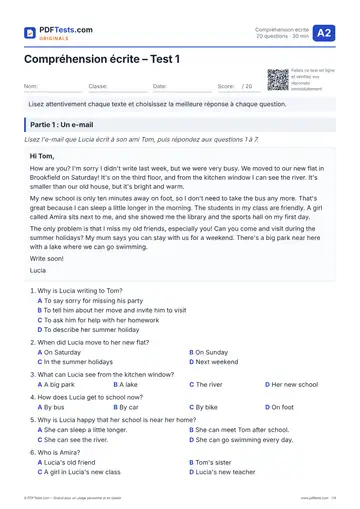
Aperçu de la page 1 : Compréhension écrite – Test 2 Ouvrir le PDF

Faire le test en ligne

Lisez attentivement chaque texte et choisissez la bonne réponse (A, B, C ou D) pour chaque question. Choisissez vos réponses, puis cliquez sur « Vérifier mes réponses ».

Partie 1 : Article de magazine

Lisez l'article sur un soigneur de zoo, puis répondez aux questions 1 à 7.

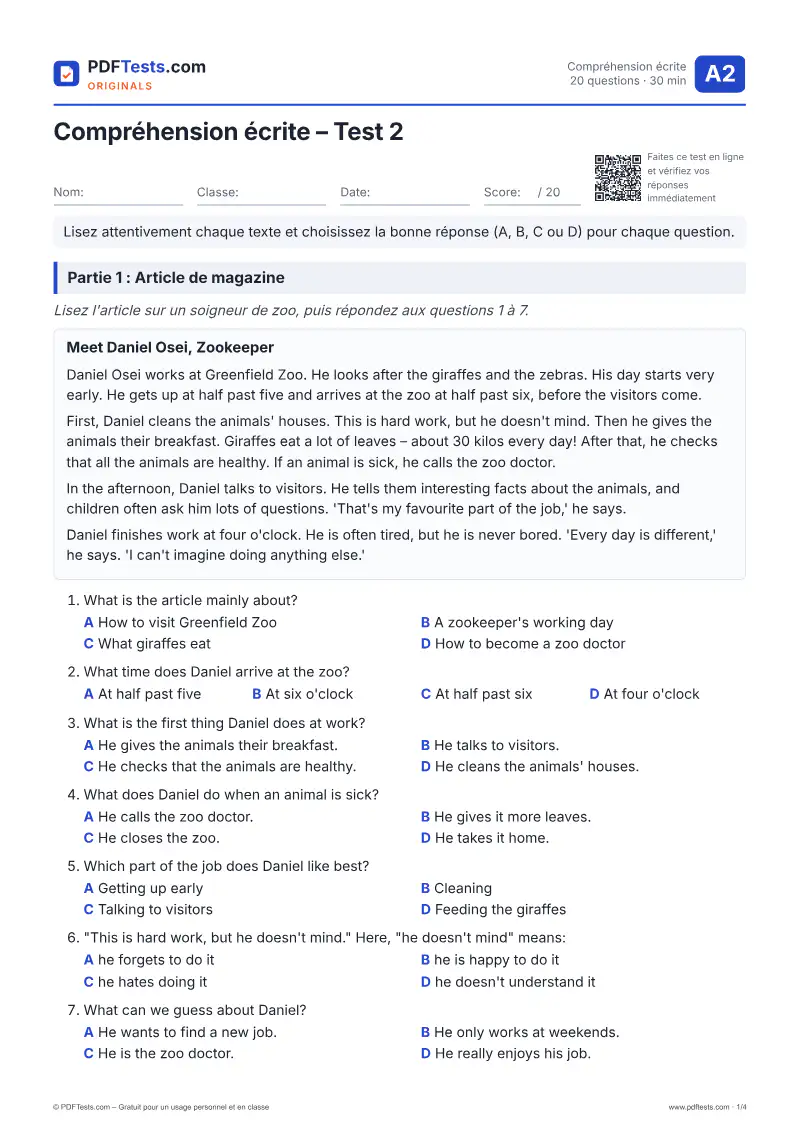
Meet Daniel Osei, Zookeeper

Daniel Osei works at Greenfield Zoo. He looks after the giraffes and the zebras. His day starts very early. He gets up at half past five and arrives at the zoo at half past six, before the visitors come.

First, Daniel cleans the animals' houses. This is hard work, but he doesn't mind. Then he gives the animals their breakfast. Giraffes eat a lot of leaves – about 30 kilos every day! After that, he checks that all the animals are healthy. If an animal is sick, he calls the zoo doctor.

In the afternoon, Daniel talks to visitors. He tells them interesting facts about the animals, and children often ask him lots of questions. 'That's my favourite part of the job,' he says.

Daniel finishes work at four o'clock. He is often tired, but he is never bored. 'Every day is different,' he says. 'I can't imagine doing anything else.'

  1. What is the article mainly about?

  2. What time does Daniel arrive at the zoo?

  3. What is the first thing Daniel does at work?

  4. What does Daniel do when an animal is sick?

  5. Which part of the job does Daniel like best?

  6. "This is hard work, but he doesn't mind." Here, "he doesn't mind" means:

  7. What can we guess about Daniel?

Partie 2 : Note d'information

Lisez la note d'information d'un camping, puis répondez aux questions 8 à 14.

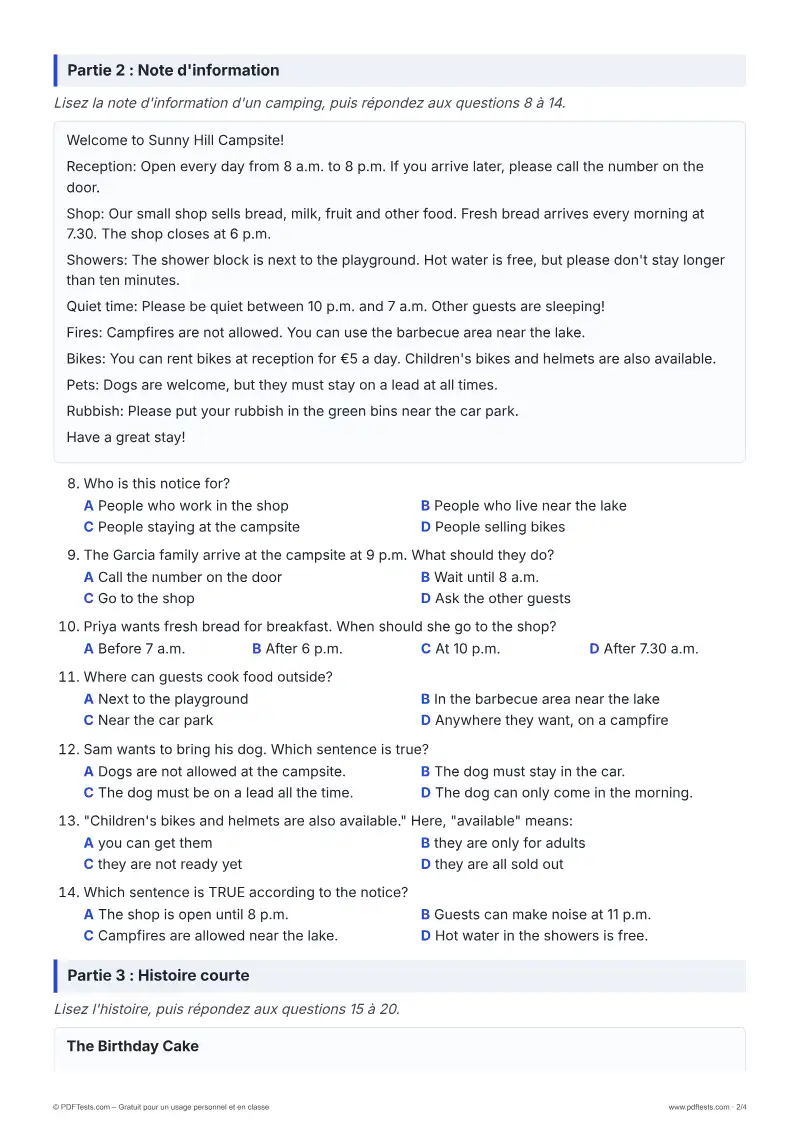
Welcome to Sunny Hill Campsite!

Reception: Open every day from 8 a.m. to 8 p.m. If you arrive later, please call the number on the door.

Shop: Our small shop sells bread, milk, fruit and other food. Fresh bread arrives every morning at 7.30. The shop closes at 6 p.m.

Showers: The shower block is next to the playground. Hot water is free, but please don't stay longer than ten minutes.

Quiet time: Please be quiet between 10 p.m. and 7 a.m. Other guests are sleeping!

Fires: Campfires are not allowed. You can use the barbecue area near the lake.

Bikes: You can rent bikes at reception for €5 a day. Children's bikes and helmets are also available.

Pets: Dogs are welcome, but they must stay on a lead at all times.

Rubbish: Please put your rubbish in the green bins near the car park.

Have a great stay!

  1. Who is this notice for?

  2. The Garcia family arrive at the campsite at 9 p.m. What should they do?

  3. Priya wants fresh bread for breakfast. When should she go to the shop?

  4. Where can guests cook food outside?

  5. Sam wants to bring his dog. Which sentence is true?

  6. "Children's bikes and helmets are also available." Here, "available" means:

  7. Which sentence is TRUE according to the notice?

Partie 3 : Histoire courte

Lisez l'histoire, puis répondez aux questions 15 à 20.

The Birthday Cake

Nadia's brother, Omar, was going to be eighteen on Saturday. Nadia wanted to give him something special, but she didn't have much money. Then she had an idea: she could make him a chocolate cake.

On Friday evening, while Omar was at football practice, Nadia found a recipe online and started baking. Unfortunately, she forgot to set the timer. When she opened the oven, the cake was black and the kitchen was full of smoke.

Nadia almost cried. Just then, someone knocked on the door. It was Mrs Kowalski, their neighbour. 'I smelled the smoke,' she said. 'Is everything OK?' Nadia explained the problem. Mrs Kowalski smiled. 'Come to my flat. I have everything we need.'

Together they made a new cake, and this time it was perfect. The next day, Omar's eyes opened wide when he saw it. 'You made this?' he asked. Nadia looked at Mrs Kowalski and laughed. 'Well, I had a little help.'

  1. Why did Nadia decide to make a cake for Omar?

  2. Where was Omar when Nadia started baking?

  3. What went wrong with the first cake?

  4. How did Mrs Kowalski know there was a problem?

  5. "Omar's eyes opened wide when he saw it." This shows that Omar was:

  6. What does Nadia mean when she says, "I had a little help"?

Aperçu

À propos de ce test

Ce test de compréhension écrite de niveau A2 propose trois courts textes originaux : un article de magazine sur un soigneur de zoo, une note d'information d'un camping et une histoire autour d'un gâteau d'anniversaire. Les 20 questions à choix multiple évaluent la compréhension globale, la recherche d'informations précises, la capacité à déduire et le vocabulaire en contexte. Il convient aux apprenants de niveau élémentaire comme aux enseignants qui cherchent une évaluation de lecture prête à imprimer.

Thèmes abordés

Compréhension écriteArticle de magazineAvis au publicHistoire courteVocabulaire en contexteInférence

Comment utiliser ce test

  1. Téléchargez le PDF et imprimez-le, ou faites le test en ligne ci-dessous.
  2. Répondez à toutes les questions sans dictionnaire et sans vous presser.
  3. Vérifiez vos réponses et notez les points à revoir.

Notes pour l’enseignant

Prévoyez environ 10 minutes par texte et encouragez les élèves à lire d'abord le texte en entier pour en saisir le sens général avant de répondre. Les questions vérifient s'ils savent repérer des informations précises, comme des horaires et des lieux, et s'ils évitent les distracteurs qui reprennent des mots d'une autre partie du texte. Les questions de vocabulaire portent sur des expressions comme « doesn't mind » et « available ». En prolongement, les élèves peuvent rédiger une courte note d'information pour leur établissement ou un article « une journée dans la vie de… » sur une personne de leur entourage.