PDFTests Originals

Compréhension écrite – Test 2

B1 Intermédiaire Compréhension écriteAnglais

Ce test de compréhension écrite de niveau B1 comporte trois textes originaux : une annonce d'un centre sportif, un article de magazine sur une reconversion professionnelle et une nouvelle autour d'un carnet perdu. Les 20 questions à choix multiples évaluent la compréhension globale, la compréhension détaillée, la capacité à faire des déductions et le vocabulaire en contexte. Il convient aux apprenants de niveau intermédiaire qui préparent un examen B1 et aux enseignants à la recherche d'une évaluation de lecture prête à l'emploi.
Questions
20
Durée
30 min
PDF
5 pages
Corrigé
Inclus
  • 100 % gratuit
  • Sans inscription
  • PDF A4 prêt à imprimer
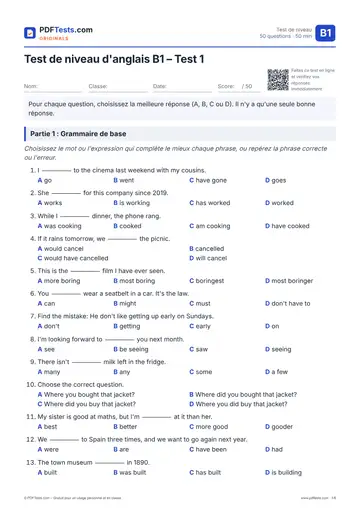
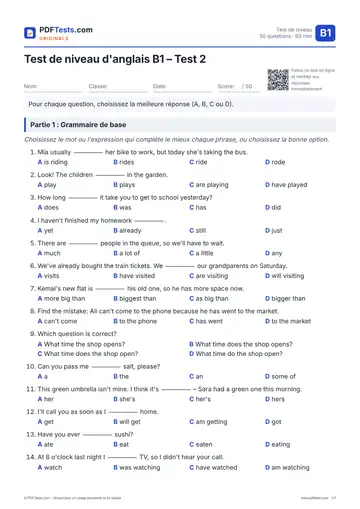
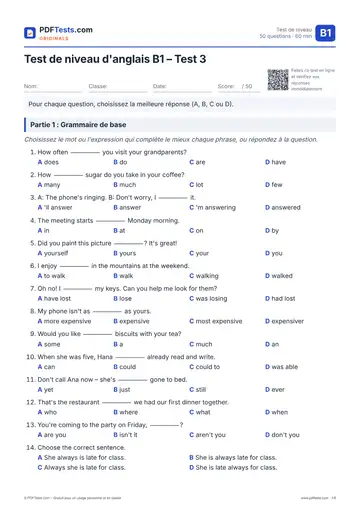
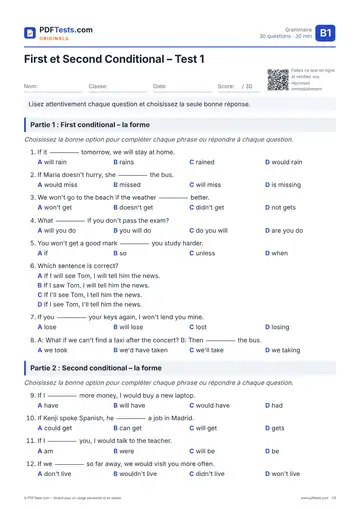
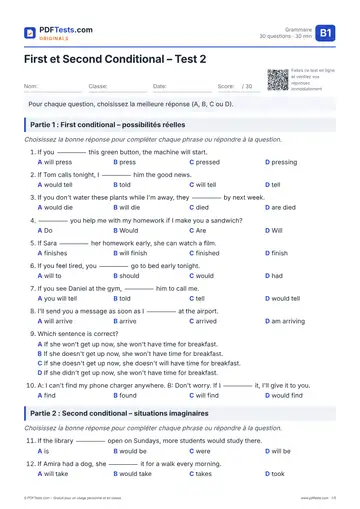
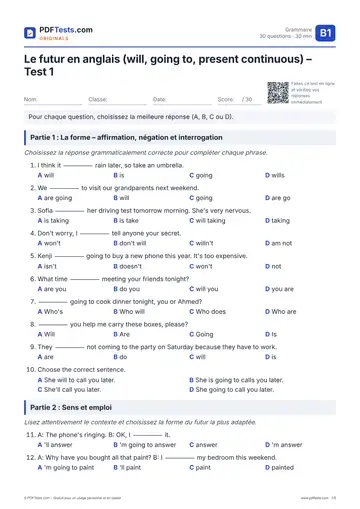
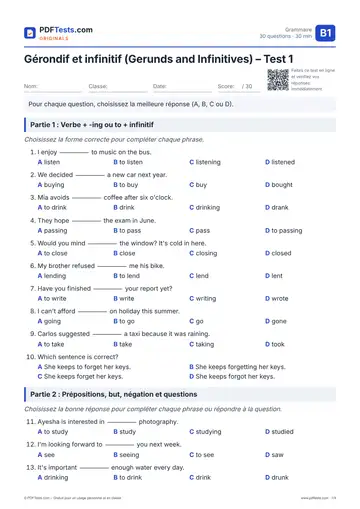
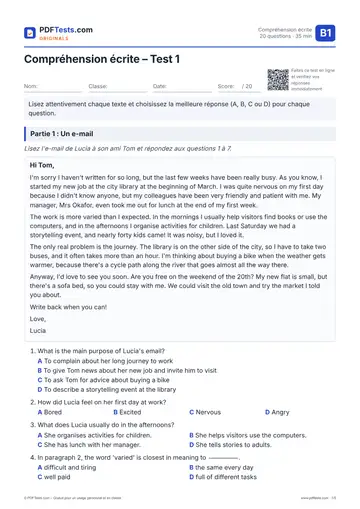
Aperçu de la page 1 : Compréhension écrite – Test 2 Ouvrir le PDF

Faire le test en ligne

Lisez attentivement chaque texte et choisissez la bonne réponse (A, B, C ou D) pour chaque question. Choisissez vos réponses, puis cliquez sur « Vérifier mes réponses ».

Partie 1 : Une annonce

Lisez l'annonce du centre sportif et répondez aux questions 1 à 6.

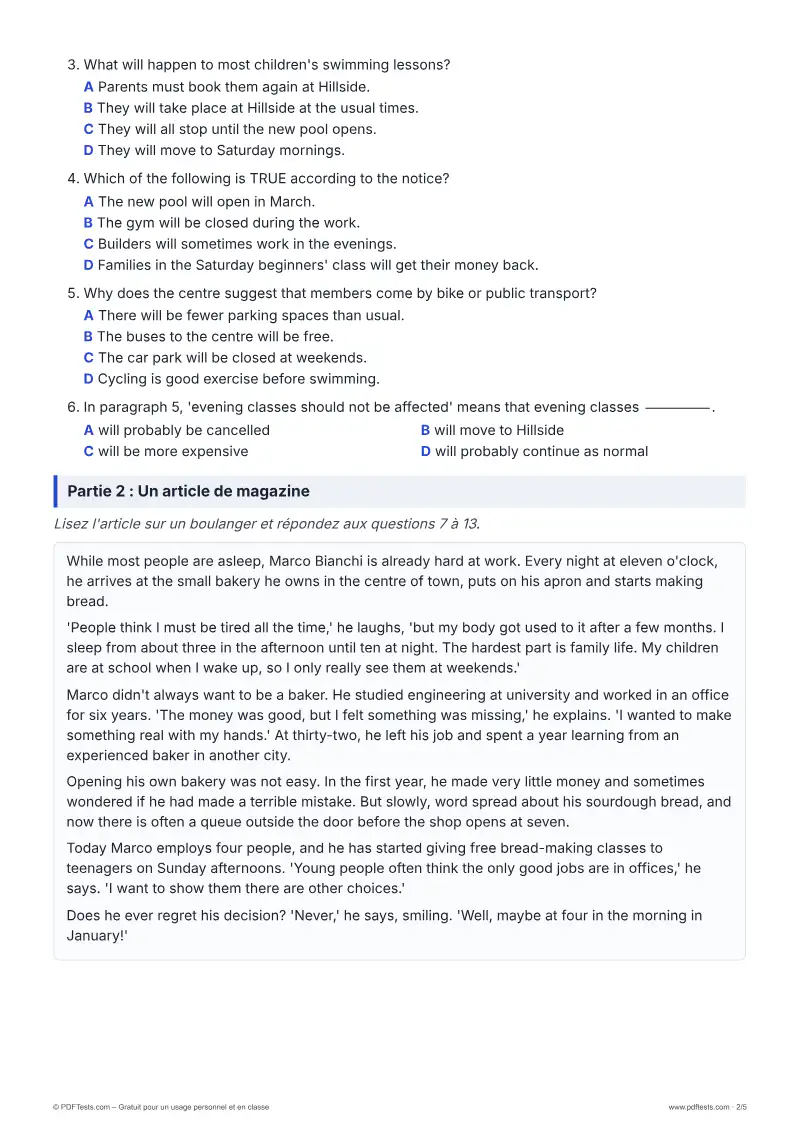
RIVERSIDE SPORTS CENTRE – IMPORTANT CHANGES FROM 1 MARCH

Dear members,

We are pleased to announce that work on our new swimming pool will begin on 1 March. The project will take about three months, and we expect the new pool to open in early June. During this time, the old pool will be closed, but all other areas of the centre, including the gym and the sports hall, will stay open as usual.

We understand that many of you swim regularly, so we have made an agreement with Hillside Leisure Centre, which is a fifteen-minute bus ride away. Members can use the pool there for free between 7 a.m. and 4 p.m., Monday to Friday. Just show your Riverside membership card at reception. Please note that this offer does not include evenings or weekends.

Children's swimming lessons will also move to Hillside. The lessons will take place at the same times as before, and parents do not need to book again. However, the Saturday morning class for beginners will be cancelled until June, and families will receive a full refund.

Because of the building work, the main car park will be smaller than usual. We recommend that you come by bike or public transport if possible. Extra bike racks have been put next to the main entrance.

Finally, we would like to apologise for any noise during the work. Builders will only work between 8 a.m. and 5 p.m., so evening classes should not be affected.

If you have any questions, please speak to a member of staff at reception.

Thank you for your patience.

The Riverside Team

  1. What is the main purpose of this notice?

  2. When can a Riverside member swim at Hillside for free?

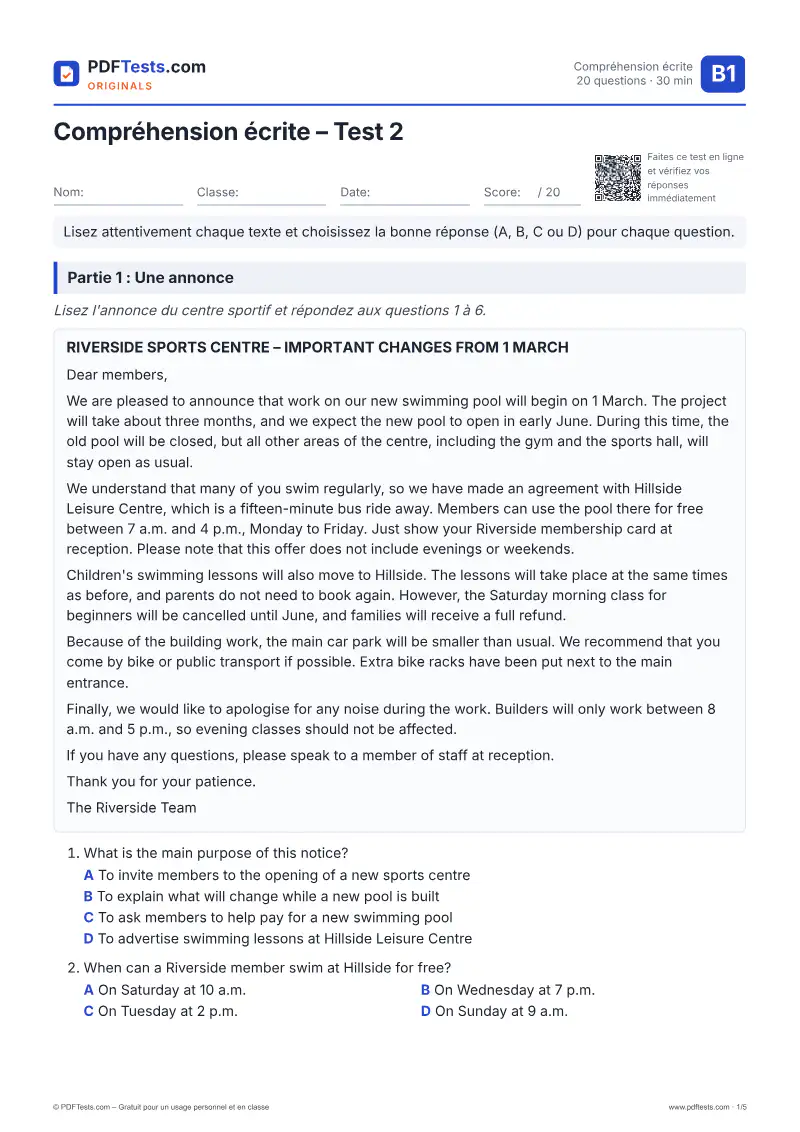
  3. What will happen to most children's swimming lessons?

  4. Which of the following is TRUE according to the notice?

  5. Why does the centre suggest that members come by bike or public transport?

  6. In paragraph 5, 'evening classes should not be affected' means that evening classes _____.

Partie 2 : Un article de magazine

Lisez l'article sur un boulanger et répondez aux questions 7 à 13.

While most people are asleep, Marco Bianchi is already hard at work. Every night at eleven o'clock, he arrives at the small bakery he owns in the centre of town, puts on his apron and starts making bread.

'People think I must be tired all the time,' he laughs, 'but my body got used to it after a few months. I sleep from about three in the afternoon until ten at night. The hardest part is family life. My children are at school when I wake up, so I only really see them at weekends.'

Marco didn't always want to be a baker. He studied engineering at university and worked in an office for six years. 'The money was good, but I felt something was missing,' he explains. 'I wanted to make something real with my hands.' At thirty-two, he left his job and spent a year learning from an experienced baker in another city.

Opening his own bakery was not easy. In the first year, he made very little money and sometimes wondered if he had made a terrible mistake. But slowly, word spread about his sourdough bread, and now there is often a queue outside the door before the shop opens at seven.

Today Marco employs four people, and he has started giving free bread-making classes to teenagers on Sunday afternoons. 'Young people often think the only good jobs are in offices,' he says. 'I want to show them there are other choices.'

Does he ever regret his decision? 'Never,' he says, smiling. 'Well, maybe at four in the morning in January!'

  1. What is the article mainly about?

  2. According to Marco, what is the most difficult part of his job?

  3. Why did Marco leave his office job?

  4. What did Marco do before he opened his bakery?

  5. In paragraph 4, 'word spread about his sourdough bread' means that _____.

  6. Why does Marco give free classes to teenagers?

  7. What does Marco's final comment suggest?

Partie 3 : Une nouvelle

Lisez la nouvelle et répondez aux questions 14 à 20.

Kofi had been looking forward to the weekend for weeks. He was taking the train to visit his grandmother, who lived by the sea, and he planned to spend the journey reading.

About an hour after the train left, a young woman sitting opposite him got off at a small station. She was in such a hurry that she left a notebook on the seat. Kofi picked it up and ran to the door, but it was too late – the train was already moving, and the woman was nowhere to be seen.

He opened the notebook, hoping to find a name or a phone number. Instead, he found pages and pages of drawings: old buildings, trees, the faces of people on trains. They were beautiful. On the last page there was a sketch of a young man reading a book, and Kofi realised with surprise that the man was him.

At the back of the notebook, in tiny letters, he found an email address. That evening, at his grandmother's house, he wrote a short message explaining what had happened.

The reply came the next morning. The woman, whose name was Elena, was an art student. She had been terribly worried, she wrote, because the notebook contained a whole year of work for her final exam. She couldn't thank him enough.

When he got home, Kofi posted the notebook back to her. A few days later, a small parcel arrived at his flat. Inside was the drawing of him on the train, now in a simple wooden frame, with a note that said: 'For the honest reader.'

  1. Why was Kofi on the train?

  2. Why couldn't Kofi return the notebook to the woman immediately?

  3. What surprised Kofi when he looked at the last page?

  4. How did Kofi contact the owner of the notebook?

  5. In paragraph 5, 'She couldn't thank him enough' means that Elena _____.

  6. Why had Elena been so worried?

  7. Why did Elena write 'For the honest reader' on her note?

Cette page vous a-t-elle été utile ?

Signaler une erreur

Une mauvaise réponse, une faute de frappe ou une explication peu claire ? Dites-le-nous, nous corrigerons.

Aperçu

À propos de ce test

Ce test de compréhension écrite de niveau B1 comporte trois textes originaux : une annonce d'un centre sportif, un article de magazine sur une reconversion professionnelle et une nouvelle autour d'un carnet perdu. Les 20 questions à choix multiples évaluent la compréhension globale, la compréhension détaillée, la capacité à faire des déductions et le vocabulaire en contexte. Il convient aux apprenants de niveau intermédiaire qui préparent un examen B1 et aux enseignants à la recherche d'une évaluation de lecture prête à l'emploi.

Thèmes abordés

Compréhension écriteAnnoncesArticles de magazineNouvellesDéduction (inference)Vocabulaire en contexte

Comment utiliser ce test

  1. Téléchargez le PDF et imprimez-le, ou faites le test en ligne ci-dessous.
  2. Répondez à toutes les questions sans dictionnaire et sans vous presser.
  3. Vérifiez vos réponses et notez les points à revoir.

Notes pour l’enseignant

Chaque partie peut être faite séparément, ou les trois peuvent être données ensemble sous forme d'un test de 30 minutes. Les questions ciblent les difficultés typiques du niveau B1 en lecture : choisir un distracteur qui reprend des mots du texte, passer à côté des négations et des exceptions (par ex. 'this offer does not include evenings') et prendre les expressions idiomatiques au pied de la lettre. En prolongement, demandez aux élèves de souligner dans le texte les éléments qui justifient chaque réponse, ou de rédiger une courte réponse à l'annonce ou un résumé de la nouvelle.