PDFTests Originals

Le travail et les études – Test 1

B1 Intermédiaire VocabulaireAnglais

Ce test de vocabulaire de niveau B1 permet de vérifier si les apprenants maîtrisent les mots anglais courants liés aux métiers, à l'école, à l'université et au monde du travail. Il porte sur le sens des mots, les collocations fréquentes comme « apply for a job » et « meet a deadline », le vocabulaire dans un court texte et les familles de mots. Il s'adresse aux apprenants de niveau intermédiaire, aux candidats aux examens et aux enseignants qui cherchent un test prêt à l'emploi pour la classe.
Questions
30
Durée
35 min
PDF
5 pages
Corrigé
Inclus
  • 100 % gratuit
  • Sans inscription
  • PDF A4 prêt à imprimer
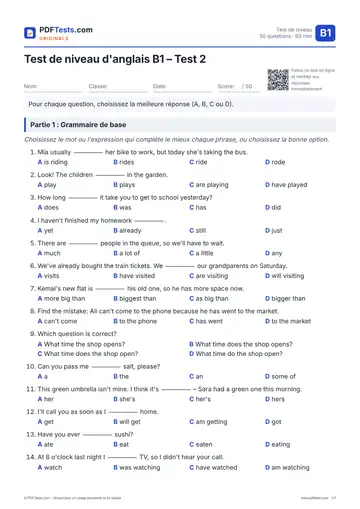
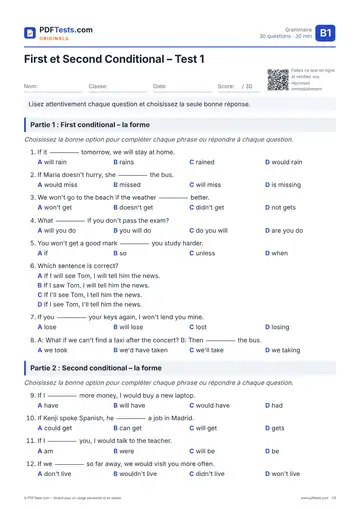
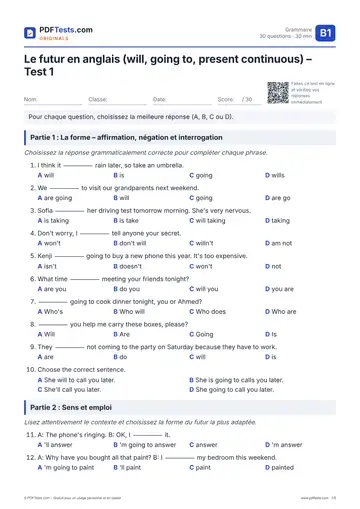
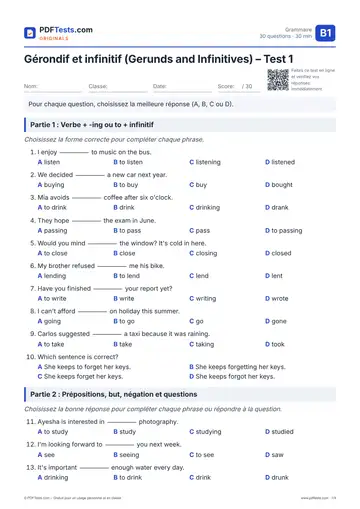
Aperçu de la page 1 : Le travail et les études – Test 1 Ouvrir le PDF

Faire le test en ligne

Pour chaque question, choisissez la meilleure réponse (A, B, C ou D). Choisissez vos réponses, puis cliquez sur « Vérifier mes réponses ».

Partie 1 : Sens des mots et choix du mot juste

Choisissez le mot ou l'expression qui complète le mieux chaque phrase ou qui répond à la question.

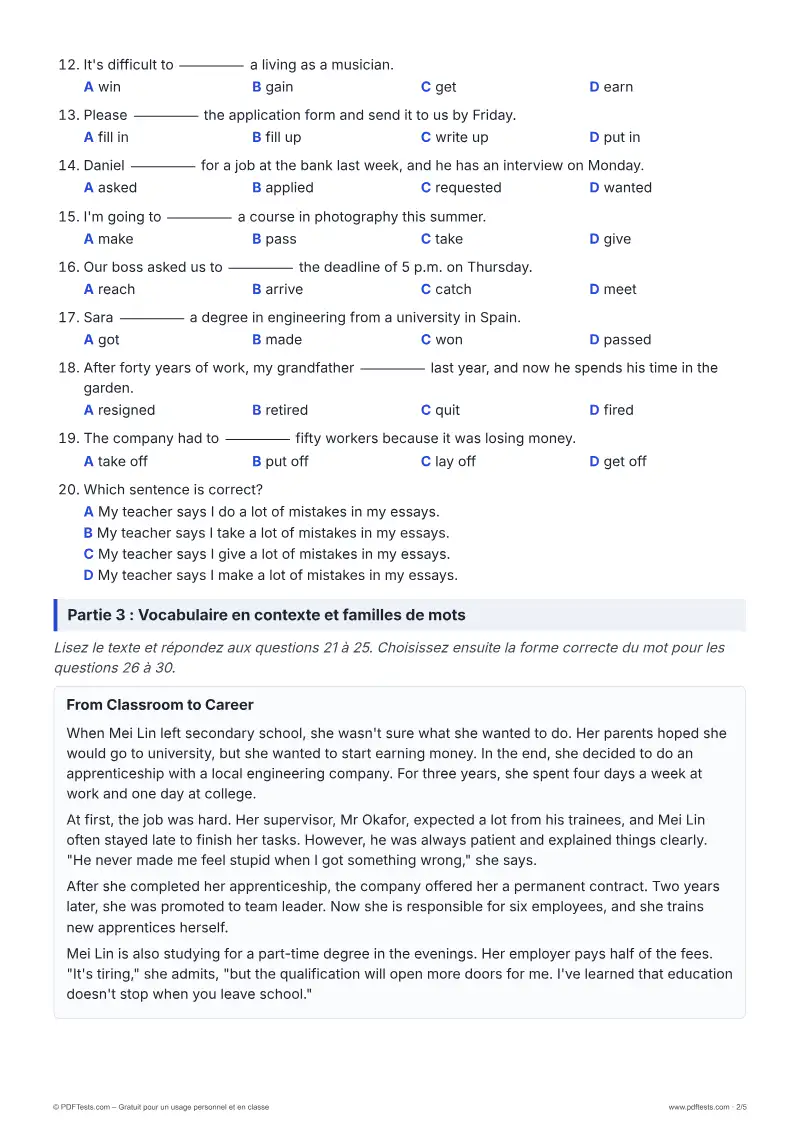
  1. Someone who learns a trade by working with an experienced person for a fixed time is _____.

  2. The money you pay to a university or college for your course is called _____.

  3. Priya works only four hours a day, from 9 to 1. She has a _____ job.

  4. My manager is very pleased with my work, so she has given me a _____. Now I earn more and I'm in charge of a small team.

  5. Which sentence is correct?

  6. Tomás studied hard and _____ all his exams with high marks.

  7. The _____ is responsible for all the teachers and students in the school.

  8. A short period of work in a company, often for students who want to get experience, is called an _____.

  9. I work the night _____ at the hospital, from 10 p.m. to 6 a.m.

  10. "Our company is going to hire twenty new staff next year." What does 'hire' mean here?

Partie 2 : Collocations et verbes à particule (phrasal verbs)

Choisissez le mot ou l'expression qui s'associe naturellement aux mots autour du blanc.

  1. I can't come to the cinema tonight. I have to _____ my homework.

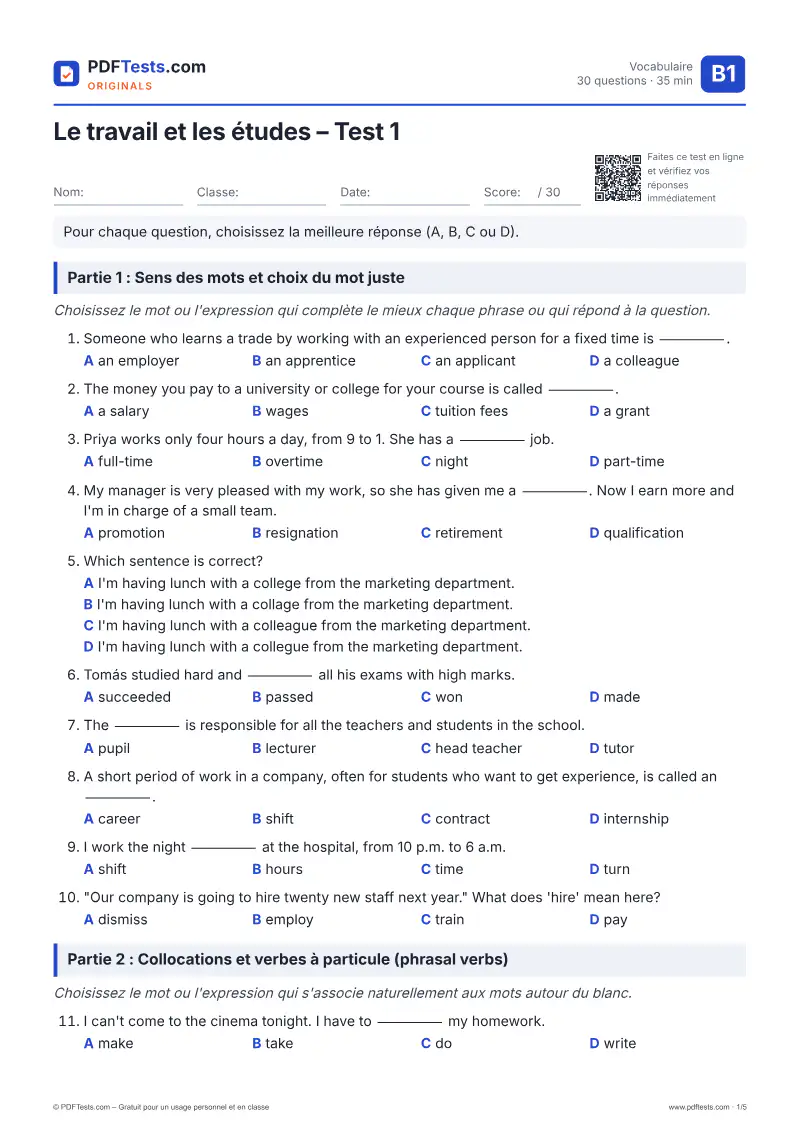
  2. It's difficult to _____ a living as a musician.

  3. Please _____ the application form and send it to us by Friday.

  4. Daniel _____ for a job at the bank last week, and he has an interview on Monday.

  5. I'm going to _____ a course in photography this summer.

  6. Our boss asked us to _____ the deadline of 5 p.m. on Thursday.

  7. Sara _____ a degree in engineering from a university in Spain.

  8. After forty years of work, my grandfather _____ last year, and now he spends his time in the garden.

  9. The company had to _____ fifty workers because it was losing money.

  10. Which sentence is correct?

Partie 3 : Vocabulaire en contexte et familles de mots

Lisez le texte et répondez aux questions 21 à 25. Choisissez ensuite la forme correcte du mot pour les questions 26 à 30.

From Classroom to Career

When Mei Lin left secondary school, she wasn't sure what she wanted to do. Her parents hoped she would go to university, but she wanted to start earning money. In the end, she decided to do an apprenticeship with a local engineering company. For three years, she spent four days a week at work and one day at college.

At first, the job was hard. Her supervisor, Mr Okafor, expected a lot from his trainees, and Mei Lin often stayed late to finish her tasks. However, he was always patient and explained things clearly. "He never made me feel stupid when I got something wrong," she says.

After she completed her apprenticeship, the company offered her a permanent contract. Two years later, she was promoted to team leader. Now she is responsible for six employees, and she trains new apprentices herself.

Mei Lin is also studying for a part-time degree in the evenings. Her employer pays half of the fees. "It's tiring," she admits, "but the qualification will open more doors for me. I've learned that education doesn't stop when you leave school."

  1. In paragraph 1, 'earning money' means:

  2. In paragraph 2, a 'supervisor' is a person who:

  3. A 'permanent contract' (paragraph 3) means that Mei Lin's job:

  4. Which word in the text means 'people who are learning to do a job'?

  5. "The qualification will open more doors for me" means the qualification will:

  6. Mei Lin's _____ to team leader came after two years. (PROMOTE)

  7. The company has over 200 _____ working in its factories. (EMPLOY)

  8. Hana always does her homework on time. She is a very _____ student. (RESPONSIBLE)

  9. There is high _____ in the town, and many young people can't find work. (EMPLOY)

  10. Teaching young children requires a lot of _____. (PATIENT)

Aperçu

À propos de ce test

Ce test de vocabulaire de niveau B1 permet de vérifier si les apprenants maîtrisent les mots anglais courants liés aux métiers, à l'école, à l'université et au monde du travail. Il porte sur le sens des mots, les collocations fréquentes comme « apply for a job » et « meet a deadline », le vocabulaire dans un court texte et les familles de mots. Il s'adresse aux apprenants de niveau intermédiaire, aux candidats aux examens et aux enseignants qui cherchent un test prêt à l'emploi pour la classe.

Thèmes abordés

Les métiers et le monde du travailL'école et l'universitéLes collocations liées au travail et aux étudesLes verbes à particule (phrasal verbs)Les familles de motsLe vocabulaire en contexte

Comment utiliser ce test

  1. Téléchargez le PDF et imprimez-le, ou faites le test en ligne ci-dessous.
  2. Répondez à toutes les questions sans dictionnaire et sans vous presser.
  3. Vérifiez vos réponses et notez les points à revoir.

Notes pour l’enseignant

Utilisez ce test à la fin d'une séquence sur le travail et les études, ou comme évaluation diagnostique avant de l'aborder. Il cible des erreurs fréquentes chez les apprenants : la confusion entre do/make/take, entre « colleague » et « college », entre « employer » et « employee », ainsi que le mauvais choix de la forme du mot. En prolongement, demandez aux élèves de rédiger un court paragraphe sur leurs propres études ou leur emploi en utilisant au moins huit collocations de la partie 2.