PDFTests Originals

Everyday Vocabulary: Family, Home and Daily Routine – Test 1

A1 Beginner VocabularyGerman

This A1 German vocabulary test checks everyday words for family members, rooms and furniture, and daily routines. It includes gap fills, word meanings, collocations, plurals, short responses and a reading text about a normal day. It suits beginners, adult learners and school classes revising the first topics of a German course.
Questions
30
Time
30 min
PDF
4 pages
Answer key
Included
  • 100% free
  • No sign-up or email
  • Print-ready A4 PDF
Preview of page 1 of Everyday Vocabulary: Family, Home and Daily Routine – Test 1 Open PDF

Take the test online

Choose the correct answer (A, B, C or D) for each question. Choose your answers, then press “Check my answers”.

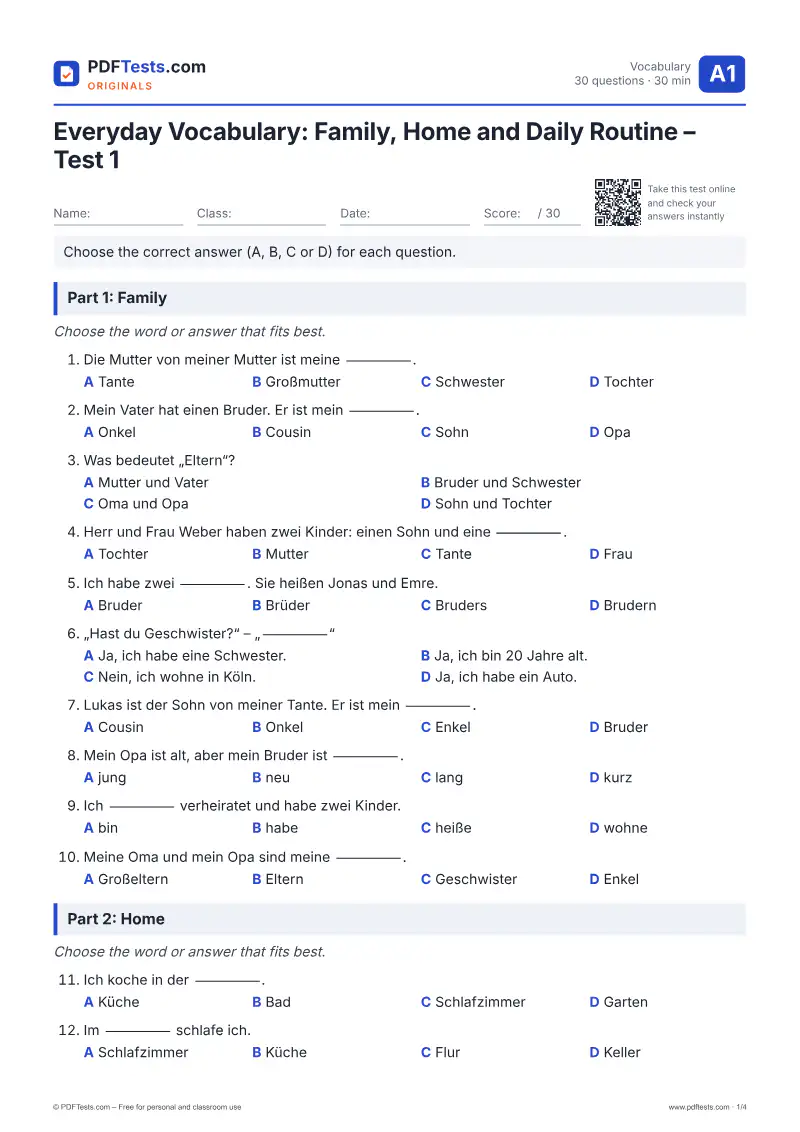
Part 1: Family

Choose the word or answer that fits best.

  1. Die Mutter von meiner Mutter ist meine _____.

  2. Mein Vater hat einen Bruder. Er ist mein _____.

  3. Was bedeutet „Eltern“?

  4. Herr und Frau Weber haben zwei Kinder: einen Sohn und eine _____.

  5. Ich habe zwei _____. Sie heißen Jonas und Emre.

  6. „Hast du Geschwister?“ – „_____“

  7. Lukas ist der Sohn von meiner Tante. Er ist mein _____.

  8. Mein Opa ist alt, aber mein Bruder ist _____.

  9. Ich _____ verheiratet und habe zwei Kinder.

  10. Meine Oma und mein Opa sind meine _____.

Part 2: Home

Choose the word or answer that fits best.

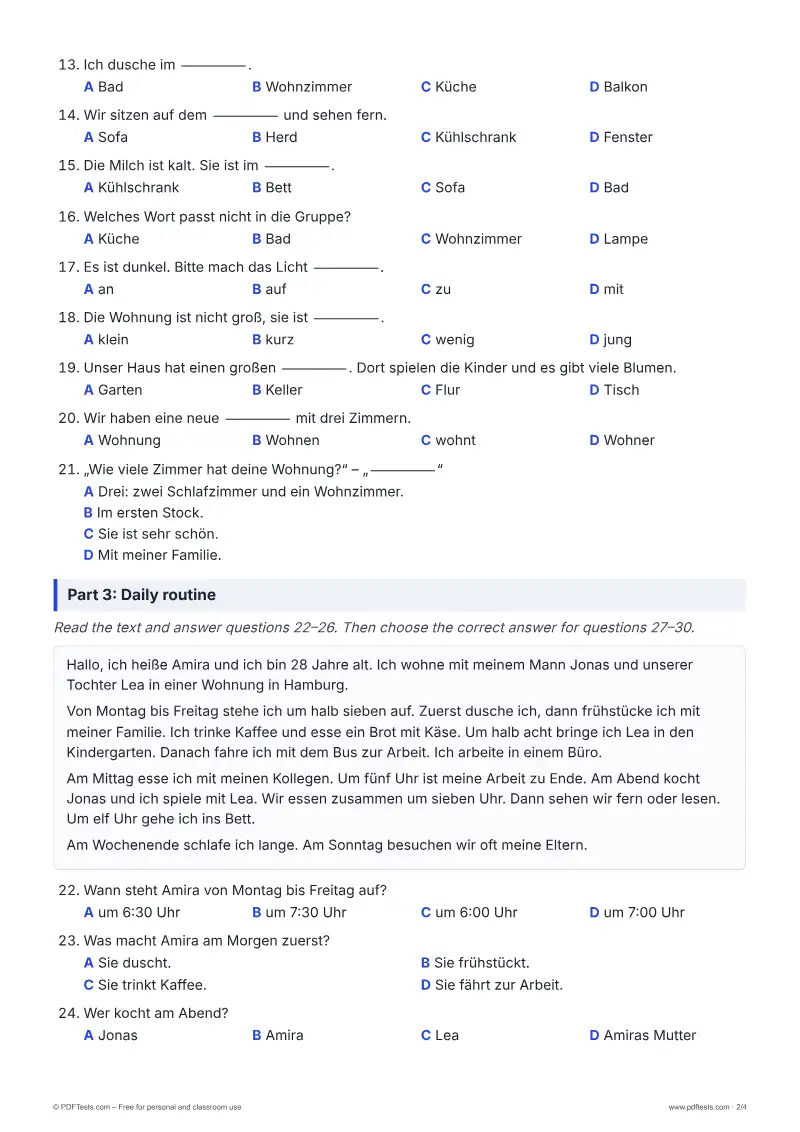
  1. Ich koche in der _____.

  2. Im _____ schlafe ich.

  3. Ich dusche im _____.

  4. Wir sitzen auf dem _____ und sehen fern.

  5. Die Milch ist kalt. Sie ist im _____.

  6. Welches Wort passt nicht in die Gruppe?

  7. Es ist dunkel. Bitte mach das Licht _____.

  8. Die Wohnung ist nicht groß, sie ist _____.

  9. Unser Haus hat einen großen _____. Dort spielen die Kinder und es gibt viele Blumen.

  10. Wir haben eine neue _____ mit drei Zimmern.

  11. „Wie viele Zimmer hat deine Wohnung?“ – „_____“

Part 3: Daily routine

Read the text and answer questions 22–26. Then choose the correct answer for questions 27–30.

Hallo, ich heiße Amira und ich bin 28 Jahre alt. Ich wohne mit meinem Mann Jonas und unserer Tochter Lea in einer Wohnung in Hamburg.

Von Montag bis Freitag stehe ich um halb sieben auf. Zuerst dusche ich, dann frühstücke ich mit meiner Familie. Ich trinke Kaffee und esse ein Brot mit Käse. Um halb acht bringe ich Lea in den Kindergarten. Danach fahre ich mit dem Bus zur Arbeit. Ich arbeite in einem Büro.

Am Mittag esse ich mit meinen Kollegen. Um fünf Uhr ist meine Arbeit zu Ende. Am Abend kocht Jonas und ich spiele mit Lea. Wir essen zusammen um sieben Uhr. Dann sehen wir fern oder lesen. Um elf Uhr gehe ich ins Bett.

Am Wochenende schlafe ich lange. Am Sonntag besuchen wir oft meine Eltern.

  1. Wann steht Amira von Montag bis Freitag auf?

  2. Was macht Amira am Morgen zuerst?

  3. Wer kocht am Abend?

  4. Im Text steht „frühstücken“. Was bedeutet das?

  5. Was macht die Familie am Sonntag oft?

  6. Nach dem Frühstück _____ ich mir die Zähne.

  7. Es ist 23 Uhr und ich bin sehr müde. Ich gehe jetzt _____.

  8. Ich gehe um acht Uhr aus dem Haus und komme um 18 Uhr nach _____.

  9. Welcher Satz ist falsch?

Preview

About this test

This A1 German vocabulary test checks everyday words for family members, rooms and furniture, and daily routines. It includes gap fills, word meanings, collocations, plurals, short responses and a reading text about a normal day. It suits beginners, adult learners and school classes revising the first topics of a German course.

Topics covered

Family membersRooms and furnitureDaily routineCollocationsPlural formsTelling the timeReading comprehension

How to use this test

  1. Download the PDF and print it, or take the test online below.
  2. Answer every question without a dictionary or time pressure.
  3. Check your answers and note the topics you need to review.

Notes for teachers

Use this test after the first units on family, home and routine, or as a placement check for beginners. It targets common mistakes such as confusing Onkel/Cousin and Eltern/Großeltern, misreading 'halb sieben', and wrong verb-noun pairs like 'das Licht aufmachen' or 'nach Haus' instead of 'nach Hause'. As a follow-up, ask learners to draw their family tree or write five sentences about their own day using the Part 3 text as a model.