PDFTests Originals

Dative Case (Dativ) – Test 2

A2 Elementary GrammarGerman

This A2 test checks how well you use the German dative case (Dativ). It covers articles and possessive words, personal pronouns, common verbs that take the dative, and prepositions such as aus, bei, mit, nach, seit, von and zu. It suits learners at the end of A2 and teachers who want a quick, printable check.
Questions
30
Time
25 min
PDF
3 pages
Answer key
Included
  • 100% free
  • No sign-up or email
  • Print-ready A4 PDF
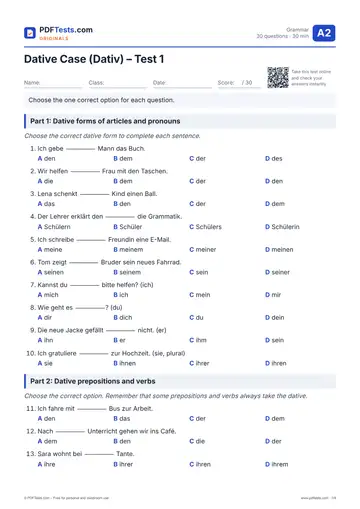
Preview of page 1 of Dative Case (Dativ) – Test 2 Open PDF
New to this topic? Read the guide first: German Dative Case (Dativ): Rules, Examples and Common Mistakes

Take the test online

Choose the one correct option (A, B, C or D) for each question. Choose your answers, then press “Check my answers”.

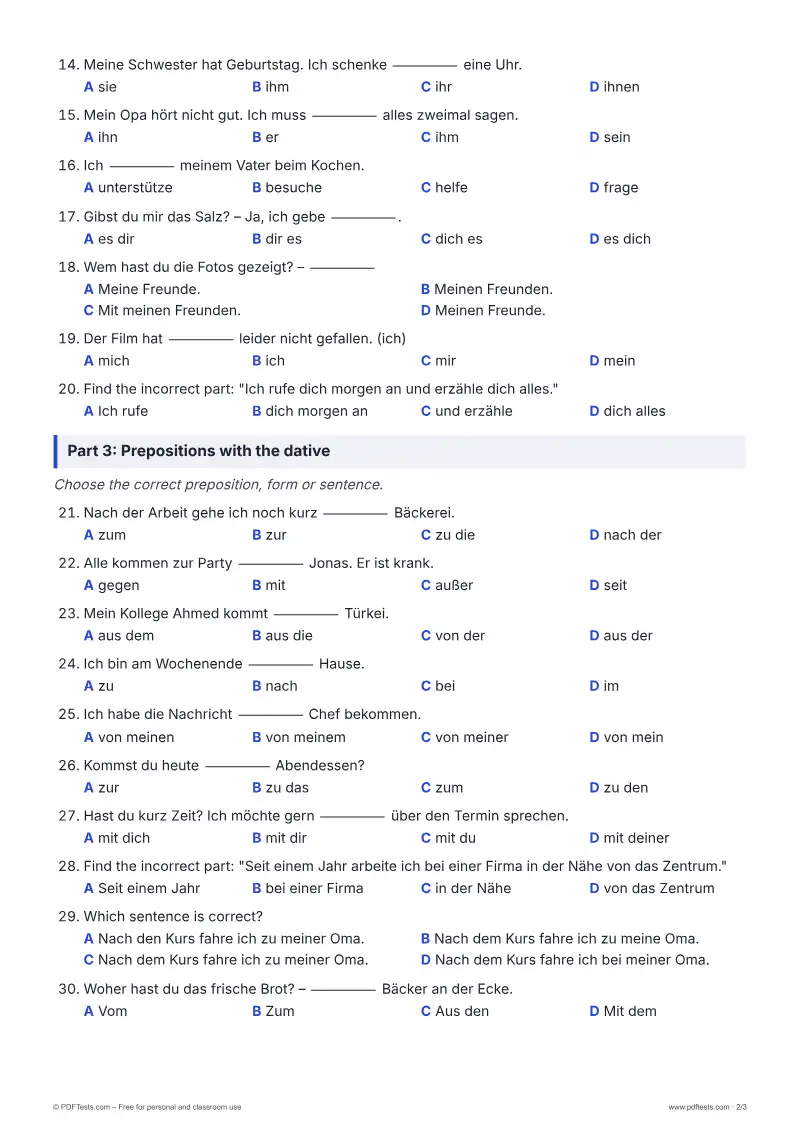
Part 1: Articles and possessive words in the dative

Choose the correct form to complete each sentence.

  1. Der Kellner bringt _____ Gast die Speisekarte.

  2. Die Ärztin gibt _____ Patientin ein Rezept.

  3. Wir schicken _____ Kindern eine Postkarte aus dem Urlaub.

  4. Paul kauft _____ Schwester ein Buch zum Geburtstag.

  5. Frau Yilmaz erklärt _____ Sohn die Hausaufgaben.

  6. Ich spiele oft mit den _____ im Park. (Hund)

  7. Das Auto gehört _____ Eltern.

  8. Er telefoniert jeden Abend mit _____ Freund in Spanien.

  9. Which sentence is correct?

  10. Die Großmutter liest _____ Enkelkindern eine Geschichte vor.

Part 2: Pronouns and verbs with the dative

Choose the correct pronoun, verb or answer.

  1. Das Essen schmeckt _____ sehr gut. (wir)

  2. Hallo Mia und Ben! Gefällt _____ die neue Wohnung? (ihr)

  3. Frau Schmidt, gehört _____ dieser Schirm?

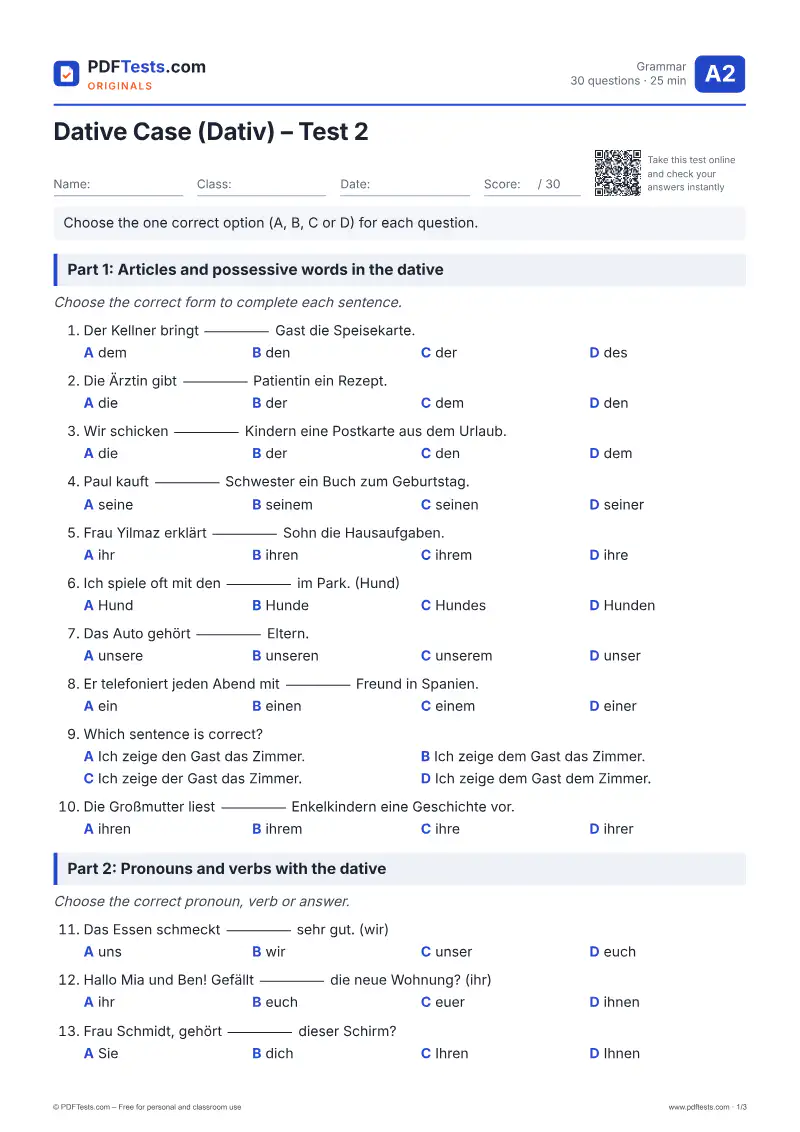
  4. Meine Schwester hat Geburtstag. Ich schenke _____ eine Uhr.

  5. Mein Opa hört nicht gut. Ich muss _____ alles zweimal sagen.

  6. Ich _____ meinem Vater beim Kochen.

  7. Gibst du mir das Salz? – Ja, ich gebe _____.

  8. Wem hast du die Fotos gezeigt? – _____

  9. Der Film hat _____ leider nicht gefallen. (ich)

  10. Find the incorrect part: "Ich rufe dich morgen an und erzähle dich alles."

Part 3: Prepositions with the dative

Choose the correct preposition, form or sentence.

  1. Nach der Arbeit gehe ich noch kurz _____ Bäckerei.

  2. Alle kommen zur Party _____ Jonas. Er ist krank.

  3. Mein Kollege Ahmed kommt _____ Türkei.

  4. Ich bin am Wochenende _____ Hause.

  5. Ich habe die Nachricht _____ Chef bekommen.

  6. Kommst du heute _____ Abendessen?

  7. Hast du kurz Zeit? Ich möchte gern _____ über den Termin sprechen.

  8. Find the incorrect part: "Seit einem Jahr arbeite ich bei einer Firma in der Nähe von das Zentrum."

  9. Which sentence is correct?

  10. Woher hast du das frische Brot? – _____ Bäcker an der Ecke.

Was this page helpful?

Report a mistake

Spotted a wrong answer, a typo or an unclear explanation? Tell us and we will fix it.

Practise with a worksheet: Dative Case (Dativ) – Worksheet 1

Preview

About this test

This A2 test checks how well you use the German dative case (Dativ). It covers articles and possessive words, personal pronouns, common verbs that take the dative, and prepositions such as aus, bei, mit, nach, seit, von and zu. It suits learners at the end of A2 and teachers who want a quick, printable check.

Topics covered

Dative articlesPossessive determinersDative personal pronounsVerbs with the dativeDative prepositionsContractions zum, zur, vomWord order with two objects

How to use this test

  1. Download the PDF and print it, or take the test online below.
  2. Answer every question without a dictionary or time pressure.
  3. Check your answers and note the topics you need to review.

Notes for teachers

Use this test after teaching the dative forms of articles, possessives and pronouns. It targets typical A2 errors: accusative instead of dative after helfen, gefallen and mit, a missing -n in the dative plural, mixing up zu Hause and nach Hause, and wrong contractions. As a follow-up, ask learners to write five sentences about gifts they give to family members, using two objects in the correct order.