PDFTests Originals

Dative Case (Dativ) – Worksheet 1

A2 Elementary WorksheetGerman

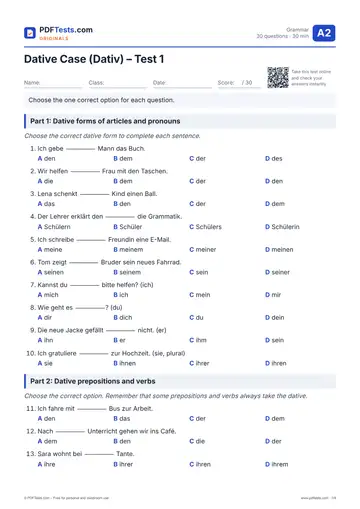
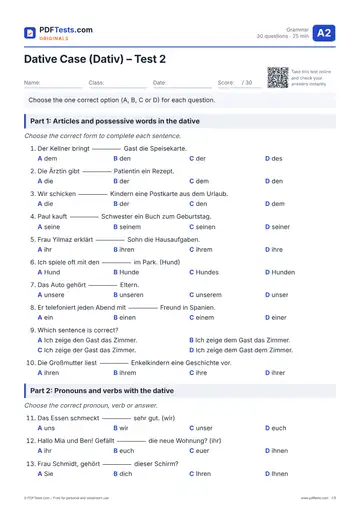
This worksheet practises the German dative case (Dativ) at A2 level: dative articles and possessives, personal pronouns, common dative verbs like helfen, gehören and gefallen, and the prepositions aus, bei, mit, nach, seit, von, zu and gegenüber. It is for learners who know the nominative and accusative and want to use the dative confidently in statements, negatives and questions.
items
37
Time
35 min
PDF
5 pages
Answer key
Included
  • 100% free
  • No sign-up or email
  • Print-ready A4 PDF
Preview of page 1 of Dative Case (Dativ) – Worksheet 1 Open PDF
New to this topic? Read the guide first: German Dative Case (Dativ): Rules, Examples and Common Mistakes

Do the worksheet online

Type your answers, then press “Check my answers”. Alternative correct answers are accepted.

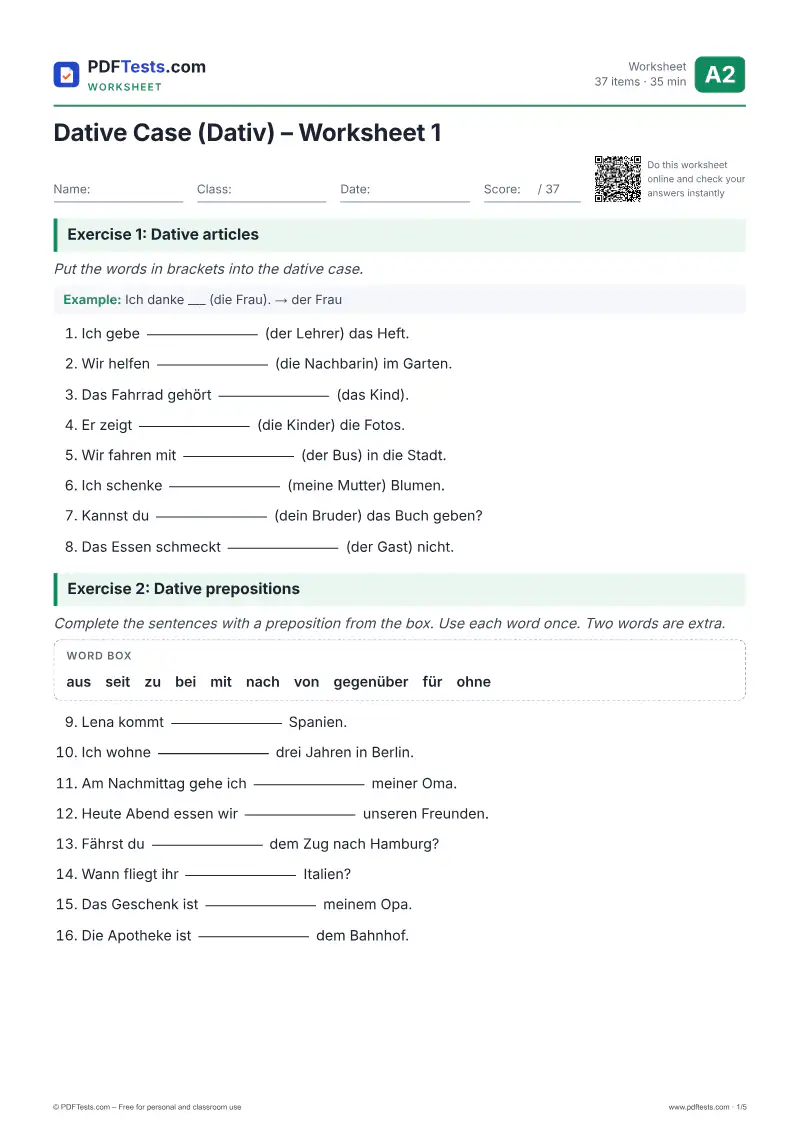
Exercise 1: Dative articles

Put the words in brackets into the dative case.

Example: Ich danke ___ (die Frau). → der Frau

  1. Ich gebe (der Lehrer) das Heft.

  2. Wir helfen (die Nachbarin) im Garten.

  3. Das Fahrrad gehört (das Kind).

  4. Er zeigt (die Kinder) die Fotos.

  5. Wir fahren mit (der Bus) in die Stadt.

  6. Ich schenke (meine Mutter) Blumen.

  7. Kannst du (dein Bruder) das Buch geben?

  8. Das Essen schmeckt (der Gast) nicht.

Exercise 2: Dative prepositions

Complete the sentences with a preposition from the box. Use each word once. Two words are extra.

Word box ausseitzubeimitnachvongegenüberfürohne

  1. Lena kommt Spanien.

  2. Ich wohne drei Jahren in Berlin.

  3. Am Nachmittag gehe ich meiner Oma.

  4. Heute Abend essen wir unseren Freunden.

  5. Fährst du dem Zug nach Hamburg?

  6. Wann fliegt ihr Italien?

  7. Das Geschenk ist meinem Opa.

  8. Die Apotheke ist dem Bahnhof.

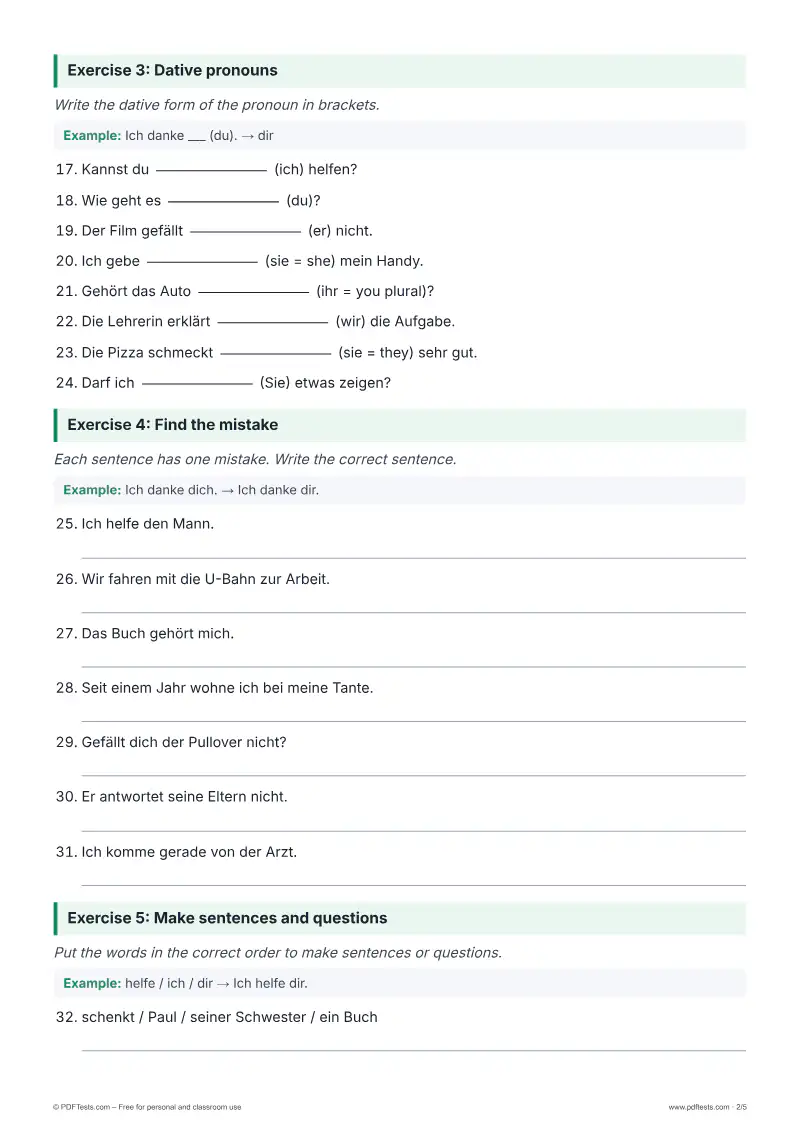
Exercise 3: Dative pronouns

Write the dative form of the pronoun in brackets.

Example: Ich danke ___ (du). → dir

  1. Kannst du (ich) helfen?

  2. Wie geht es (du)?

  3. Der Film gefällt (er) nicht.

  4. Ich gebe (sie = she) mein Handy.

  5. Gehört das Auto (ihr = you plural)?

  6. Die Lehrerin erklärt (wir) die Aufgabe.

  7. Die Pizza schmeckt (sie = they) sehr gut.

  8. Darf ich (Sie) etwas zeigen?

Exercise 4: Find the mistake

Each sentence has one mistake. Write the correct sentence.

Example: Ich danke dich. → Ich danke dir.

  1. Ich helfe den Mann.

  2. Wir fahren mit die U-Bahn zur Arbeit.

  3. Das Buch gehört mich.

  4. Seit einem Jahr wohne ich bei meine Tante.

  5. Gefällt dich der Pullover nicht?

  6. Er antwortet seine Eltern nicht.

  7. Ich komme gerade von der Arzt.

Exercise 5: Make sentences and questions

Put the words in the correct order to make sentences or questions.

Example: helfe / ich / dir → Ich helfe dir.

  1. schenkt / Paul / seiner Schwester / ein Buch

  2. du / mir / hilfst / ?

  3. gehört / wem / die Tasche / ?

  4. schmeckt / die Suppe / nicht / meinem Vater

  5. mit / fährst / dem Fahrrad / du / zur Schule / ?

  6. kann / ich / Ihnen / helfen / ?

Was this page helpful?

Report a mistake

Spotted a wrong answer, a typo or an unclear explanation? Tell us and we will fix it.

Preview

About this test

Printable A2 German worksheet on the dative case: articles, pronouns, dative verbs and prepositions, with negatives and questions. Answers included.

Topics covered

Dative articles (dem, der, den + -n)Dative personal pronounsVerbs with the dativeDative prepositionsQuestions with wemNegatives with nicht

Notes for teachers

Start by reviewing the dative article table (dem – der – dem – den + -n) and the question word wem before Exercise 1. Typical mistakes are using the accusative after helfen or danken (*Ich helfe den Mann), forgetting the -n in the dative plural (*den Kinder), and confusing dich/dir and mich/mir. As a follow-up, have pairs ask each other 'Wem gehört …?' and 'Wie gefällt dir …?' about objects in the classroom.

All German A2 tests →