The dative case (der Dativ) is the German case for the indirect object: the person or thing that receives something or benefits from an action. It answers the question wem? (to whom? / for whom?). You also need the dative after certain prepositions, such as mit, bei and zu, and after some very common verbs, such as helfen and gefallen.
If you already know the accusative, the dative is the next step. If not, review our guide to the Accusative Case first, because the two cases often appear in the same sentence.
When to use the dative
1. The indirect object (the receiver)
Many verbs have two objects: a thing (accusative) and a person who receives it (dative).
- Ich gebe dem Kind einen Apfel. — I give the child an apple.
- Sie schenkt ihrer Mutter Blumen. — She gives her mother flowers.
- Kannst du mir den Weg zeigen? — Can you show me the way?
Common verbs of this type: geben (give), schenken (give as a present), zeigen (show), schicken (send), bringen (bring), erklären (explain), kaufen (buy), empfehlen (recommend), leihen (lend).
2. After dative prepositions
These prepositions always take the dative, whatever the meaning:
| Preposition | Meaning | Example |
|---|---|---|
| aus | from, out of | Ich komme aus der Schweiz. — I come from Switzerland. |
| bei | at, near, with | Ich wohne bei meinen Eltern. — I live with my parents. |
| mit | with, by (transport) | Wir fahren mit dem Bus. — We are going by bus. |
| nach | after, to (cities, countries) | Nach dem Essen gehe ich spazieren. — After the meal I go for a walk. |
| seit | since, for (time) | Ich lerne seit einem Jahr Deutsch. — I have been learning German for a year. |
| von | from, of, by | Das ist ein Geschenk von meinem Bruder. — That is a present from my brother. |
| zu | to | Ich gehe zum Arzt. — I am going to the doctor. |
| gegenüber | opposite | Die Bank ist gegenüber dem Bahnhof. — The bank is opposite the station. |
A simple way to remember the main ones: aus – bei – mit – nach – seit – von – zu.
3. After dative verbs
Some verbs take a dative object even though English uses a normal direct object:
- Ich helfe dir. — I’ll help you.
- Wir danken Ihnen für die Einladung. — We thank you for the invitation.
- Das Hemd gefällt mir. — I like the shirt. (literally: The shirt pleases me.)
- Wem gehört das Handy? Es gehört meiner Schwester. — Whose phone is it? It belongs to my sister.
- Ich gratuliere dir zum Geburtstag. — Happy birthday. (literally: I congratulate you on your birthday.)
Other useful A2 dative verbs: antworten (answer), schmecken (taste good), passen (fit, suit), stehen (look good on), glauben (believe a person), fehlen (be missing), folgen (follow).
4. Two-way prepositions for location
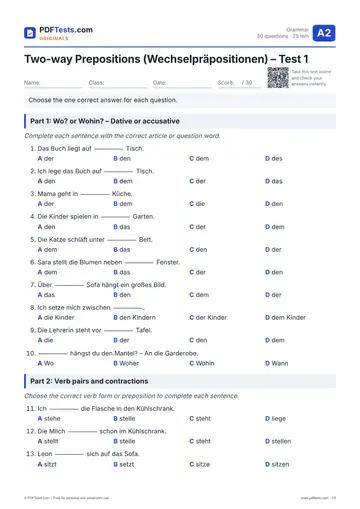
The prepositions in, an, auf, über, unter, vor, hinter, neben, zwischen take the dative when they describe where something is (question wo?), and the accusative when they describe movement to a place (wohin?).
- Das Buch liegt auf dem Tisch. — The book is on the table. (wo? → dative)
- Ich lege das Buch auf den Tisch. — I put the book on the table. (wohin? → accusative)
This topic has its own guide to Two-way Prepositions.
5. Fixed expressions
A number of everyday phrases use the dative:
- Mir ist kalt. — I’m cold.
- Wie geht es Ihnen? — How are you?
- Es tut mir leid. — I’m sorry.
- Das ist mir egal. — I don’t mind. / I don’t care.
Form: dative articles
The article shows the case. Compare the three cases you use at A2:
| Case | Masculine | Feminine | Neuter | Plural |
|---|---|---|---|---|
| Nominative | der / ein | die / eine | das / ein | die / – |
| Accusative | den / einen | die / eine | das / ein | die / – |
| Dative | dem / einem | der / einer | dem / einem | den / – |
Three patterns to notice:
- Masculine and neuter are the same in the dative: -m (dem, einem).
- Feminine dative is -r (der, einer), so der can be nominative masculine or dative feminine.
- Plural dative is den, and the noun usually adds -n.
Kein and possessive articles follow the same endings as ein:
| Masculine | Feminine | Neuter | Plural | |
|---|---|---|---|---|
| kein | keinem | keiner | keinem | keinen |
| mein | meinem | meiner | meinem | meinen |
| unser | unserem | unserer | unserem | unseren |
- Ich telefoniere mit meiner Freundin. — I’m on the phone with my girlfriend.
- Er spricht mit keinem Kollegen. — He doesn’t speak to any colleague.
For all forms of mein, dein, sein and so on, see the guide to Possessive Articles.
The plural -n
In the dative plural, add -n to the noun if it does not already end in -n or -s:
- die Kinder → mit den Kindern — with the children
- die Freunde → mit meinen Freunden — with my friends
- die Jahre → seit zwei Jahren — for two years
No extra -n: den Frauen (already -n), den Autos (plural in -s).
Weak masculine nouns
A small group of masculine nouns, often for people, add -n or -en in every case except the nominative: der Junge → dem Jungen, der Student → dem Studenten, der Kollege → dem Kollegen, der Herr → dem Herrn.
- Ich helfe dem Studenten. — I’m helping the student.
Contractions
Some prepositions merge with dem or der. These short forms are normal in both speech and writing:
| Full form | Contraction | Example |
|---|---|---|
| zu dem | zum | Ich gehe zum Bahnhof. — I’m going to the station. |
| zu der | zur | Sie fährt zur Arbeit. — She drives to work. |
| bei dem | beim | Er ist beim Arzt. — He is at the doctor’s. |
| von dem | vom | Ich komme vom Sport. — I’m coming from sport. |
| in dem | im | Wir sind im Kino. — We are at the cinema. |
| an dem | am | Wir treffen uns am Montag. — We’re meeting on Monday. |
Form: dative pronouns
| Nominative | Accusative | Dative |
|---|---|---|
| ich | mich | mir |
| du | dich | dir |
| er | ihn | ihm |
| sie | sie | ihr |
| es | es | ihm |
| wir | uns | uns |
| ihr | euch | euch |
| sie | sie | ihnen |
| Sie | Sie | Ihnen |
- Kannst du ihr helfen? — Can you help her?
- Die Pizza schmeckt uns. — We like the pizza. (literally: The pizza tastes good to us.)
- Wie gefällt Ihnen Berlin? — How do you like Berlin?
Be careful: ihr can mean you (plural, nominative) or to her (dative). The verb and context tell you which one it is.
Word order: dative and accusative together
When a sentence has both objects, follow these rules:
- Two nouns: dative before accusative.
- Ich gebe dem Lehrer das Heft. — I give the teacher the exercise book.
- One pronoun, one noun: the pronoun comes first.
- Ich gebe ihm das Heft. — I give him the exercise book.
- Ich gebe es dem Lehrer. — I give it to the teacher.
- Two pronouns: accusative before dative.
- Ich gebe es ihm. — I give it to him.
Dative or accusative?
Learners often mix up the two object cases. Ask yourself:
| Question | Case | Role | Example |
|---|---|---|---|
| Wen? / Was? | Accusative | the thing or person directly affected | Ich sehe den Mann. — I see the man. |
| Wem? | Dative | the receiver, or the object of a dative verb/preposition | Ich helfe dem Mann. — I help the man. |
The English translation does not help here: I see the man and I help the man look the same in English, but sehen takes the accusative and helfen takes the dative. Learn dative verbs as fixed pairs: helfen + Dativ, gefallen + Dativ.
Common mistakes
- ✗ Ich helfe dich. → ✓ Ich helfe dir. — helfen always takes the dative.
- ✗ Wir fahren mit der Bus. → ✓ Wir fahren mit dem Bus. — mit takes the dative, and Bus is masculine.
- ✗ Ich spiele mit meine Freunde. → ✓ Ich spiele mit meinen Freunden. — dative plural needs -en on the article and -n on the noun.
- ✗ Das Kleid gefällt ich. → ✓ Das Kleid gefällt mir. — the person who likes something is in the dative.
- ✗ Ich gebe ihm es. → ✓ Ich gebe es ihm. — with two pronouns, the accusative comes first.
- ✗ Ich lerne seit zwei Jahre Deutsch. → ✓ Ich lerne seit zwei Jahren Deutsch. — seit takes the dative, so the plural adds -n.
- ✗ Ich bin kalt. → ✓ Mir ist kalt. — feeling cold or warm is expressed with a dative pronoun.
- ✗ Ich gehe zu dem Supermarkt. → ✓ Ich gehe zum Supermarkt. — the full form is not wrong, but zum is what native speakers normally say.
Quick check
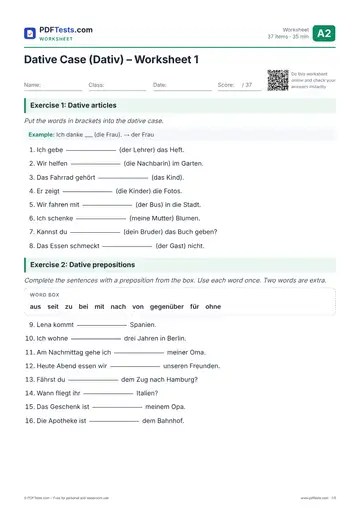
Fill in the correct dative form.
- Ich fahre mit ___ Zug nach Hamburg. (der)
- Kannst du ___ bitte helfen? (ich)
- Die Jacke gefällt ___ Schwester. (meine)
- Wir spielen im Park mit ___ Kindern. (die)
- Ich wohne seit drei ___ in München. (Jahr, plural)
Answers
- dem — Ich fahre mit dem Zug nach Hamburg. — I’m going to Hamburg by train.
- mir — Kannst du mir bitte helfen? — Can you help me, please?
- meiner — Die Jacke gefällt meiner Schwester. — My sister likes the jacket.
- den — Wir spielen im Park mit den Kindern. — We play in the park with the children.
- Jahren — Ich wohne seit drei Jahren in München. — I have lived in Munich for three years.
Next step
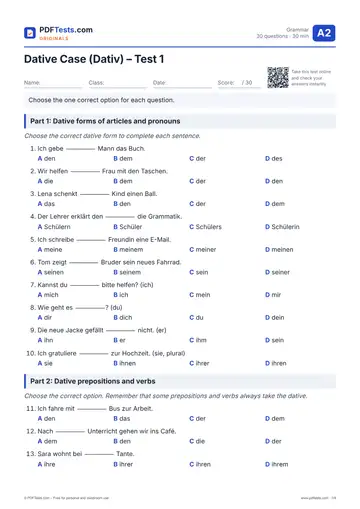
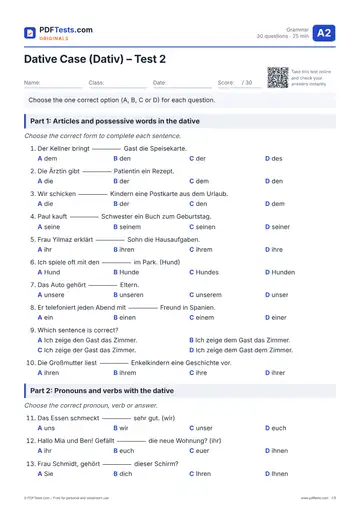
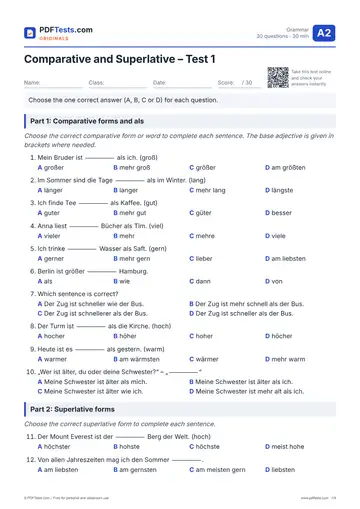
Now put the rules into practice: test yourself with our A2 Dative Case test, then try Dative Case Test 2 for more dative verbs, prepositions and word order. When you feel confident, move on to the A2 Two-way Prepositions test, where you have to choose between dative and accusative in every sentence.
Was this page helpful?
What was the problem?
Thank you for your feedback!