PDFTests Originals

Academic Vocabulary – Test 1

C1 Advanced VocabularyEnglish

This C1 test checks the vocabulary needed for reading and writing academic texts. It covers meaning in context, common academic collocations and word formation across word families. It suits advanced learners preparing for university study or exams such as IELTS and C1 Advanced, and teachers of EAP courses.
Questions
30
Time
30 min
PDF
5 pages
Answer key
Included
  • 100% free
  • No sign-up or email
  • Print-ready A4 PDF
Preview of page 1 of Academic Vocabulary – Test 1 Open PDF

Take the test online

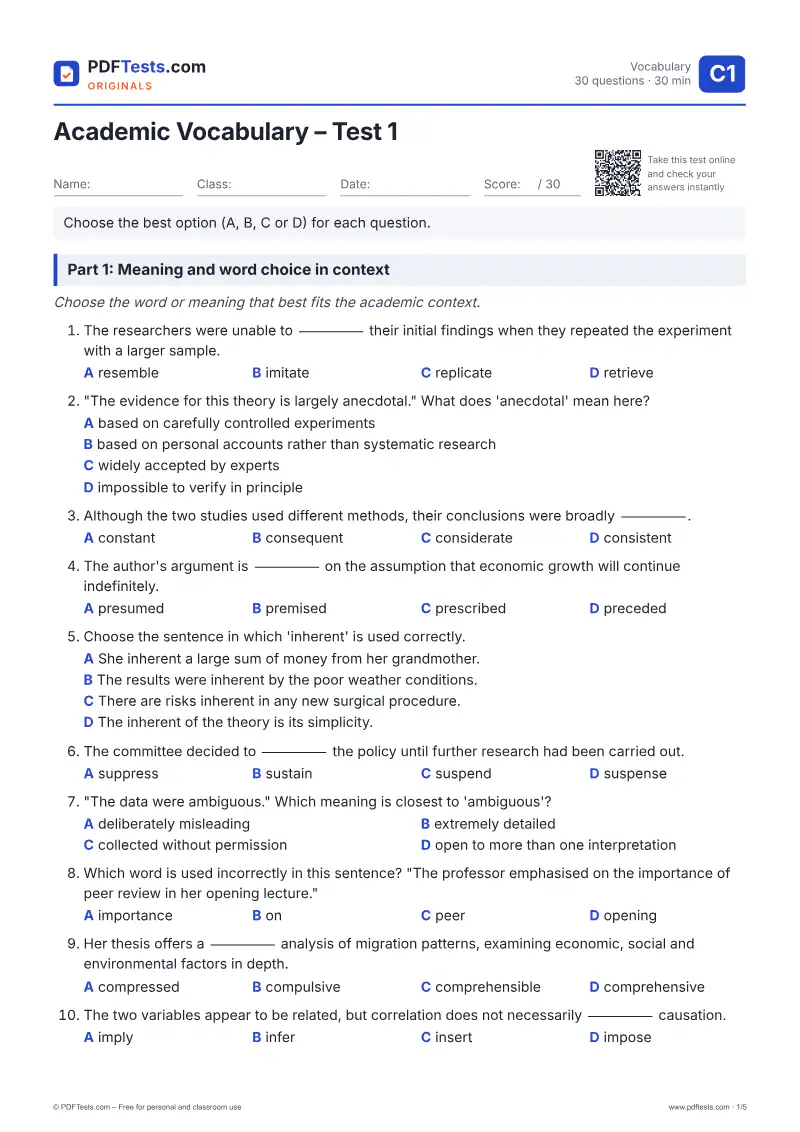
Choose the best option (A, B, C or D) for each question. Choose your answers, then press “Check my answers”.

Part 1: Meaning and word choice in context

Choose the word or meaning that best fits the academic context.

  1. The researchers were unable to _____ their initial findings when they repeated the experiment with a larger sample.

  2. "The evidence for this theory is largely anecdotal." What does 'anecdotal' mean here?

  3. Although the two studies used different methods, their conclusions were broadly _____.

  4. The author's argument is _____ on the assumption that economic growth will continue indefinitely.

  5. Choose the sentence in which 'inherent' is used correctly.

  6. The committee decided to _____ the policy until further research had been carried out.

  7. "The data were ambiguous." Which meaning is closest to 'ambiguous'?

  8. Which word is used incorrectly in this sentence? "The professor emphasised on the importance of peer review in her opening lecture."

  9. Her thesis offers a _____ analysis of migration patterns, examining economic, social and environmental factors in depth.

  10. The two variables appear to be related, but correlation does not necessarily _____ causation.

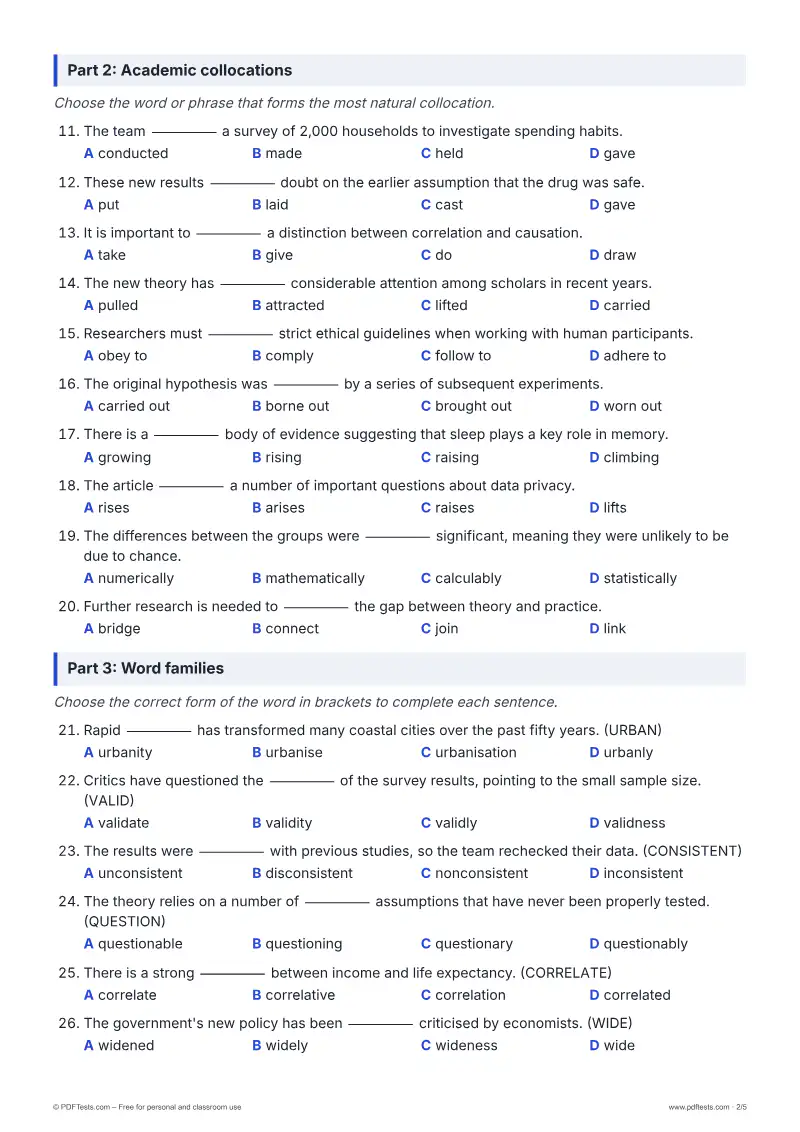
Part 2: Academic collocations

Choose the word or phrase that forms the most natural collocation.

  1. The team _____ a survey of 2,000 households to investigate spending habits.

  2. These new results _____ doubt on the earlier assumption that the drug was safe.

  3. It is important to _____ a distinction between correlation and causation.

  4. The new theory has _____ considerable attention among scholars in recent years.

  5. Researchers must _____ strict ethical guidelines when working with human participants.

  6. The original hypothesis was _____ by a series of subsequent experiments.

  7. There is a _____ body of evidence suggesting that sleep plays a key role in memory.

  8. The article _____ a number of important questions about data privacy.

  9. The differences between the groups were _____ significant, meaning they were unlikely to be due to chance.

  10. Further research is needed to _____ the gap between theory and practice.

Part 3: Word families

Choose the correct form of the word in brackets to complete each sentence.

  1. Rapid _____ has transformed many coastal cities over the past fifty years. (URBAN)

  2. Critics have questioned the _____ of the survey results, pointing to the small sample size. (VALID)

  3. The results were _____ with previous studies, so the team rechecked their data. (CONSISTENT)

  4. The theory relies on a number of _____ assumptions that have never been properly tested. (QUESTION)

  5. There is a strong _____ between income and life expectancy. (CORRELATE)

  6. The government's new policy has been _____ criticised by economists. (WIDE)

  7. Researchers must ensure the _____ of participants' personal data. (CONFIDENTIAL)

  8. Her findings _____ the claim that bilingual children develop better problem-solving skills. (STRONG)

  9. The sample was not _____ of the wider population, so the conclusions cannot be generalised. (REPRESENT)

  10. The author's argument is rather _____ because it ignores several key factors. (SIMPLE)

Preview

About this test

This C1 test checks the vocabulary needed for reading and writing academic texts. It covers meaning in context, common academic collocations and word formation across word families. It suits advanced learners preparing for university study or exams such as IELTS and C1 Advanced, and teachers of EAP courses.

Topics covered

Academic vocabularyMeaning in contextCollocationsWord familiesWord formationConfusable words

How to use this test

  1. Download the PDF and print it, or take the test online below.
  2. Answer every question without a dictionary or time pressure.
  3. Check your answers and note the topics you need to review.

Notes for teachers

Use the test as a diagnostic at the start of an EAP course or as a review after work on academic writing. It targets common C1 errors such as confusing similar-looking words (imply/infer, comprehensive/comprehensible), adding unnecessary prepositions (emphasise on) and choosing the wrong verb in fixed collocations (cast doubt, draw a distinction). As follow-up, ask students to write their own academic sentences with the collocations from Part 2. They can also build full word-family tables for the words in Part 3.