PDFTests Originals

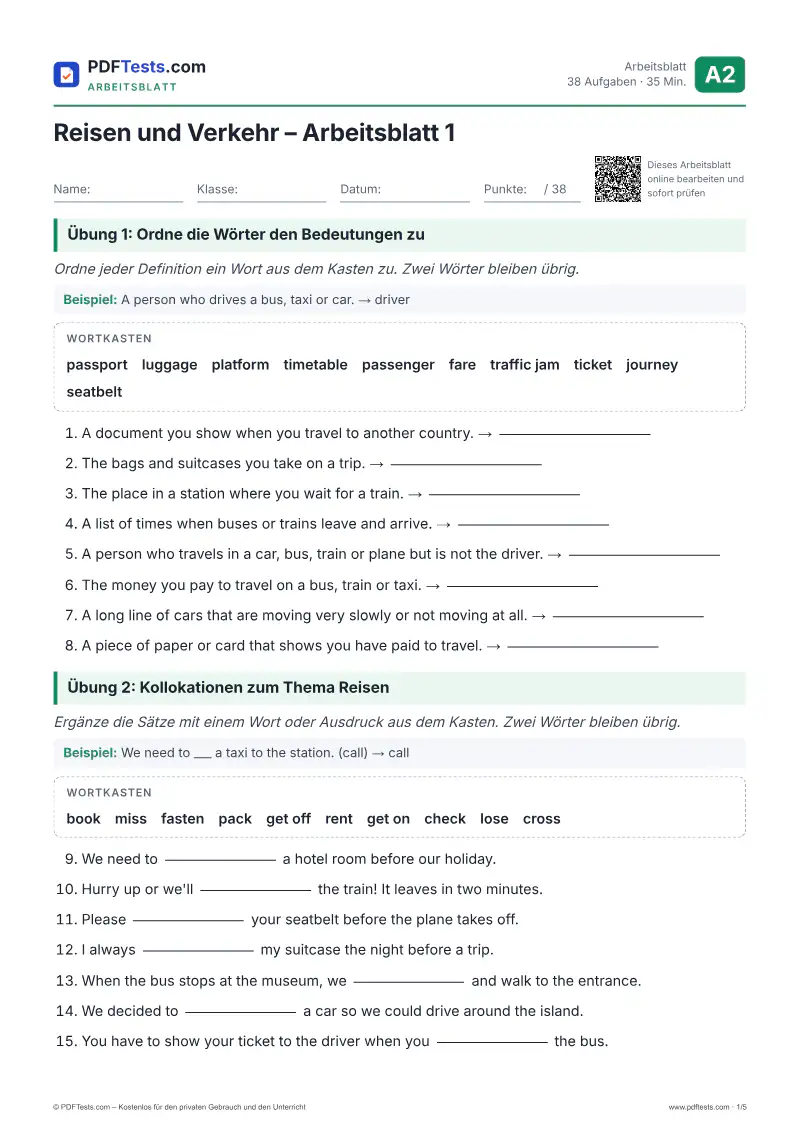
Reisen und Verkehr – Arbeitsblatt 1

A2 Grundstufe ArbeitsblattEnglisch

Dieses Arbeitsblatt übt alltäglichen englischen Wortschatz rund um Reisen und Verkehr auf dem Niveau A2: wichtige Wörter und ihre Bedeutungen, typische Kollokationen wie miss the bus oder fasten your seatbelt, Präpositionen wie by car und on foot sowie nützliche Wortformen. Es eignet sich für Jugendliche und Erwachsene, im Unterricht oder als Hausaufgabe.
Aufgaben
38
Zeit
35 Min.
PDF
5 Seiten
Lösungen
Enthalten
  • 100 % kostenlos
  • Ohne Anmeldung
  • Druckfertiges A4-PDF
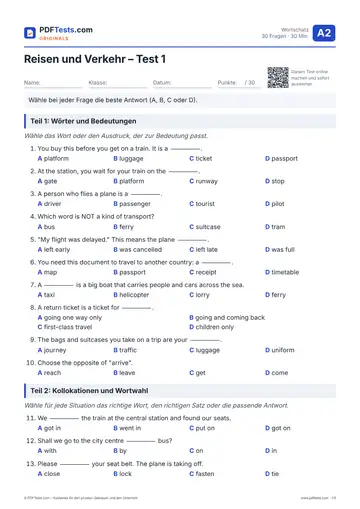
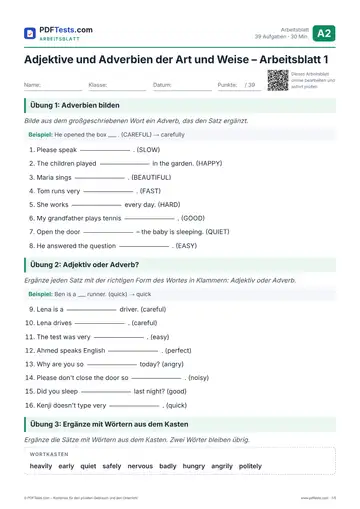
Vorschau von Seite 1: Reisen und Verkehr – Arbeitsblatt 1 PDF öffnen

Arbeitsblatt online bearbeiten

Tippen Sie Ihre Antworten ein und klicken Sie auf „Antworten prüfen“. Alternative richtige Antworten werden akzeptiert.

Übung 1: Ordne die Wörter den Bedeutungen zu

Ordne jeder Definition ein Wort aus dem Kasten zu. Zwei Wörter bleiben übrig.

Beispiel: A person who drives a bus, taxi or car. → driver

Wortkasten passportluggageplatformtimetablepassengerfaretraffic jamticketjourneyseatbelt

  1. A document you show when you travel to another country.

  2. The bags and suitcases you take on a trip.

  3. The place in a station where you wait for a train.

  4. A list of times when buses or trains leave and arrive.

  5. A person who travels in a car, bus, train or plane but is not the driver.

  6. The money you pay to travel on a bus, train or taxi.

  7. A long line of cars that are moving very slowly or not moving at all.

  8. A piece of paper or card that shows you have paid to travel.

Übung 2: Kollokationen zum Thema Reisen

Ergänze die Sätze mit einem Wort oder Ausdruck aus dem Kasten. Zwei Wörter bleiben übrig.

Beispiel: We need to ___ a taxi to the station. (call) → call

Wortkasten bookmissfastenpackget offrentget onchecklosecross

  1. We need to a hotel room before our holiday.

  2. Hurry up or we'll the train! It leaves in two minutes.

  3. Please your seatbelt before the plane takes off.

  4. I always my suitcase the night before a trip.

  5. When the bus stops at the museum, we and walk to the entrance.

  6. We decided to a car so we could drive around the island.

  7. You have to show your ticket to the driver when you the bus.

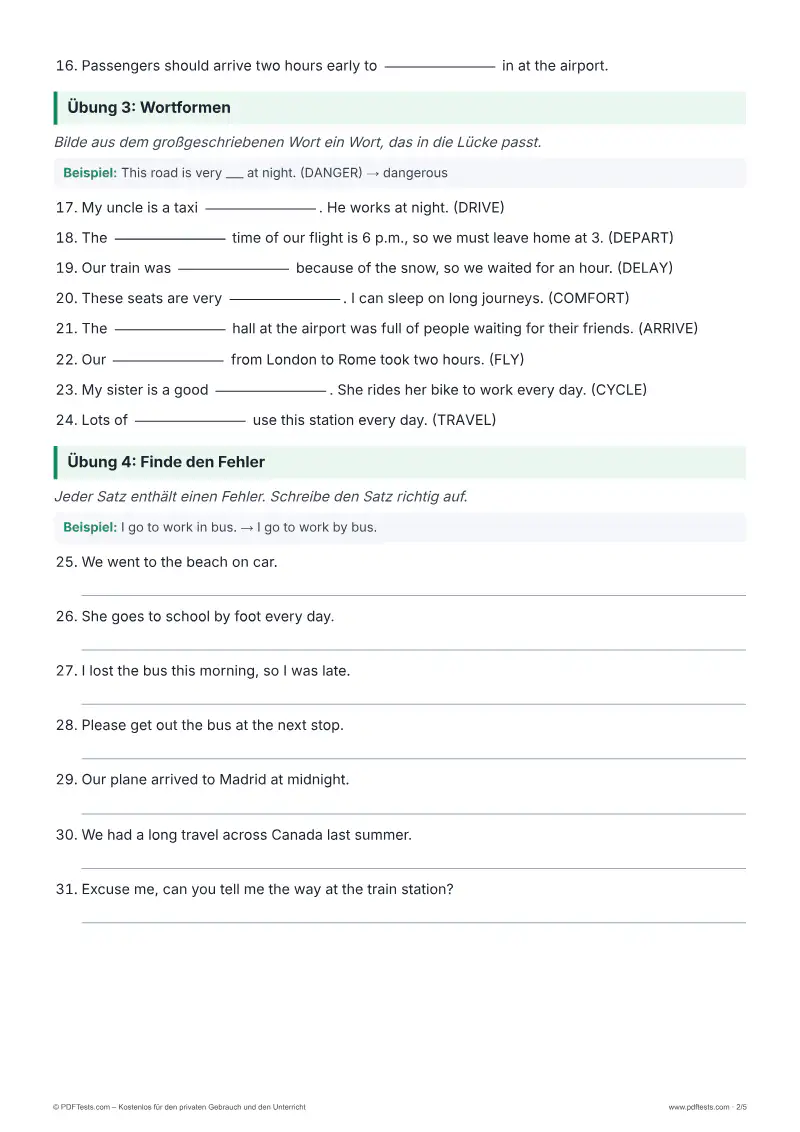
  8. Passengers should arrive two hours early to in at the airport.

Übung 3: Wortformen

Bilde aus dem großgeschriebenen Wort ein Wort, das in die Lücke passt.

Beispiel: This road is very ___ at night. (DANGER) → dangerous

  1. My uncle is a taxi . He works at night. (DRIVE)

  2. The time of our flight is 6 p.m., so we must leave home at 3. (DEPART)

  3. Our train was because of the snow, so we waited for an hour. (DELAY)

  4. These seats are very . I can sleep on long journeys. (COMFORT)

  5. The hall at the airport was full of people waiting for their friends. (ARRIVE)

  6. Our from London to Rome took two hours. (FLY)

  7. My sister is a good . She rides her bike to work every day. (CYCLE)

  8. Lots of use this station every day. (TRAVEL)

Übung 4: Finde den Fehler

Jeder Satz enthält einen Fehler. Schreibe den Satz richtig auf.

Beispiel: I go to work in bus. → I go to work by bus.

  1. We went to the beach on car.

  2. She goes to school by foot every day.

  3. I lost the bus this morning, so I was late.

  4. Please get out the bus at the next stop.

  5. Our plane arrived to Madrid at midnight.

  6. We had a long travel across Canada last summer.

  7. Excuse me, can you tell me the way at the train station?

Übung 5: Bringe die Wörter in die richtige Reihenfolge

Bringe die Wörter in die richtige Reihenfolge, sodass Sätze entstehen.

Beispiel: by / train / travel / we → We travel by train.

  1. by / usually / go / I / to / work / bus

  2. the / does / leave / time / what / train / ?

  3. ticket / a / return / I'd / to / like / Oxford

  4. airport / took / to / a / we / taxi / the

  5. is / next / when / the / bus / ?

  6. her / forgot / passport / she / home / at

  7. you / need / to / get / off / at / the / next / stop

War diese Seite hilfreich?

Fehler melden

Falsche Lösung, Tippfehler oder unklare Erklärung? Schreiben Sie uns, wir korrigieren es.

Vorschau

Über diesen Test

Englisch Arbeitsblatt A2 Reisen und Verkehr (PDF): Wortschatz, Kollokationen wie catch/miss/get off, Präpositionen by/on, Wortbildung. Mit Lösungen.

Themen

Wortschatz ReisenKollokationen zum Thema VerkehrPräpositionen bei VerkehrsmittelnWortbildungFlughafen und Bahnhof

Hinweise für Lehrkräfte

Beginnen Sie mit Übung 1, um die Bedeutungen zu sichern, und arbeiten Sie dann die Aufgaben zu Kollokationen und Wortformen durch, bevor Fehlerkorrektur und Satzstellung folgen. Lernende sagen oft 'on car' statt 'by car', 'by foot' statt 'on foot' und 'lose the bus' statt 'miss the bus' (Einfluss von „den Bus verlieren“ bzw. „mit dem Auto“). Außerdem verwenden sie 'travel' häufig als zählbares Nomen statt 'journey' oder 'trip'. Als Anschlussaktivität können Paare mit den Sätzen aus Übung 5 ein Rollenspiel zum Fahrkartenkauf am Bahnhof durchführen.

Alle Englisch-Tests A2 →