PDFTests Originals

Voyages et transports – Fiche 1

A2 Élémentaire FicheAnglais

Cette fiche d'exercices permet de travailler le vocabulaire courant des voyages et des transports au niveau A2 : mots clés et leur sens, collocations fréquentes comme miss the bus ou fasten your seatbelt, prépositions comme by car et on foot, ainsi que des formes dérivées utiles. Elle convient aux adolescents comme aux adultes, en classe ou à la maison.
items
38
Durée
35 min
PDF
5 pages
Corrigé
Inclus
  • 100 % gratuit
  • Sans inscription
  • PDF A4 prêt à imprimer
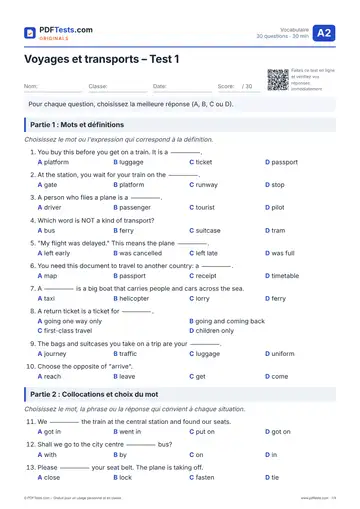
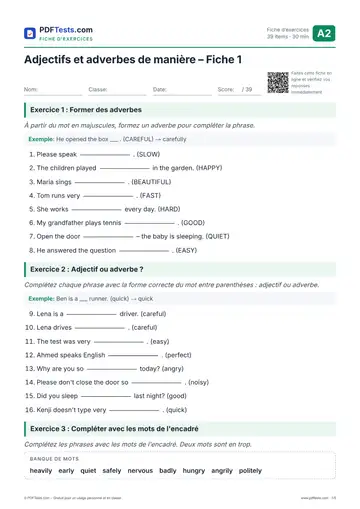
Aperçu de la page 1 : Voyages et transports – Fiche 1 Ouvrir le PDF

Faire la fiche en ligne

Tapez vos réponses puis cliquez sur « Vérifier mes réponses ». Les autres réponses correctes sont acceptées.

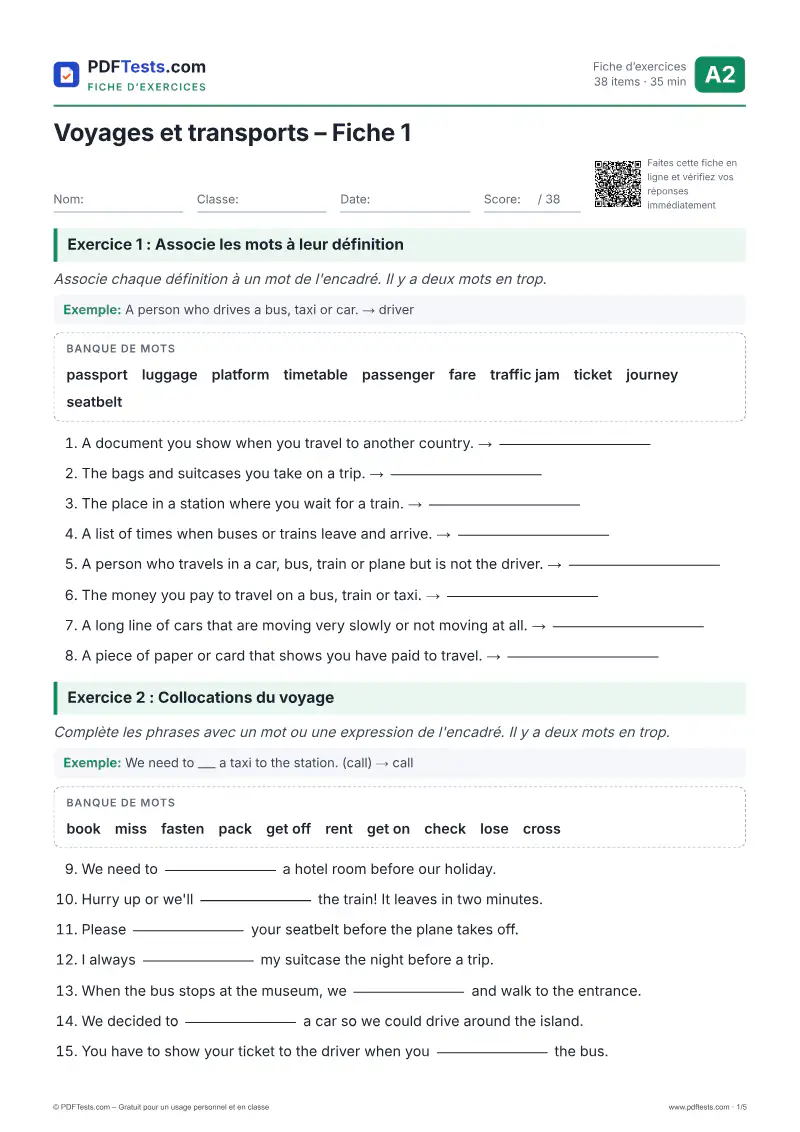
Exercice 1 : Associe les mots à leur définition

Associe chaque définition à un mot de l'encadré. Il y a deux mots en trop.

Exemple: A person who drives a bus, taxi or car. → driver

Banque de mots passportluggageplatformtimetablepassengerfaretraffic jamticketjourneyseatbelt

  1. A document you show when you travel to another country.

  2. The bags and suitcases you take on a trip.

  3. The place in a station where you wait for a train.

  4. A list of times when buses or trains leave and arrive.

  5. A person who travels in a car, bus, train or plane but is not the driver.

  6. The money you pay to travel on a bus, train or taxi.

  7. A long line of cars that are moving very slowly or not moving at all.

  8. A piece of paper or card that shows you have paid to travel.

Exercice 2 : Collocations du voyage

Complète les phrases avec un mot ou une expression de l'encadré. Il y a deux mots en trop.

Exemple: We need to ___ a taxi to the station. (call) → call

Banque de mots bookmissfastenpackget offrentget onchecklosecross

  1. We need to a hotel room before our holiday.

  2. Hurry up or we'll the train! It leaves in two minutes.

  3. Please your seatbelt before the plane takes off.

  4. I always my suitcase the night before a trip.

  5. When the bus stops at the museum, we and walk to the entrance.

  6. We decided to a car so we could drive around the island.

  7. You have to show your ticket to the driver when you the bus.

  8. Passengers should arrive two hours early to in at the airport.

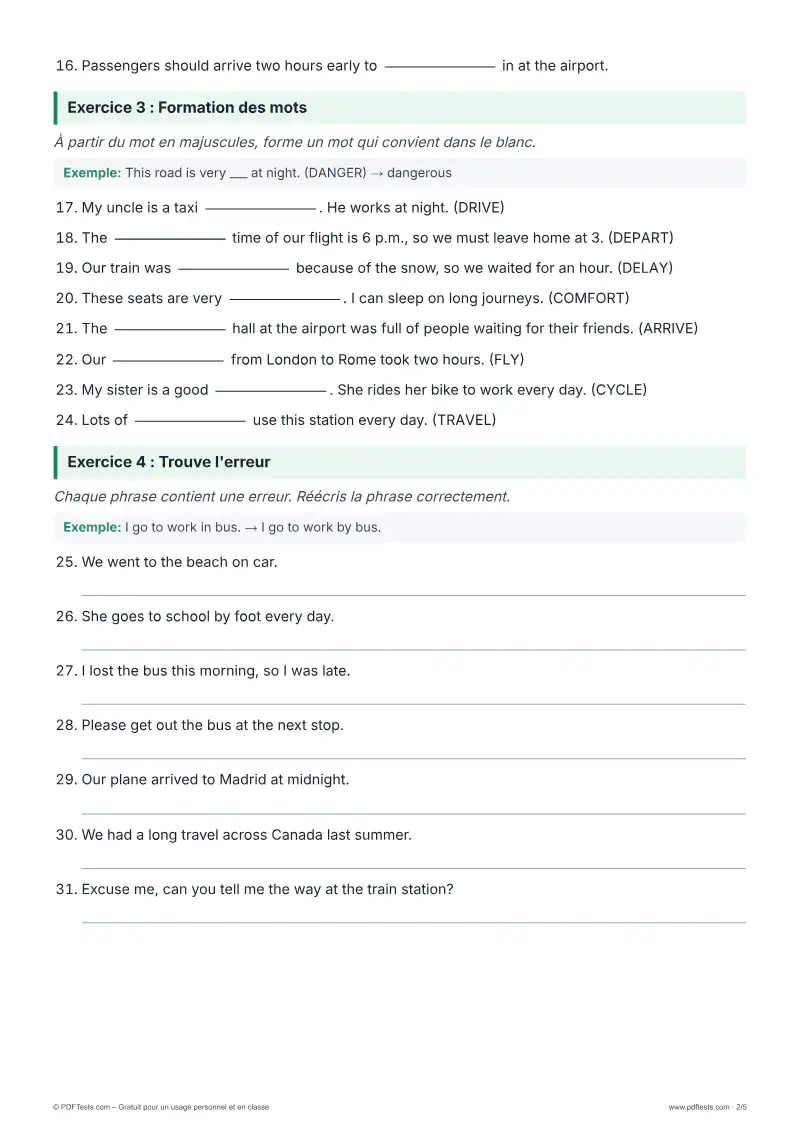
Exercice 3 : Formation des mots

À partir du mot en majuscules, forme un mot qui convient dans le blanc.

Exemple: This road is very ___ at night. (DANGER) → dangerous

  1. My uncle is a taxi . He works at night. (DRIVE)

  2. The time of our flight is 6 p.m., so we must leave home at 3. (DEPART)

  3. Our train was because of the snow, so we waited for an hour. (DELAY)

  4. These seats are very . I can sleep on long journeys. (COMFORT)

  5. The hall at the airport was full of people waiting for their friends. (ARRIVE)

  6. Our from London to Rome took two hours. (FLY)

  7. My sister is a good . She rides her bike to work every day. (CYCLE)

  8. Lots of use this station every day. (TRAVEL)

Exercice 4 : Trouve l'erreur

Chaque phrase contient une erreur. Réécris la phrase correctement.

Exemple: I go to work in bus. → I go to work by bus.

  1. We went to the beach on car.

  2. She goes to school by foot every day.

  3. I lost the bus this morning, so I was late.

  4. Please get out the bus at the next stop.

  5. Our plane arrived to Madrid at midnight.

  6. We had a long travel across Canada last summer.

  7. Excuse me, can you tell me the way at the train station?

Exercice 5 : Remets les mots dans l'ordre

Remets les mots dans le bon ordre pour former des phrases.

Exemple: by / train / travel / we → We travel by train.

  1. by / usually / go / I / to / work / bus

  2. the / does / leave / time / what / train / ?

  3. ticket / a / return / I'd / to / like / Oxford

  4. airport / took / to / a / we / taxi / the

  5. is / next / when / the / bus / ?

  6. her / forgot / passport / she / home / at

  7. you / need / to / get / off / at / the / next / stop

Cette page vous a-t-elle été utile ?

Signaler une erreur

Une mauvaise réponse, une faute de frappe ou une explication peu claire ? Dites-le-nous, nous corrigerons.

Aperçu

À propos de ce test

Fiche d'anglais A2 en PDF sur les voyages et transports : vocabulaire, collocations (catch/miss/get off), prépositions by/on, dérivation. Avec corrigé.

Thèmes abordés

Vocabulaire du voyageCollocations liées aux transportsPrépositions avec les moyens de transportFormation des motsAéroports et gares

Notes pour l’enseignant

Commencez par l'exercice 1 pour vérifier la compréhension du vocabulaire, puis passez aux exercices sur les collocations et la formation des mots avant d'aborder la correction d'erreurs et la remise en ordre des phrases. Les apprenants disent souvent « on car » au lieu de « by car », « by foot » au lieu de « on foot » et « lose the bus » au lieu de « miss the bus » (calque du français « perdre/rater »). Ils ont aussi tendance à employer « travel » comme nom dénombrable au lieu de « journey » ou « trip ». En prolongement, demandez aux élèves de jouer en binôme une scène d'achat de billet à la gare en réutilisant les phrases de l'exercice 5.

Tous les tests Anglais A2 →