PDFTests Originals

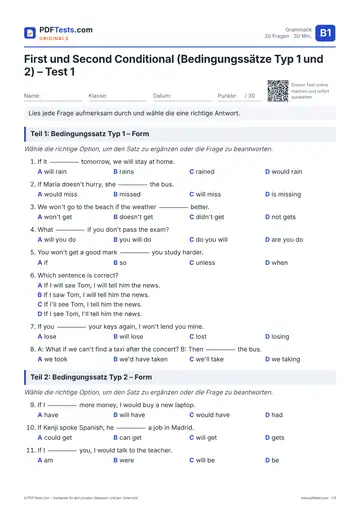
If-Sätze Typ 1 und Typ 2 – Arbeitsblatt 1

B1 Mittelstufe ArbeitsblattEnglisch

Dieses Arbeitsblatt übt den if-Satz Typ 1 für reale, mögliche Situationen in der Zukunft und den if-Satz Typ 2 für gedachte oder unwahrscheinliche Situationen. Geübt werden bejahte Sätze, Verneinungen und Fragen in beiden Formen. Es richtet sich an Lernende auf Niveau B1 und eignet sich für den Unterricht wie für zu Hause.
Aufgaben
37
Zeit
35 Min.
PDF
5 Seiten
Lösungen
Enthalten
  • 100 % kostenlos
  • Ohne Anmeldung
  • Druckfertiges A4-PDF
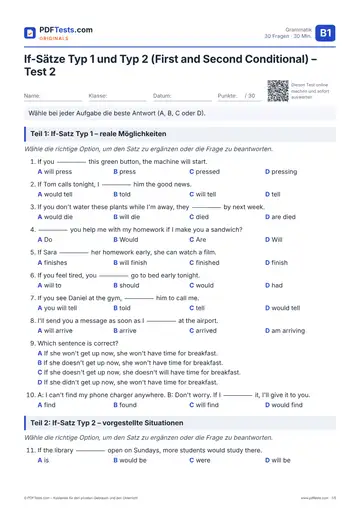
Vorschau von Seite 1: If-Sätze Typ 1 und Typ 2 – Arbeitsblatt 1 PDF öffnen

Arbeitsblatt online bearbeiten

Tippen Sie Ihre Antworten ein und klicken Sie auf „Antworten prüfen“. Alternative richtige Antworten werden akzeptiert.

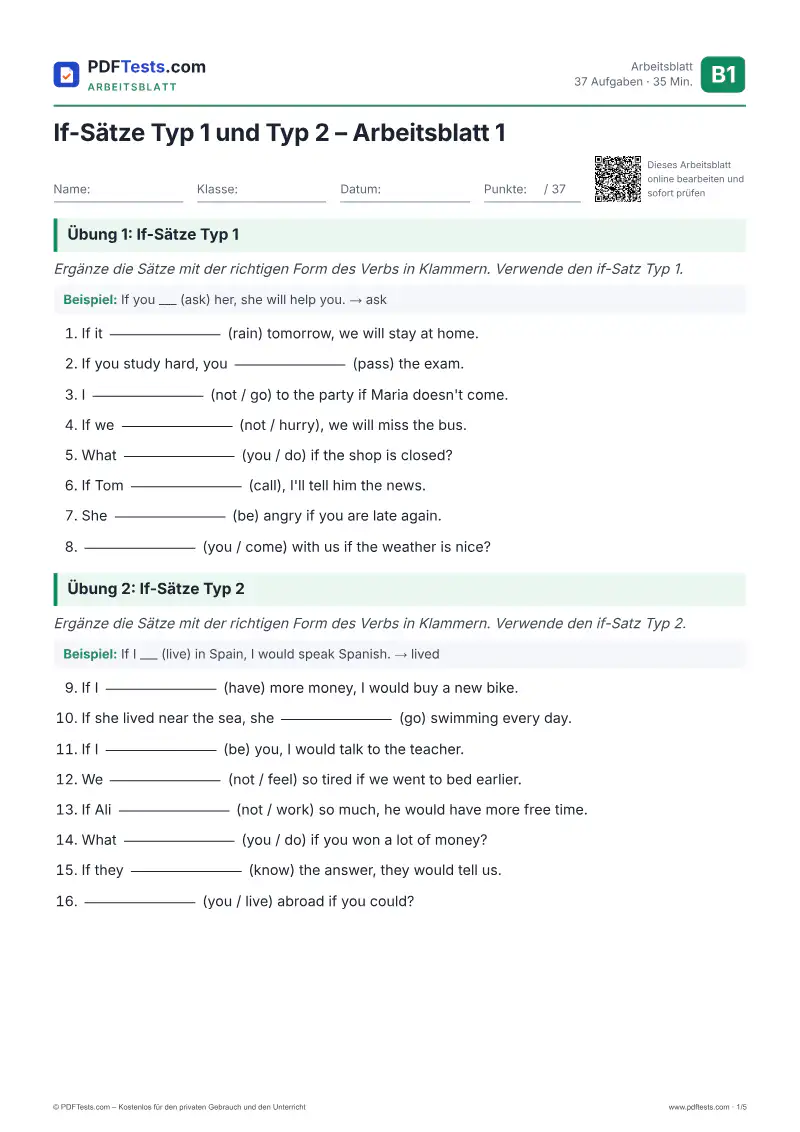
Übung 1: If-Sätze Typ 1

Ergänze die Sätze mit der richtigen Form des Verbs in Klammern. Verwende den if-Satz Typ 1.

Beispiel: If you ___ (ask) her, she will help you. → ask

  1. If it (rain) tomorrow, we will stay at home.

  2. If you study hard, you (pass) the exam.

  3. I (not / go) to the party if Maria doesn't come.

  4. If we (not / hurry), we will miss the bus.

  5. What (you / do) if the shop is closed?

  6. If Tom (call), I'll tell him the news.

  7. She (be) angry if you are late again.

  8. (you / come) with us if the weather is nice?

Übung 2: If-Sätze Typ 2

Ergänze die Sätze mit der richtigen Form des Verbs in Klammern. Verwende den if-Satz Typ 2.

Beispiel: If I ___ (live) in Spain, I would speak Spanish. → lived

  1. If I (have) more money, I would buy a new bike.

  2. If she lived near the sea, she (go) swimming every day.

  3. If I (be) you, I would talk to the teacher.

  4. We (not / feel) so tired if we went to bed earlier.

  5. If Ali (not / work) so much, he would have more free time.

  6. What (you / do) if you won a lot of money?

  7. If they (know) the answer, they would tell us.

  8. (you / live) abroad if you could?

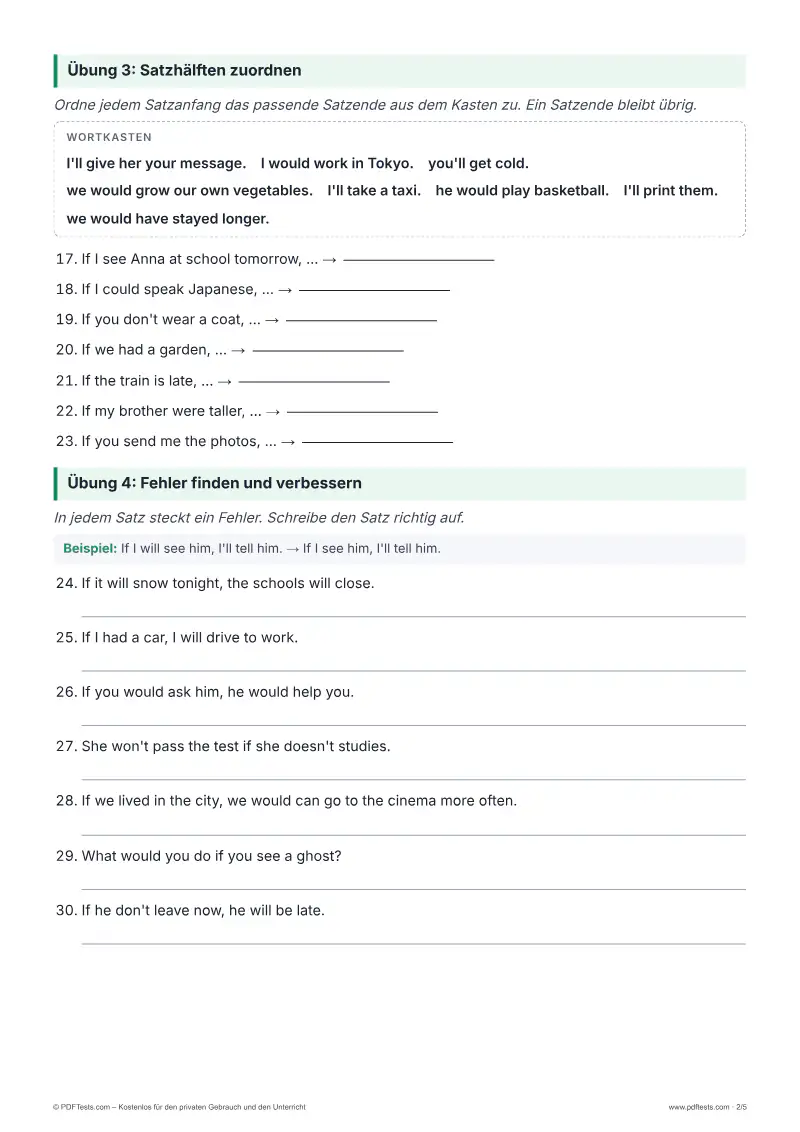
Übung 3: Satzhälften zuordnen

Ordne jedem Satzanfang das passende Satzende aus dem Kasten zu. Ein Satzende bleibt übrig.

Wortkasten I'll give her your message.I would work in Tokyo.you'll get cold.we would grow our own vegetables.I'll take a taxi.he would play basketball.I'll print them.we would have stayed longer.

  1. If I see Anna at school tomorrow, ...

  2. If I could speak Japanese, ...

  3. If you don't wear a coat, ...

  4. If we had a garden, ...

  5. If the train is late, ...

  6. If my brother were taller, ...

  7. If you send me the photos, ...

Übung 4: Fehler finden und verbessern

In jedem Satz steckt ein Fehler. Schreibe den Satz richtig auf.

Beispiel: If I will see him, I'll tell him. → If I see him, I'll tell him.

  1. If it will snow tonight, the schools will close.

  2. If I had a car, I will drive to work.

  3. If you would ask him, he would help you.

  4. She won't pass the test if she doesn't studies.

  5. If we lived in the city, we would can go to the cinema more often.

  6. What would you do if you see a ghost?

  7. If he don't leave now, he will be late.

Übung 5: Sätze umformen

Forme jeden Satz in einen Bedingungssatz um, der mit If beginnt. Verwende den Typ, der in Klammern angegeben ist.

Beispiel: I'm not tall, so I can't reach the shelf. (second) → If I were tall, I could reach the shelf.

  1. I don't have a car, so I can't drive to the beach. (second)

  2. She doesn't speak French, so she can't work in Paris. (second)

  3. Leave now or you'll miss the train. (first)

  4. It's cold, so we aren't going to the park. (second)

  5. Maybe it will be sunny tomorrow. Then we'll have a picnic. (first)

  6. I'm not rich, so I don't travel a lot. (second)

  7. Be careful or you'll break the glass. (first)

War diese Seite hilfreich?

Fehler melden

Falsche Lösung, Tippfehler oder unklare Erklärung? Schreiben Sie uns, wir korrigieren es.

Vorschau

Über diesen Test

Arbeitsblatt Englisch B1 zu if-Sätzen Typ 1 und 2 als PDF: Bildung, Bedeutung, Verneinung und Fragen. Fünf Übungen mit Lösungen zum Ausdrucken.

Themen

If-Sätze Typ 1If-Sätze Typ 2Bedingungssätze (if-clauses)Will und wouldVerneinungen und FragenReale vs. gedachte Situationen

Hinweise für Lehrkräfte

Stellen Sie zum Einstieg zwei Sätze an der Tafel gegenüber, etwa 'If I have time, I'll call you' und 'If I had time, I'd call you', und fragen Sie, welche Situation wahrscheinlicher ist. Typische Fehler sind will oder would im if-Satz ('If it will rain…') und das Mischen der Zeitformen ('If I had a car, I will…'). Weisen Sie darauf hin, dass 'If I were you' die übliche Form ist, um einen Rat zu geben. Als Anschlussaktivität können die Lernenden fünf Fragen nach dem Muster 'What would you do if…?' schreiben und damit eine Partnerin oder einen Partner interviewen.

Alle Englisch-Tests B1 →