PDFTests Originals

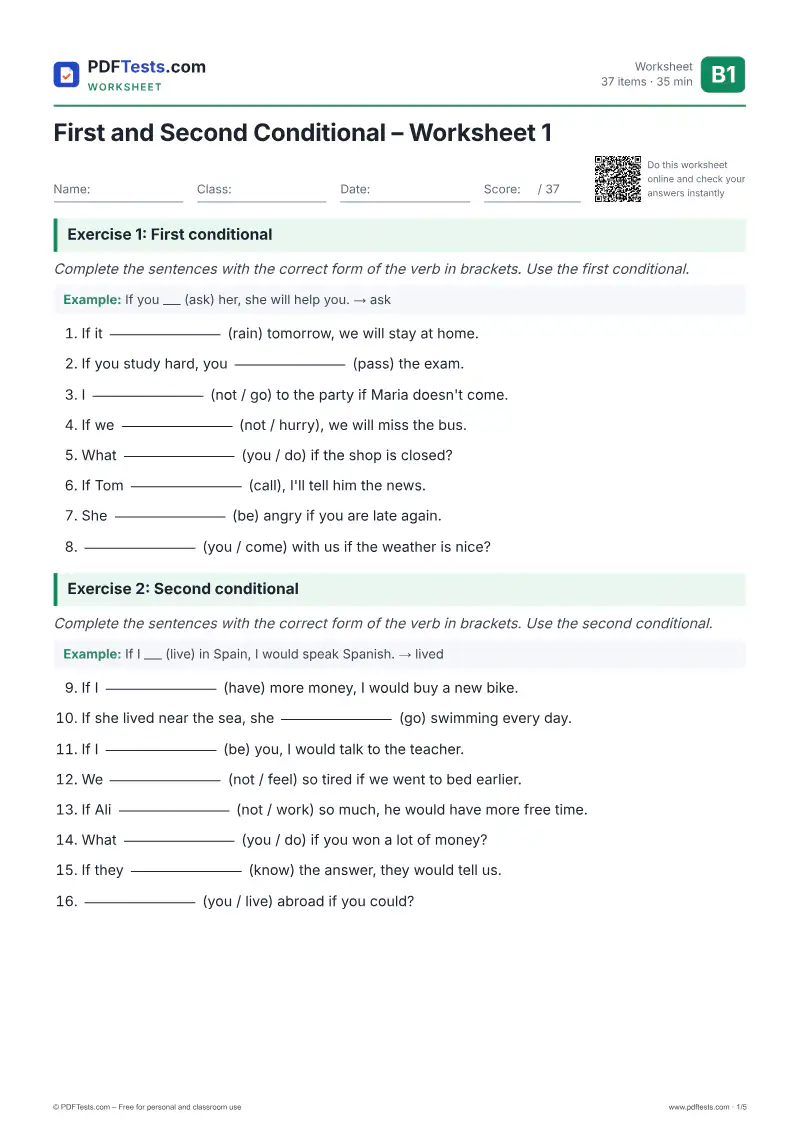
First and Second Conditional – Worksheet 1

B1 Intermediate WorksheetEnglish

This worksheet practises the first conditional for real, possible future situations and the second conditional for imaginary or unlikely situations. It covers positive sentences, negatives and questions in both forms. It is designed for B1 learners in class or at home.
items
37
Time
35 min
PDF
5 pages
Answer key
Included
  • 100% free
  • No sign-up or email
  • Print-ready A4 PDF
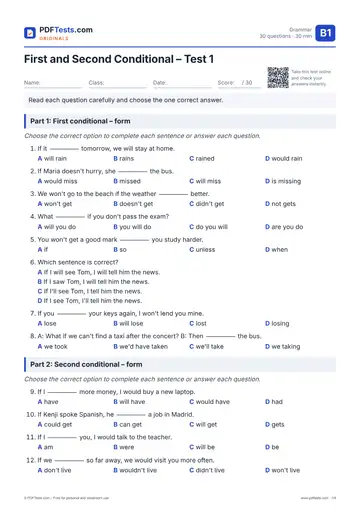
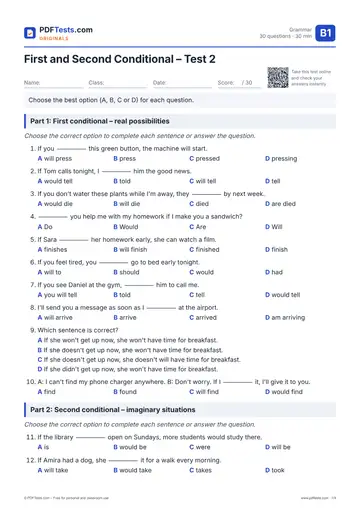
Preview of page 1 of First and Second Conditional – Worksheet 1 Open PDF
New to this topic? Read the guide first: First and Second Conditional: Rules, Examples and Common Mistakes

Do the worksheet online

Type your answers, then press “Check my answers”. Alternative correct answers are accepted.

Exercise 1: First conditional

Complete the sentences with the correct form of the verb in brackets. Use the first conditional.

Example: If you ___ (ask) her, she will help you. → ask

  1. If it (rain) tomorrow, we will stay at home.

  2. If you study hard, you (pass) the exam.

  3. I (not / go) to the party if Maria doesn't come.

  4. If we (not / hurry), we will miss the bus.

  5. What (you / do) if the shop is closed?

  6. If Tom (call), I'll tell him the news.

  7. She (be) angry if you are late again.

  8. (you / come) with us if the weather is nice?

Exercise 2: Second conditional

Complete the sentences with the correct form of the verb in brackets. Use the second conditional.

Example: If I ___ (live) in Spain, I would speak Spanish. → lived

  1. If I (have) more money, I would buy a new bike.

  2. If she lived near the sea, she (go) swimming every day.

  3. If I (be) you, I would talk to the teacher.

  4. We (not / feel) so tired if we went to bed earlier.

  5. If Ali (not / work) so much, he would have more free time.

  6. What (you / do) if you won a lot of money?

  7. If they (know) the answer, they would tell us.

  8. (you / live) abroad if you could?

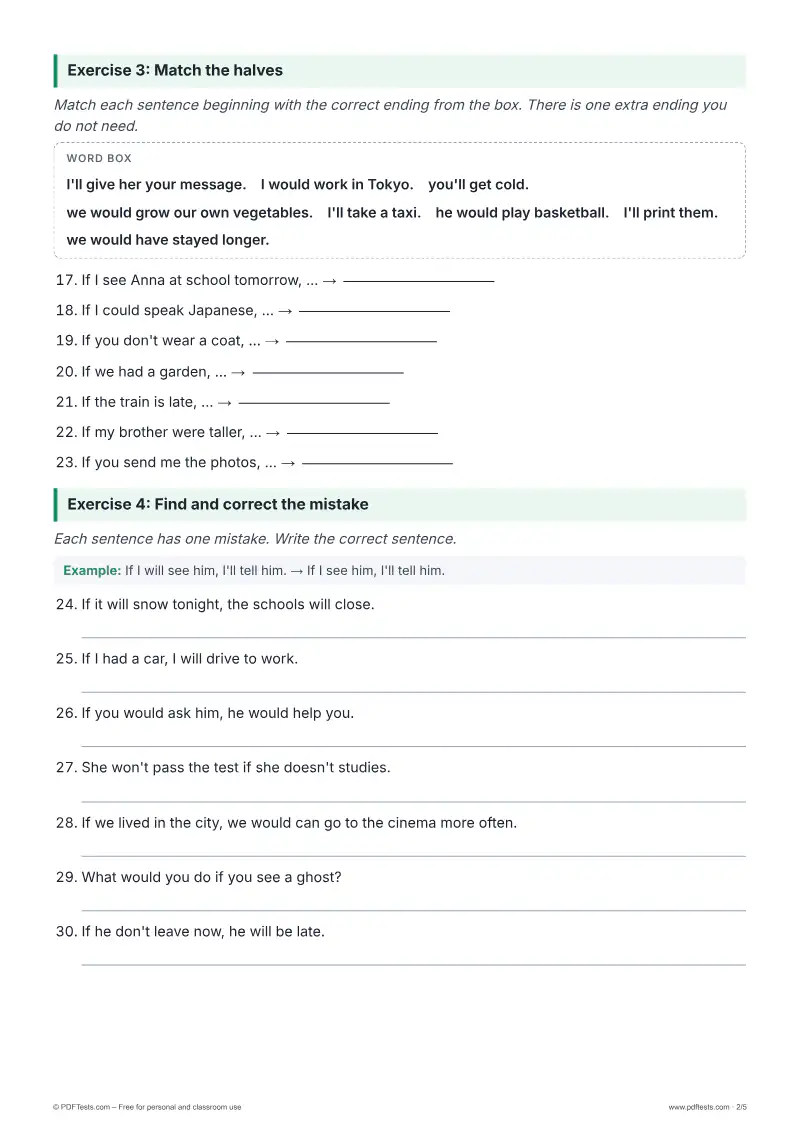
Exercise 3: Match the halves

Match each sentence beginning with the correct ending from the box. There is one extra ending you do not need.

Word box I'll give her your message.I would work in Tokyo.you'll get cold.we would grow our own vegetables.I'll take a taxi.he would play basketball.I'll print them.we would have stayed longer.

  1. If I see Anna at school tomorrow, ...

  2. If I could speak Japanese, ...

  3. If you don't wear a coat, ...

  4. If we had a garden, ...

  5. If the train is late, ...

  6. If my brother were taller, ...

  7. If you send me the photos, ...

Exercise 4: Find and correct the mistake

Each sentence has one mistake. Write the correct sentence.

Example: If I will see him, I'll tell him. → If I see him, I'll tell him.

  1. If it will snow tonight, the schools will close.

  2. If I had a car, I will drive to work.

  3. If you would ask him, he would help you.

  4. She won't pass the test if she doesn't studies.

  5. If we lived in the city, we would can go to the cinema more often.

  6. What would you do if you see a ghost?

  7. If he don't leave now, he will be late.

Exercise 5: Rewrite the sentences

Rewrite each sentence as a conditional sentence starting with If. Use the conditional shown in brackets.

Example: I'm not tall, so I can't reach the shelf. (second) → If I were tall, I could reach the shelf.

  1. I don't have a car, so I can't drive to the beach. (second)

  2. She doesn't speak French, so she can't work in Paris. (second)

  3. Leave now or you'll miss the train. (first)

  4. It's cold, so we aren't going to the park. (second)

  5. Maybe it will be sunny tomorrow. Then we'll have a picnic. (first)

  6. I'm not rich, so I don't travel a lot. (second)

  7. Be careful or you'll break the glass. (first)

Was this page helpful?

Report a mistake

Spotted a wrong answer, a typo or an unclear explanation? Tell us and we will fix it.

Preview

About this test

Printable B1 worksheet on first and second conditionals: form, meaning, negatives and questions. Five exercises with answers.

Topics covered

First conditionalSecond conditionalIf-clausesWill and wouldNegatives and questionsReal vs. imaginary situations

Notes for teachers

Start by contrasting two sentences on the board, such as 'If I have time, I'll call you' and 'If I had time, I'd call you', and ask which situation is more likely. Typical mistakes are putting will or would in the if-clause ('If it will rain…') and mixing tenses ('If I had a car, I will…'). Remind students that 'If I were you' is the standard form for giving advice. As a follow-up, students can write five 'What would you do if…?' questions and interview a partner.

All English B1 tests →