PDFTests Originals

Use of English B2 – Test 2

B2 Gute Mittelstufe GrammatikEnglisch

Dieser Use-of-English-Test auf Niveau B2 trainiert die Grammatik- und Wortschatzkenntnisse, die in Prüfungen auf der oberen Mittelstufe verlangt werden. Er umfasst 36 Multiple-Choice-Aufgaben in vier prüfungsnahen Teilen: Kollokationen und Phrasal Verbs im Kontext, Grammatikwörter, Wortbildung und Satzumformungen. Ideal für B2-Lernende in der Prüfungsvorbereitung und für Lehrkräfte, die ein fertiges Übungsblatt suchen.
Fragen
36
Zeit
45 Min.
PDF
6 Seiten
Lösungen
Enthalten
  • 100 % kostenlos
  • Ohne Anmeldung
  • Druckfertiges A4-PDF
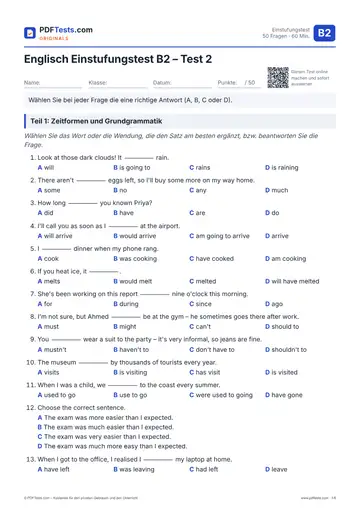
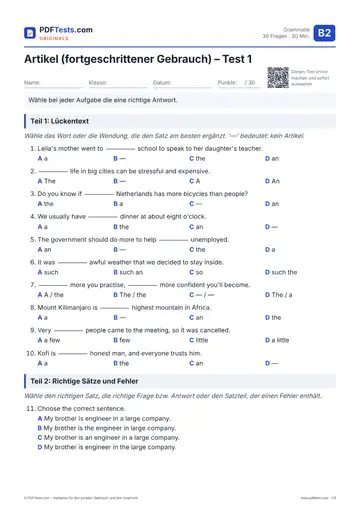
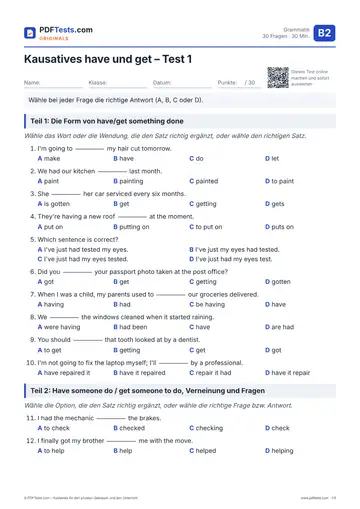
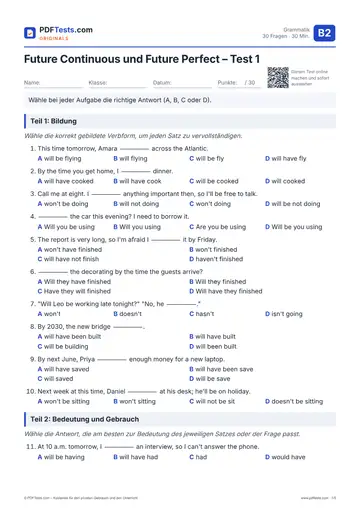
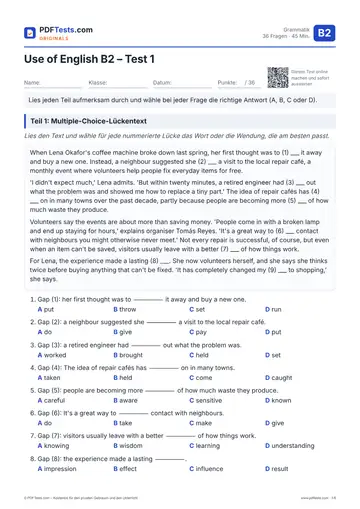
Vorschau von Seite 1: Use of English B2 – Test 2 PDF öffnen
Use of English B1–C2 · alle Tests im Prüfungsformat, Aufgabentypen und Tipps

Test online machen

Wähle bei jeder Aufgabe die richtige Antwort (A, B, C oder D). Wählen Sie Ihre Antworten und klicken Sie auf „Antworten prüfen“.

Teil 1: Multiple-Choice-Lückentext

Lies den Text und wähle das Wort oder die Wendung, die am besten in jede Lücke (1–10) passt.

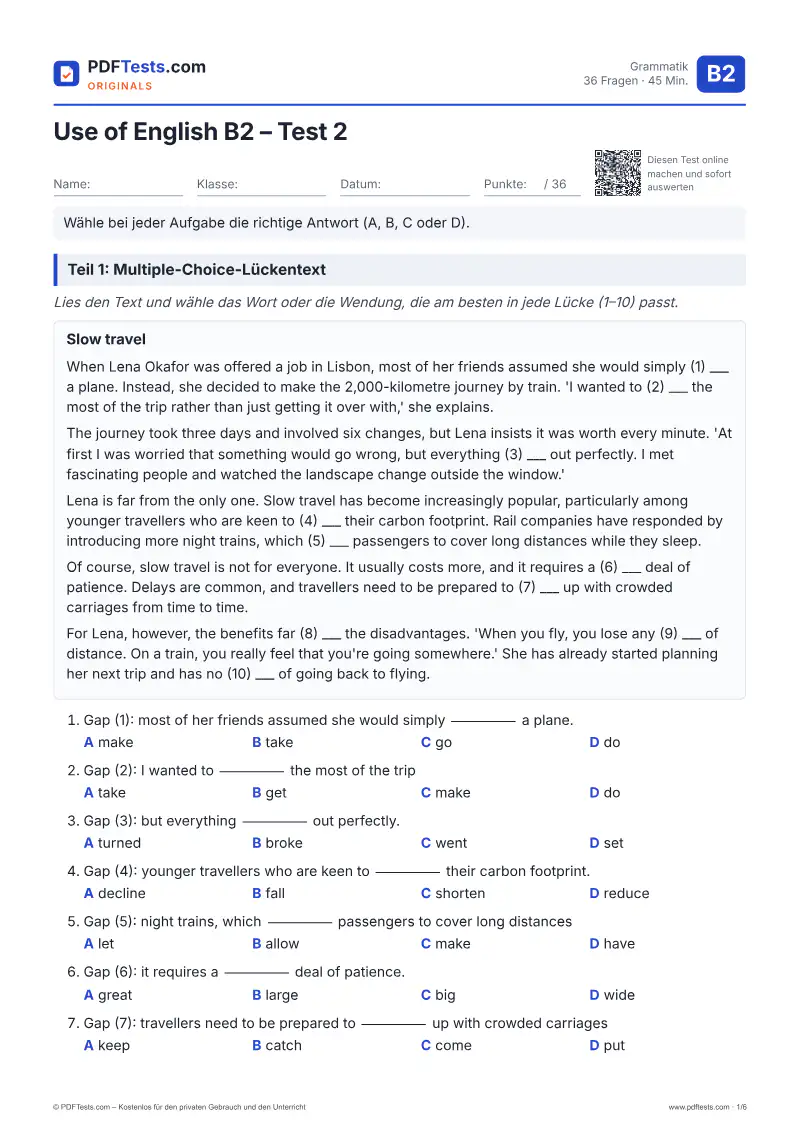
Slow travel

When Lena Okafor was offered a job in Lisbon, most of her friends assumed she would simply (1) ___ a plane. Instead, she decided to make the 2,000-kilometre journey by train. 'I wanted to (2) ___ the most of the trip rather than just getting it over with,' she explains.

The journey took three days and involved six changes, but Lena insists it was worth every minute. 'At first I was worried that something would go wrong, but everything (3) ___ out perfectly. I met fascinating people and watched the landscape change outside the window.'

Lena is far from the only one. Slow travel has become increasingly popular, particularly among younger travellers who are keen to (4) ___ their carbon footprint. Rail companies have responded by introducing more night trains, which (5) ___ passengers to cover long distances while they sleep.

Of course, slow travel is not for everyone. It usually costs more, and it requires a (6) ___ deal of patience. Delays are common, and travellers need to be prepared to (7) ___ up with crowded carriages from time to time.

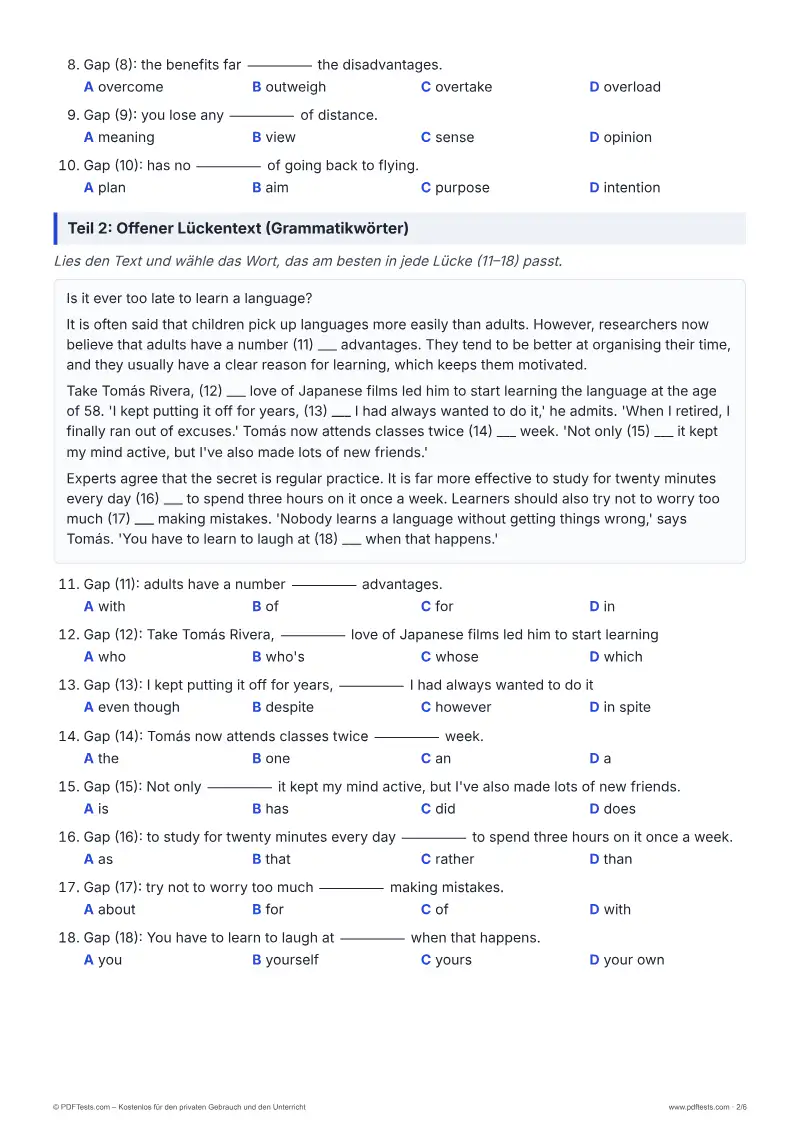
For Lena, however, the benefits far (8) ___ the disadvantages. 'When you fly, you lose any (9) ___ of distance. On a train, you really feel that you're going somewhere.' She has already started planning her next trip and has no (10) ___ of going back to flying.

  1. Gap (1): most of her friends assumed she would simply _____ a plane.

  2. Gap (2): I wanted to _____ the most of the trip

  3. Gap (3): but everything _____ out perfectly.

  4. Gap (4): younger travellers who are keen to _____ their carbon footprint.

  5. Gap (5): night trains, which _____ passengers to cover long distances

  6. Gap (6): it requires a _____ deal of patience.

  7. Gap (7): travellers need to be prepared to _____ up with crowded carriages

  8. Gap (8): the benefits far _____ the disadvantages.

  9. Gap (9): you lose any _____ of distance.

  10. Gap (10): has no _____ of going back to flying.

Teil 2: Offener Lückentext (Grammatikwörter)

Lies den Text und wähle das Wort, das am besten in jede Lücke (11–18) passt.

Is it ever too late to learn a language?

It is often said that children pick up languages more easily than adults. However, researchers now believe that adults have a number (11) ___ advantages. They tend to be better at organising their time, and they usually have a clear reason for learning, which keeps them motivated.

Take Tomás Rivera, (12) ___ love of Japanese films led him to start learning the language at the age of 58. 'I kept putting it off for years, (13) ___ I had always wanted to do it,' he admits. 'When I retired, I finally ran out of excuses.' Tomás now attends classes twice (14) ___ week. 'Not only (15) ___ it kept my mind active, but I've also made lots of new friends.'

Experts agree that the secret is regular practice. It is far more effective to study for twenty minutes every day (16) ___ to spend three hours on it once a week. Learners should also try not to worry too much (17) ___ making mistakes. 'Nobody learns a language without getting things wrong,' says Tomás. 'You have to learn to laugh at (18) ___ when that happens.'

  1. Gap (11): adults have a number _____ advantages.

  2. Gap (12): Take Tomás Rivera, _____ love of Japanese films led him to start learning

  3. Gap (13): I kept putting it off for years, _____ I had always wanted to do it

  4. Gap (14): Tomás now attends classes twice _____ week.

  5. Gap (15): Not only _____ it kept my mind active, but I've also made lots of new friends.

  6. Gap (16): to study for twenty minutes every day _____ to spend three hours on it once a week.

  7. Gap (17): try not to worry too much _____ making mistakes.

  8. Gap (18): You have to learn to laugh at _____ when that happens.

Teil 3: Wortbildung

Wähle die Form des großgeschriebenen Wortes, die den Satz jeweils korrekt ergänzt.

  1. Many people find it _____ to work for hours on a laptop without a proper chair. (COMFORT)

  2. Regular exercise can improve your _____ to concentrate. (ABLE)

  3. The ending of the film was so _____ that nobody in the audience guessed it. (PREDICT)

  4. There is a serious _____ of qualified nurses in many countries. (SHORT)

  5. The council has promised to improve the _____ of public transport. (RELY)

  6. Thousands of _____ took part in the city marathon last Sunday. (COMPETE)

  7. The instructions were so _____ that nobody knew what to do. (CONFUSE)

  8. Getting enough sleep is _____ for good health. (ESSENCE)

  9. The new law aims to _____ the rights of part-time workers. (STRONG)

Teil 4: Satzumformungen

Wähle den Satz, der dieselbe Bedeutung wie der erste Satz hat, das großgeschriebene Wort enthält und grammatisch korrekt ist.

  1. I haven't seen my cousin for five years. (LAST)

  2. I'd prefer you not to smoke in the kitchen. (RATHER)

  3. They cancelled the concert because of the storm. (CALLED)

  4. Ana didn't go to the party because she was ill. (IF)

  5. The film was so boring that we left early. (SUCH)

  6. Kenji finds it strange to drive on the left. (USED)

  7. My brother is too young to drive a car. (ENOUGH)

  8. She was the most talented student in the class. (AS)

  9. It took me two hours to finish the report. (SPENT)

War diese Seite hilfreich?

Fehler melden

Falsche Lösung, Tippfehler oder unklare Erklärung? Schreiben Sie uns, wir korrigieren es.

Mit einem Arbeitsblatt üben: Use of English B2 – Arbeitsblatt 1

Vorschau

Über diesen Test

Dieser Use-of-English-Test auf Niveau B2 trainiert die Grammatik- und Wortschatzkenntnisse, die in Prüfungen auf der oberen Mittelstufe verlangt werden. Er umfasst 36 Multiple-Choice-Aufgaben in vier prüfungsnahen Teilen: Kollokationen und Phrasal Verbs im Kontext, Grammatikwörter, Wortbildung und Satzumformungen. Ideal für B2-Lernende in der Prüfungsvorbereitung und für Lehrkräfte, die ein fertiges Übungsblatt suchen.

Themen

Kollokationen und feste WendungenPhrasal VerbsRelativpronomen und KonnektorenInversion nach „Not only“Wortbildung und PräfixeBedingungssätze (Conditionals)Satzumformungen (Key Word Transformations)

So nutzen Sie diesen Test

  1. Laden Sie das PDF herunter und drucken Sie es aus – oder machen Sie den Test unten online.
  2. Beantworten Sie alle Fragen ohne Wörterbuch und ohne Zeitdruck.
  3. Prüfen Sie Ihre Antworten und notieren Sie, was Sie wiederholen sollten.

Hinweise für Lehrkräfte

Setzen Sie den Test als Probeprüfung mit Zeitvorgabe ein oder bearbeiten Sie ihn im Unterricht Teil für Teil und besprechen Sie, warum die falschen Antwortoptionen nicht passen. Er zielt auf typische Fehler auf B2-Niveau ab, etwa „I'd rather you don't“, „such boring film“, die Verwechslung von Adjektiven auf -ed/-ing, „used to drive“ gegenüber „used to driving“ sowie „spend time to do“. Als Anschlussaufgabe können die Lernenden eigene Umformungsaufgaben mit denselben Schlüsselwörtern schreiben oder die Lückentexte mithilfe der Zielkollokationen nacherzählen.