PDFTests Originals

Use of English B2 – Test 2

B2 Upper-intermediate GrammarEnglish

This B2 Use of English test practises the grammar and vocabulary skills needed for upper-intermediate exams. It has 36 multiple-choice questions in four exam-style parts: collocations and phrasal verbs in context, grammar words, word formation and sentence transformations. It suits B2 learners preparing for exams and teachers who need a ready-made practice paper.
Questions
36
Time
45 min
PDF
6 pages
Answer key
Included
  • 100% free
  • No sign-up or email
  • Print-ready A4 PDF
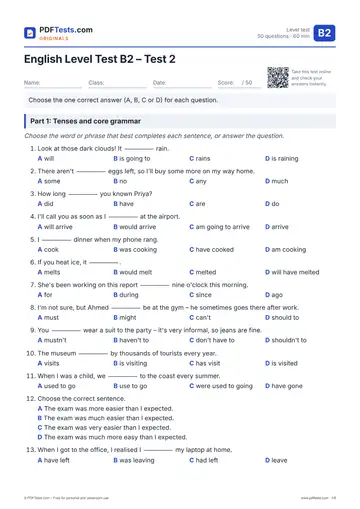
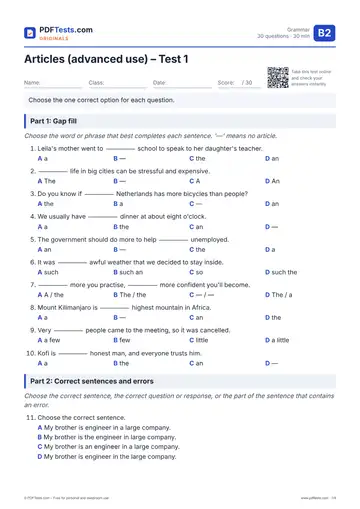
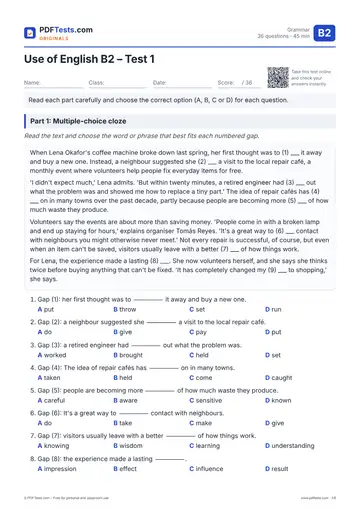
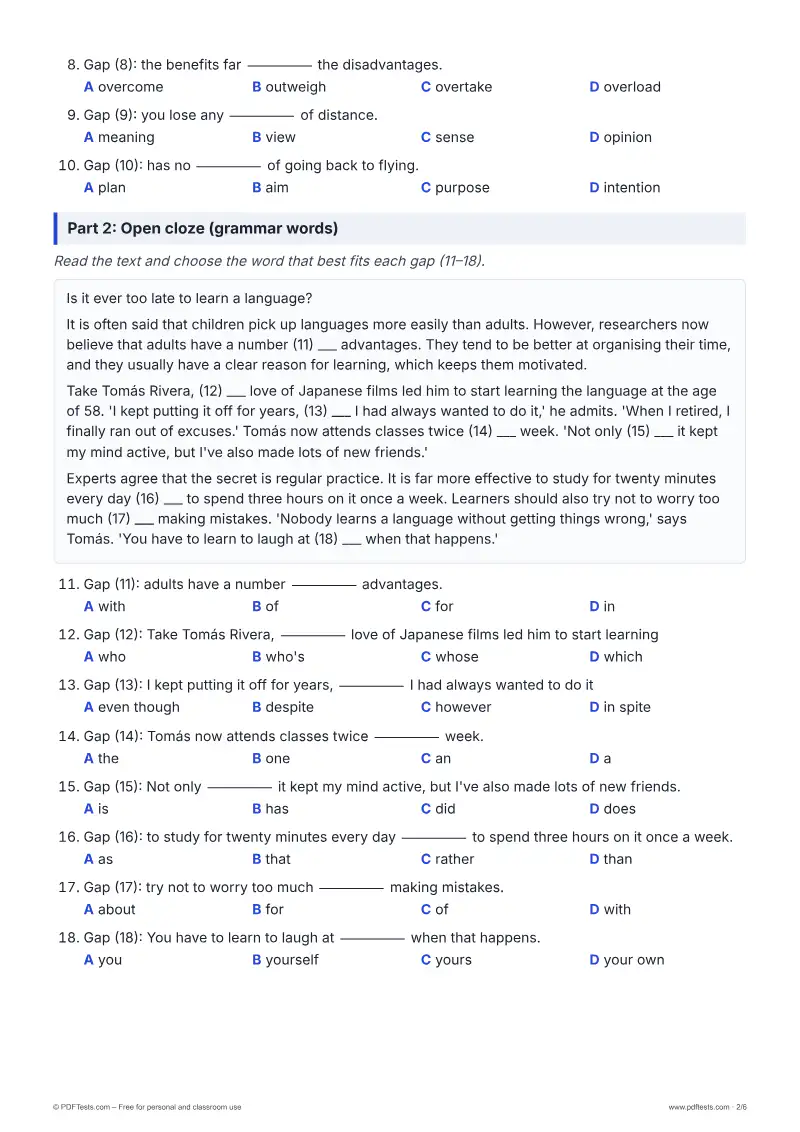
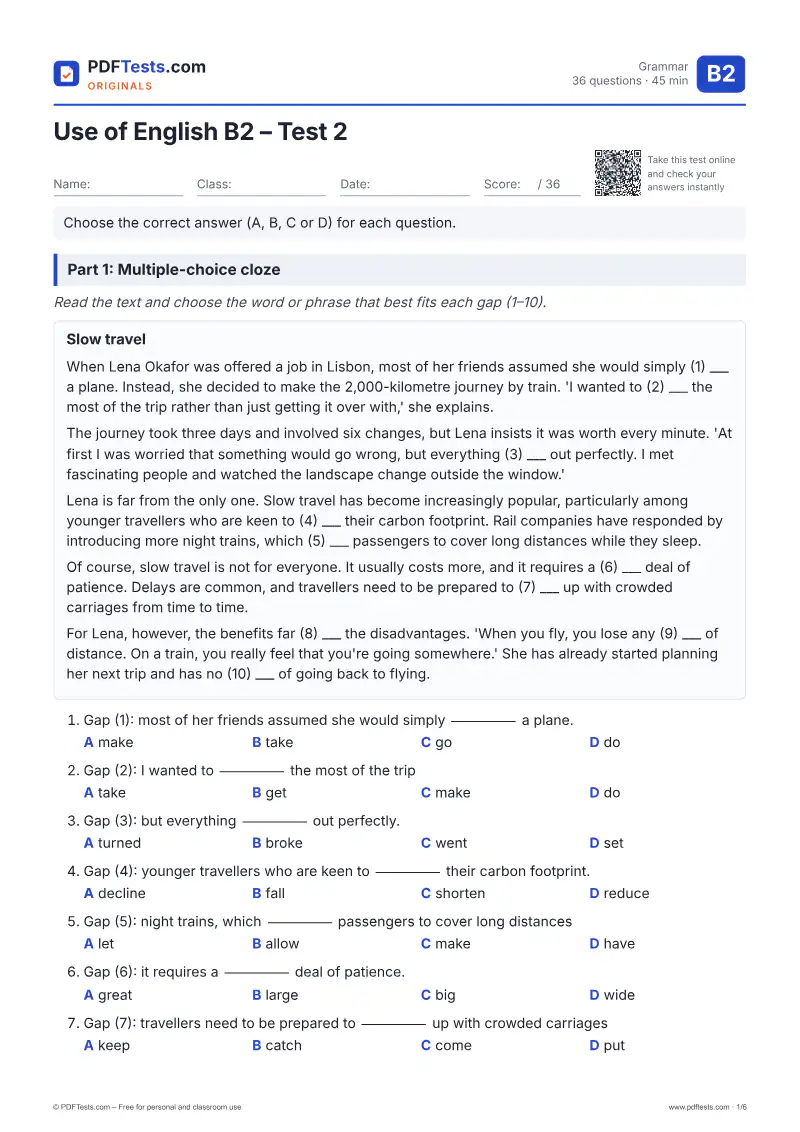
Preview of page 1 of Use of English B2 – Test 2 Open PDF
Use of English B1–C2 · all exam-style tests, task types and tips

Take the test online

Choose the correct answer (A, B, C or D) for each question. Choose your answers, then press “Check my answers”.

Part 1: Multiple-choice cloze

Read the text and choose the word or phrase that best fits each gap (1–10).

Slow travel

When Lena Okafor was offered a job in Lisbon, most of her friends assumed she would simply (1) ___ a plane. Instead, she decided to make the 2,000-kilometre journey by train. 'I wanted to (2) ___ the most of the trip rather than just getting it over with,' she explains.

The journey took three days and involved six changes, but Lena insists it was worth every minute. 'At first I was worried that something would go wrong, but everything (3) ___ out perfectly. I met fascinating people and watched the landscape change outside the window.'

Lena is far from the only one. Slow travel has become increasingly popular, particularly among younger travellers who are keen to (4) ___ their carbon footprint. Rail companies have responded by introducing more night trains, which (5) ___ passengers to cover long distances while they sleep.

Of course, slow travel is not for everyone. It usually costs more, and it requires a (6) ___ deal of patience. Delays are common, and travellers need to be prepared to (7) ___ up with crowded carriages from time to time.

For Lena, however, the benefits far (8) ___ the disadvantages. 'When you fly, you lose any (9) ___ of distance. On a train, you really feel that you're going somewhere.' She has already started planning her next trip and has no (10) ___ of going back to flying.

  1. Gap (1): most of her friends assumed she would simply _____ a plane.

  2. Gap (2): I wanted to _____ the most of the trip

  3. Gap (3): but everything _____ out perfectly.

  4. Gap (4): younger travellers who are keen to _____ their carbon footprint.

  5. Gap (5): night trains, which _____ passengers to cover long distances

  6. Gap (6): it requires a _____ deal of patience.

  7. Gap (7): travellers need to be prepared to _____ up with crowded carriages

  8. Gap (8): the benefits far _____ the disadvantages.

  9. Gap (9): you lose any _____ of distance.

  10. Gap (10): has no _____ of going back to flying.

Part 2: Open cloze (grammar words)

Read the text and choose the word that best fits each gap (11–18).

Is it ever too late to learn a language?

It is often said that children pick up languages more easily than adults. However, researchers now believe that adults have a number (11) ___ advantages. They tend to be better at organising their time, and they usually have a clear reason for learning, which keeps them motivated.

Take Tomás Rivera, (12) ___ love of Japanese films led him to start learning the language at the age of 58. 'I kept putting it off for years, (13) ___ I had always wanted to do it,' he admits. 'When I retired, I finally ran out of excuses.' Tomás now attends classes twice (14) ___ week. 'Not only (15) ___ it kept my mind active, but I've also made lots of new friends.'

Experts agree that the secret is regular practice. It is far more effective to study for twenty minutes every day (16) ___ to spend three hours on it once a week. Learners should also try not to worry too much (17) ___ making mistakes. 'Nobody learns a language without getting things wrong,' says Tomás. 'You have to learn to laugh at (18) ___ when that happens.'

  1. Gap (11): adults have a number _____ advantages.

  2. Gap (12): Take Tomás Rivera, _____ love of Japanese films led him to start learning

  3. Gap (13): I kept putting it off for years, _____ I had always wanted to do it

  4. Gap (14): Tomás now attends classes twice _____ week.

  5. Gap (15): Not only _____ it kept my mind active, but I've also made lots of new friends.

  6. Gap (16): to study for twenty minutes every day _____ to spend three hours on it once a week.

  7. Gap (17): try not to worry too much _____ making mistakes.

  8. Gap (18): You have to learn to laugh at _____ when that happens.

Part 3: Word formation

Choose the form of the word in capitals that correctly completes each sentence.

  1. Many people find it _____ to work for hours on a laptop without a proper chair. (COMFORT)

  2. Regular exercise can improve your _____ to concentrate. (ABLE)

  3. The ending of the film was so _____ that nobody in the audience guessed it. (PREDICT)

  4. There is a serious _____ of qualified nurses in many countries. (SHORT)

  5. The council has promised to improve the _____ of public transport. (RELY)

  6. Thousands of _____ took part in the city marathon last Sunday. (COMPETE)

  7. The instructions were so _____ that nobody knew what to do. (CONFUSE)

  8. Getting enough sleep is _____ for good health. (ESSENCE)

  9. The new law aims to _____ the rights of part-time workers. (STRONG)

Part 4: Key word transformations

Choose the sentence that has the same meaning as the first sentence, uses the word in capitals and is grammatically correct.

  1. I haven't seen my cousin for five years. (LAST)

  2. I'd prefer you not to smoke in the kitchen. (RATHER)

  3. They cancelled the concert because of the storm. (CALLED)

  4. Ana didn't go to the party because she was ill. (IF)

  5. The film was so boring that we left early. (SUCH)

  6. Kenji finds it strange to drive on the left. (USED)

  7. My brother is too young to drive a car. (ENOUGH)

  8. She was the most talented student in the class. (AS)

  9. It took me two hours to finish the report. (SPENT)

Was this page helpful?

Report a mistake

Spotted a wrong answer, a typo or an unclear explanation? Tell us and we will fix it.

Practise with a worksheet: Use of English B2 – Worksheet 1

Preview

About this test

This B2 Use of English test practises the grammar and vocabulary skills needed for upper-intermediate exams. It has 36 multiple-choice questions in four exam-style parts: collocations and phrasal verbs in context, grammar words, word formation and sentence transformations. It suits B2 learners preparing for exams and teachers who need a ready-made practice paper.

Topics covered

Collocations and fixed phrasesPhrasal verbsRelative pronouns and linkersInversion after 'Not only'Word formation and prefixesConditionalsKey word transformations

How to use this test

  1. Download the PDF and print it, or take the test online below.
  2. Answer every question without a dictionary or time pressure.
  3. Check your answers and note the topics you need to review.

Notes for teachers

Use the test as a timed mock or work through it part by part in class, discussing why each distractor is wrong. It targets common B2 errors such as 'I'd rather you don't', 'such boring film', '-ed/-ing' adjective confusion, 'used to drive' versus 'used to driving' and 'spend time to do'. As a follow-up, ask students to write their own transformation items using the same key words, or to retell the cloze texts using the target collocations.