PDFTests Originals

Kollokationen – Test 1

B2 Gute Mittelstufe WortschatzEnglisch

Dieser Wortschatztest auf Niveau B2 prüft, wie sicher Sie gängige englische Kollokationen beherrschen: Verb-Nomen-Verbindungen wie make progress und take action, Adjektiv- und Adverbverbindungen wie heavy rain und highly unlikely sowie Kollokationen in einem Lesetext. Er eignet sich für Lernende auf fortgeschrittenem Mittelstufenniveau, für Prüfungskandidaten und für Lehrkräfte, die schnell und ausdruckbar überprüfen möchten, ob natürliche Wortverbindungen sitzen.
Fragen
30
Zeit
30 Min.
PDF
4 Seiten
Lösungen
Enthalten
  • 100 % kostenlos
  • Ohne Anmeldung
  • Druckfertiges A4-PDF
Vorschau von Seite 1: Kollokationen – Test 1 PDF öffnen

Test online machen

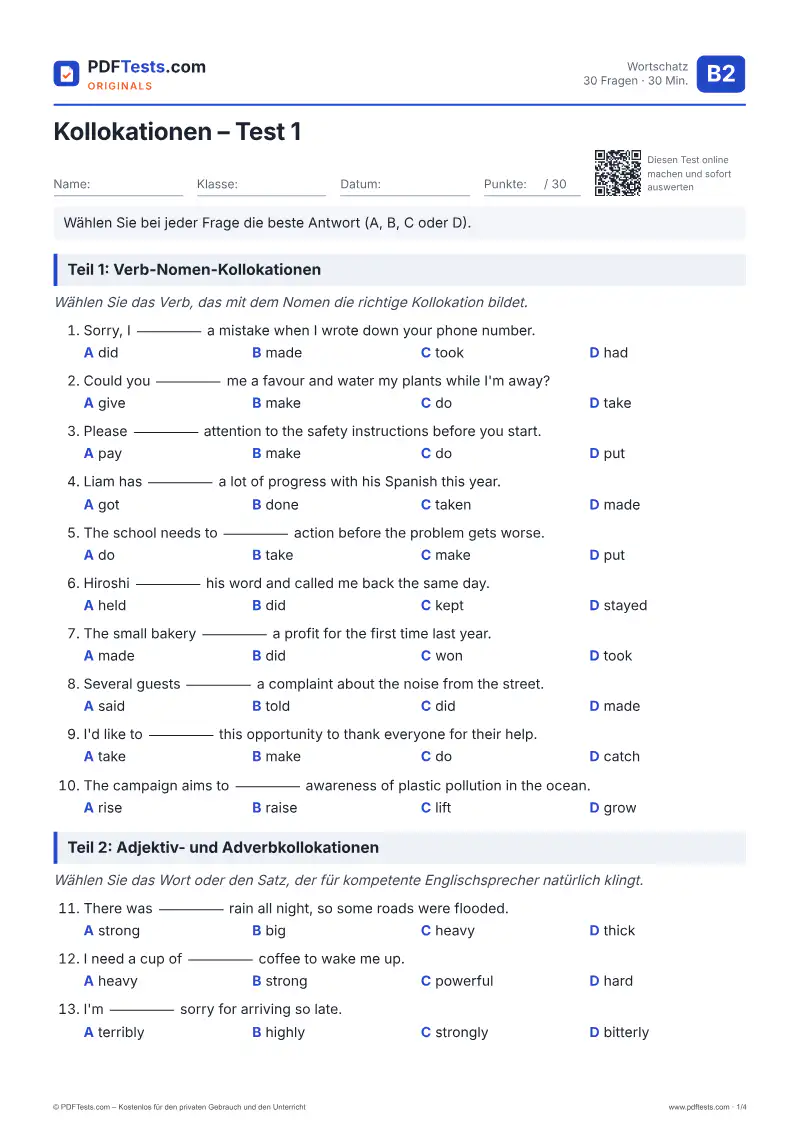
Wählen Sie bei jeder Frage die beste Antwort (A, B, C oder D). Wählen Sie Ihre Antworten und klicken Sie auf „Antworten prüfen“.

Teil 1: Verb-Nomen-Kollokationen

Wählen Sie das Verb, das mit dem Nomen die richtige Kollokation bildet.

  1. Sorry, I _____ a mistake when I wrote down your phone number.

  2. Could you _____ me a favour and water my plants while I'm away?

  3. Please _____ attention to the safety instructions before you start.

  4. Liam has _____ a lot of progress with his Spanish this year.

  5. The school needs to _____ action before the problem gets worse.

  6. Hiroshi _____ his word and called me back the same day.

  7. The small bakery _____ a profit for the first time last year.

  8. Several guests _____ a complaint about the noise from the street.

  9. I'd like to _____ this opportunity to thank everyone for their help.

  10. The campaign aims to _____ awareness of plastic pollution in the ocean.

Teil 2: Adjektiv- und Adverbkollokationen

Wählen Sie das Wort oder den Satz, der für kompetente Englischsprecher natürlich klingt.

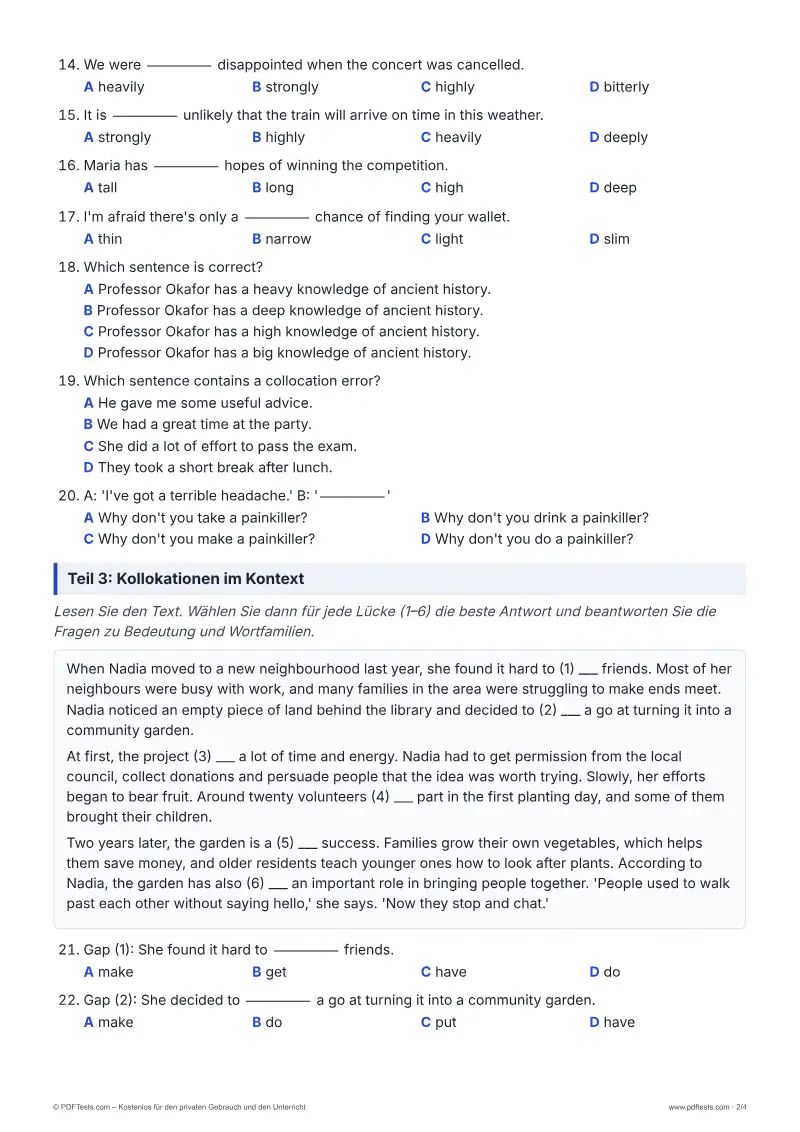
  1. There was _____ rain all night, so some roads were flooded.

  2. I need a cup of _____ coffee to wake me up.

  3. I'm _____ sorry for arriving so late.

  4. We were _____ disappointed when the concert was cancelled.

  5. It is _____ unlikely that the train will arrive on time in this weather.

  6. Maria has _____ hopes of winning the competition.

  7. I'm afraid there's only a _____ chance of finding your wallet.

  8. Which sentence is correct?

  9. Which sentence contains a collocation error?

  10. A: 'I've got a terrible headache.' B: '_____'

Teil 3: Kollokationen im Kontext

Lesen Sie den Text. Wählen Sie dann für jede Lücke (1–6) die beste Antwort und beantworten Sie die Fragen zu Bedeutung und Wortfamilien.

When Nadia moved to a new neighbourhood last year, she found it hard to (1) ___ friends. Most of her neighbours were busy with work, and many families in the area were struggling to make ends meet. Nadia noticed an empty piece of land behind the library and decided to (2) ___ a go at turning it into a community garden.

At first, the project (3) ___ a lot of time and energy. Nadia had to get permission from the local council, collect donations and persuade people that the idea was worth trying. Slowly, her efforts began to bear fruit. Around twenty volunteers (4) ___ part in the first planting day, and some of them brought their children.

Two years later, the garden is a (5) ___ success. Families grow their own vegetables, which helps them save money, and older residents teach younger ones how to look after plants. According to Nadia, the garden has also (6) ___ an important role in bringing people together. 'People used to walk past each other without saying hello,' she says. 'Now they stop and chat.'

  1. Gap (1): She found it hard to _____ friends.

  2. Gap (2): She decided to _____ a go at turning it into a community garden.

  3. Gap (3): At first, the project _____ a lot of time and energy.

  4. Gap (4): Around twenty volunteers _____ part in the first planting day.

  5. Gap (5): Two years later, the garden is a _____ success.

  6. Gap (6): The garden has also _____ an important role in bringing people together.

  7. In the text, families 'struggling to make ends meet' are families who…

  8. In the text, 'her efforts began to bear fruit' means her efforts…

  9. Nadia is a very _____ person; she never gives up easily. (DETERMINE)

  10. Each volunteer made a _____ contribution to the project. (SIGNIFY)

Vorschau

Über diesen Test

Dieser Wortschatztest auf Niveau B2 prüft, wie sicher Sie gängige englische Kollokationen beherrschen: Verb-Nomen-Verbindungen wie make progress und take action, Adjektiv- und Adverbverbindungen wie heavy rain und highly unlikely sowie Kollokationen in einem Lesetext. Er eignet sich für Lernende auf fortgeschrittenem Mittelstufenniveau, für Prüfungskandidaten und für Lehrkräfte, die schnell und ausdruckbar überprüfen möchten, ob natürliche Wortverbindungen sitzen.

Themen

Verb-Nomen-KollokationenMake, do, take und haveAdjektiv-Nomen-KollokationenAdverb-Adjektiv-KollokationenRedewendungen (Idioms) im KontextWortfamilien

So nutzen Sie diesen Test

  1. Laden Sie das PDF herunter und drucken Sie es aus – oder machen Sie den Test unten online.
  2. Beantworten Sie alle Fragen ohne Wörterbuch und ohne Zeitdruck.
  3. Prüfen Sie Ihre Antworten und notieren Sie, was Sie wiederholen sollten.

Hinweise für Lehrkräfte

Der Test führt von gängigen Verb-Nomen-Kollokationen über Adjektiv- und Adverbverbindungen bis zu Kollokationen und Redewendungen in einem Lesetext. Er zielt auf typische Fehler deutschsprachiger Lernender ab, etwa do statt make, strong statt heavy oder die wörtliche Übertragung von Wortverbindungen aus der Muttersprache (z. B. „einen Fehler machen“ → do a mistake). Als Anschlussaufgabe können die Lernenden ein Kollokationsheft nach Schlüsselverben anlegen oder einen kurzen Absatz mit fünf Kollokationen schreiben, bei denen sie Fehler gemacht haben.