PDFTests Originals

Use of English C1 – Arbeitsblatt 1

C1 Fortgeschritten ArbeitsblattEnglisch

Dieses Use-of-English-Arbeitsblatt auf C1-Niveau enthält vier Aufgaben im Prüfungsformat: einen Open Cloze, eine Wortbildungsaufgabe, Key Word Transformations und einen Lückentext zu Kollokationen. Es eignet sich für fortgeschrittene Lernende, die sich auf Prüfungen auf C1-Niveau vorbereiten, und für Lehrkräfte, die druckfertiges Übungsmaterial mit Lösungsschlüssel suchen.
Aufgaben
34
Zeit
40 Min.
PDF
5 Seiten
Lösungen
Enthalten
  • 100 % kostenlos
  • Ohne Anmeldung
  • Druckfertiges A4-PDF
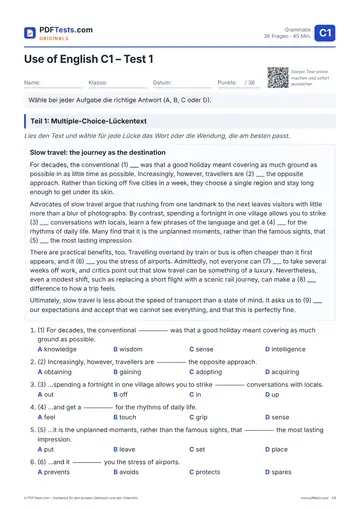
Vorschau von Seite 1: Use of English C1 – Arbeitsblatt 1 PDF öffnen
Use of English B1–C2 · alle Tests im Prüfungsformat, Aufgabentypen und Tipps

Arbeitsblatt online bearbeiten

Tippen Sie Ihre Antworten ein und klicken Sie auf „Antworten prüfen“. Alternative richtige Antworten werden akzeptiert.

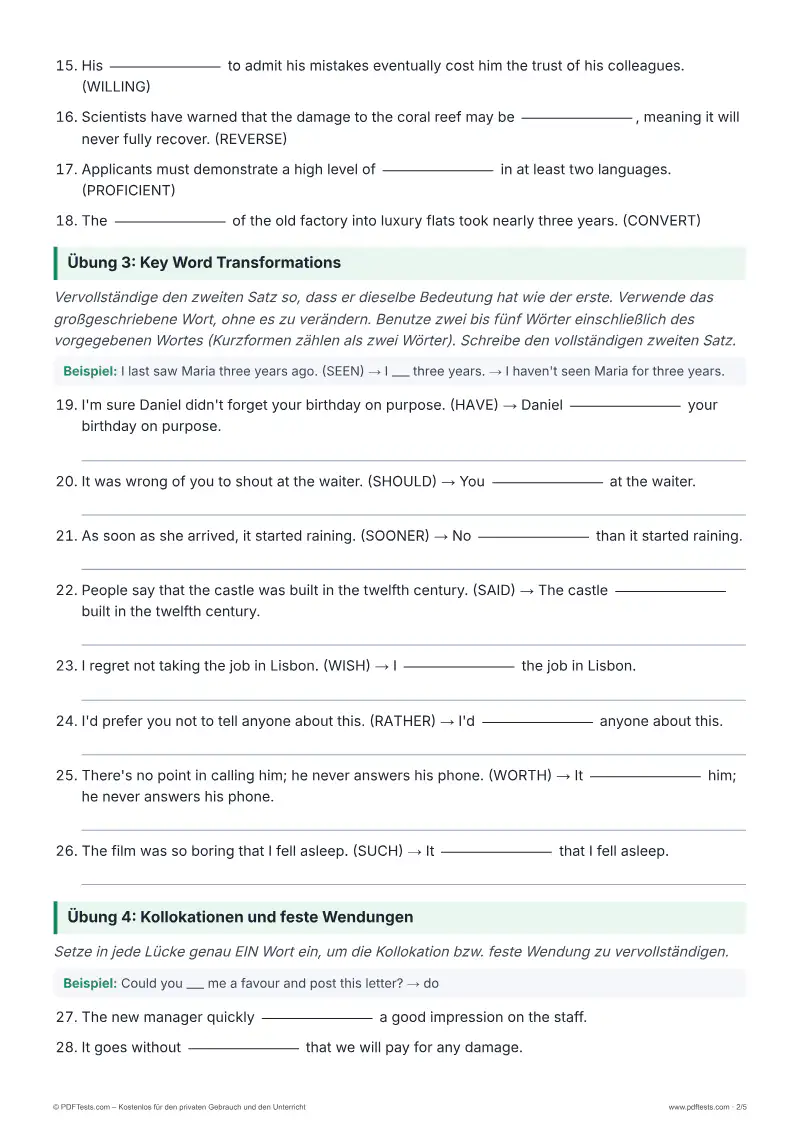
Übung 1: Open Cloze

Lies den Text über Langeweile und setze in jede Lücke genau EIN Wort ein.

Beispiel: Boredom has been studied ___ decades. → for

  1. For most of us, boredom is something to be avoided all costs.

  2. Yet a growing number of psychologists argue that, far being a waste of time, it can actually be good for us.

  3. When the mind has nothing to focus , it begins to wander.

  4. is during these moments of mental drifting that many people come up with their best ideas.

  5. In one study, participants who had spent fifteen minutes copying numbers from a phone book performed better on a creativity task those who had not.

  6. This suggests that, than reaching for our phones whenever we feel restless, we should allow ourselves to be bored.

  7. though this may sound simple, it is surprisingly difficult in practice.

  8. Many of us have become so used to constant stimulation even a few minutes of silence feels uncomfortable.

  9. Not do our devices distract us, but they also deprive us of the chance to think freely.

  10. matter how uncomfortable it feels at first, a little boredom may be exactly what your brain needs.

Übung 2: Wortbildung

Bilde aus dem großgeschriebenen Wort ein Wort, das in die Lücke passt.

Beispiel: Her ___ to the project was impressive. (COMMIT) → commitment

  1. The new policy has been met with widespread from local residents, who have organised several protests. (APPROVE)

  2. Despite months of research, the results were , so further tests are needed. (CONCLUDE)

  3. The family's old letters have little financial value, but to them they are . (PRICE)

  4. The minister claimed that the newspaper article was a deliberate of her views. (REPRESENT)

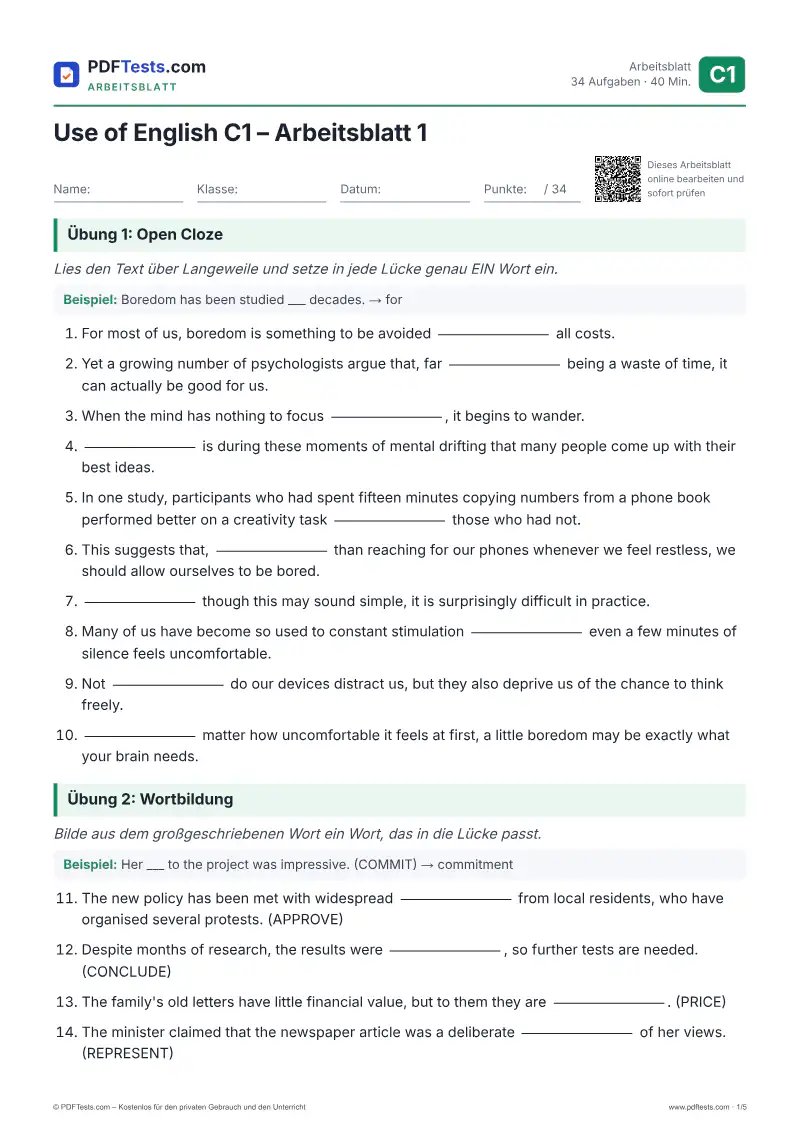
  5. His to admit his mistakes eventually cost him the trust of his colleagues. (WILLING)

  6. Scientists have warned that the damage to the coral reef may be , meaning it will never fully recover. (REVERSE)

  7. Applicants must demonstrate a high level of in at least two languages. (PROFICIENT)

  8. The of the old factory into luxury flats took nearly three years. (CONVERT)

Übung 3: Key Word Transformations

Vervollständige den zweiten Satz so, dass er dieselbe Bedeutung hat wie der erste. Verwende das großgeschriebene Wort, ohne es zu verändern. Benutze zwei bis fünf Wörter einschließlich des vorgegebenen Wortes (Kurzformen zählen als zwei Wörter). Schreibe den vollständigen zweiten Satz.

Beispiel: I last saw Maria three years ago. (SEEN) → I ___ three years. → I haven't seen Maria for three years.

  1. I'm sure Daniel didn't forget your birthday on purpose. (HAVE) → Daniel ___ your birthday on purpose.

  2. It was wrong of you to shout at the waiter. (SHOULD) → You ___ at the waiter.

  3. As soon as she arrived, it started raining. (SOONER) → No ___ than it started raining.

  4. People say that the castle was built in the twelfth century. (SAID) → The castle ___ built in the twelfth century.

  5. I regret not taking the job in Lisbon. (WISH) → I ___ the job in Lisbon.

  6. I'd prefer you not to tell anyone about this. (RATHER) → I'd ___ anyone about this.

  7. There's no point in calling him; he never answers his phone. (WORTH) → It ___ him; he never answers his phone.

  8. The film was so boring that I fell asleep. (SUCH) → It ___ that I fell asleep.

Übung 4: Kollokationen und feste Wendungen

Setze in jede Lücke genau EIN Wort ein, um die Kollokation bzw. feste Wendung zu vervollständigen.

Beispiel: Could you ___ me a favour and post this letter? → do

  1. The new manager quickly a good impression on the staff.

  2. It goes without that we will pay for any damage.

  3. There were a few small problems, but and large the event was a success.

  4. She was in two about whether to accept the offer.

  5. When planning the park, we need to into account the needs of older residents.

  6. The new regulations will come into next January.

  7. The project is still in its early , so it's hard to predict the outcome.

  8. The proposal was rejected the grounds that it was too expensive.

War diese Seite hilfreich?

Fehler melden

Falsche Lösung, Tippfehler oder unklare Erklärung? Schreiben Sie uns, wir korrigieren es.

Vorschau

Über diesen Test

Use of English C1 Arbeitsblatt Englisch PDF: Open Cloze, Wortbildung, Satzumformungen und Kollokationen im Prüfungsformat mit Lösungen.

Themen

Open Cloze (offener Lückentext)WortbildungKey Word Transformations (Satzumformungen)Kollokationen und feste WendungenModalverben im Perfekt und Inversion

Hinweise für Lehrkräfte

Setzen Sie Übung 1 als Leseaufgabe mit Zeitvorgabe ein. Die Lernenden sollen zuerst den gesamten Text lesen, bevor sie Lücken ausfüllen, und anschließend ihre Antworten in Partnerarbeit vergleichen und jede Entscheidung begründen. Bei den Key Word Transformations überschreiten Lernende häufig die Wortgrenze, verändern das vorgegebene Schlüsselwort oder vergessen, dass Kurzformen als zwei Wörter zählen. Bestehen Sie darauf, dass alle drei Punkte überprüft werden. Als Anschlussaufgabe können die Lernenden mit Strukturen aus Übung 3 eigene Umformungsaufgaben schreiben und sie mit einem Partner bzw. einer Partnerin tauschen.

Alle Englisch-Tests C1 →