PDFTests Originals

Use of English C2 – Test 2

C2 Kompetente Sprachverwendung GrammatikEnglisch

Dieser Use-of-English-Test auf Niveau C2 fordert fortgeschrittene Lernende mit 36 prüfungsnahen Multiple-Choice-Aufgaben in vier Teilen heraus: einem lexikalischen Lückentext, einem grammatischen Lückentext, Wortbildung und Satzumformungen mit Schlüsselwort (Key Word Transformations). Er eignet sich für alle, die sich auf Prüfungen auf Proficiency-Niveau vorbereiten, und für Lehrkräfte, die ein verlässliches Übungsblatt zum Ausdrucken suchen.
Fragen
36
Zeit
45 Min.
PDF
6 Seiten
Lösungen
Enthalten
  • 100 % kostenlos
  • Ohne Anmeldung
  • Druckfertiges A4-PDF
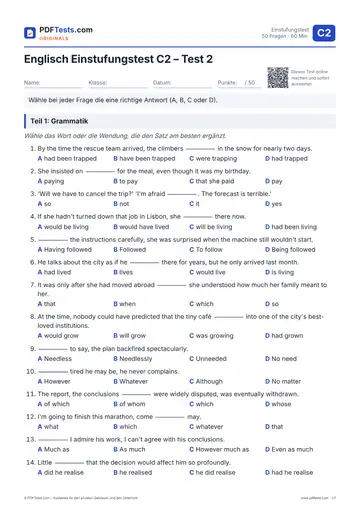
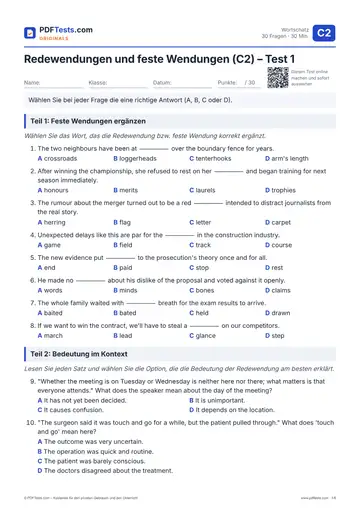
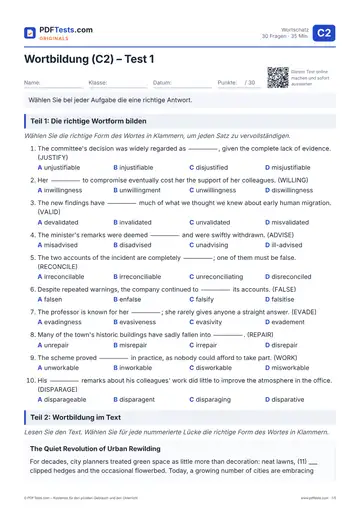
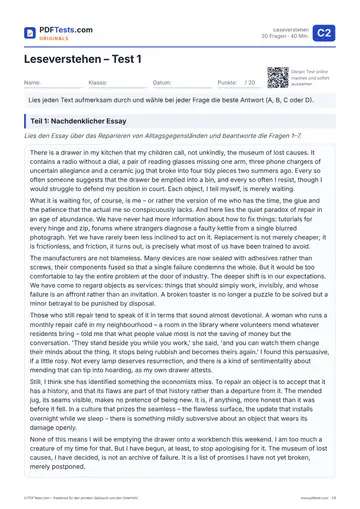
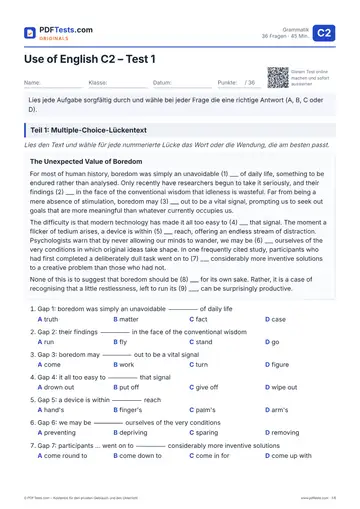
Vorschau von Seite 1: Use of English C2 – Test 2 PDF öffnen
Use of English B1–C2 · alle Tests im Prüfungsformat, Aufgabentypen und Tipps

Test online machen

Wähle für jede Aufgabe die beste Antwort (A, B, C oder D). Wählen Sie Ihre Antworten und klicken Sie auf „Antworten prüfen“.

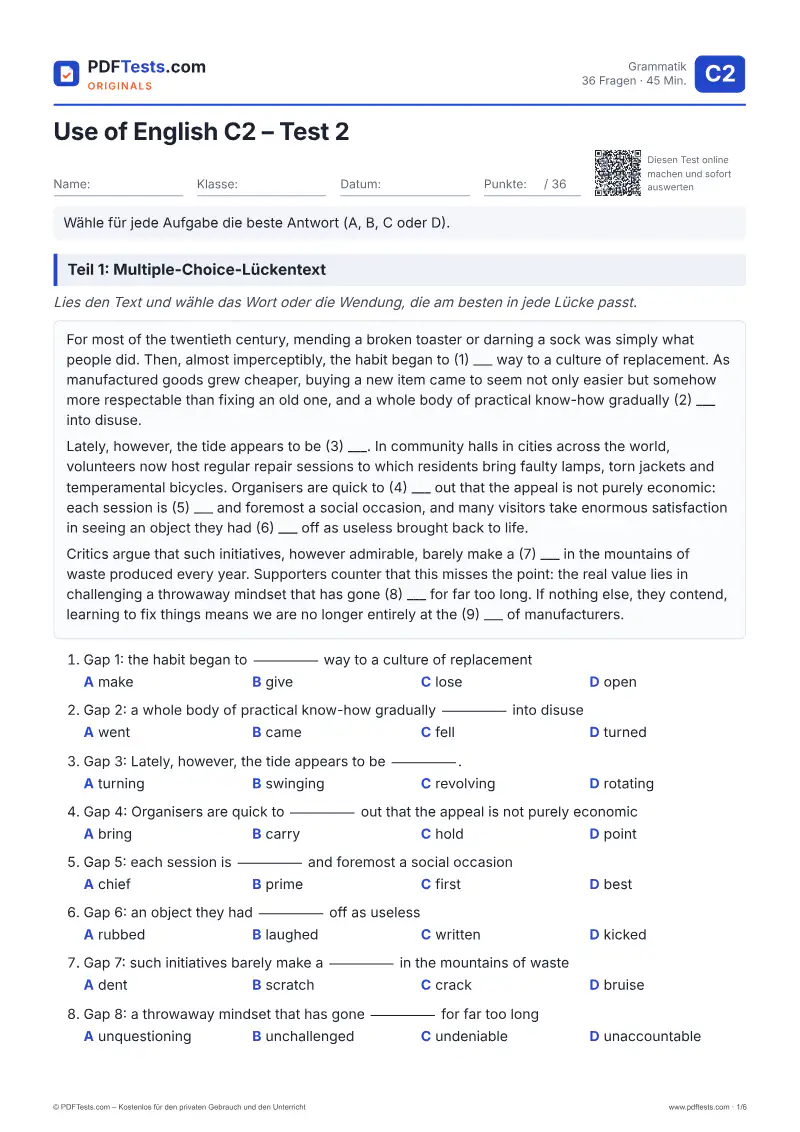
Teil 1: Multiple-Choice-Lückentext

Lies den Text und wähle das Wort oder die Wendung, die am besten in jede Lücke passt.

For most of the twentieth century, mending a broken toaster or darning a sock was simply what people did. Then, almost imperceptibly, the habit began to (1) ___ way to a culture of replacement. As manufactured goods grew cheaper, buying a new item came to seem not only easier but somehow more respectable than fixing an old one, and a whole body of practical know-how gradually (2) ___ into disuse.

Lately, however, the tide appears to be (3) ___. In community halls in cities across the world, volunteers now host regular repair sessions to which residents bring faulty lamps, torn jackets and temperamental bicycles. Organisers are quick to (4) ___ out that the appeal is not purely economic: each session is (5) ___ and foremost a social occasion, and many visitors take enormous satisfaction in seeing an object they had (6) ___ off as useless brought back to life.

Critics argue that such initiatives, however admirable, barely make a (7) ___ in the mountains of waste produced every year. Supporters counter that this misses the point: the real value lies in challenging a throwaway mindset that has gone (8) ___ for far too long. If nothing else, they contend, learning to fix things means we are no longer entirely at the (9) ___ of manufacturers.

  1. Gap 1: the habit began to _____ way to a culture of replacement

  2. Gap 2: a whole body of practical know-how gradually _____ into disuse

  3. Gap 3: Lately, however, the tide appears to be _____.

  4. Gap 4: Organisers are quick to _____ out that the appeal is not purely economic

  5. Gap 5: each session is _____ and foremost a social occasion

  6. Gap 6: an object they had _____ off as useless

  7. Gap 7: such initiatives barely make a _____ in the mountains of waste

  8. Gap 8: a throwaway mindset that has gone _____ for far too long

  9. Gap 9: we are no longer entirely at the _____ of manufacturers

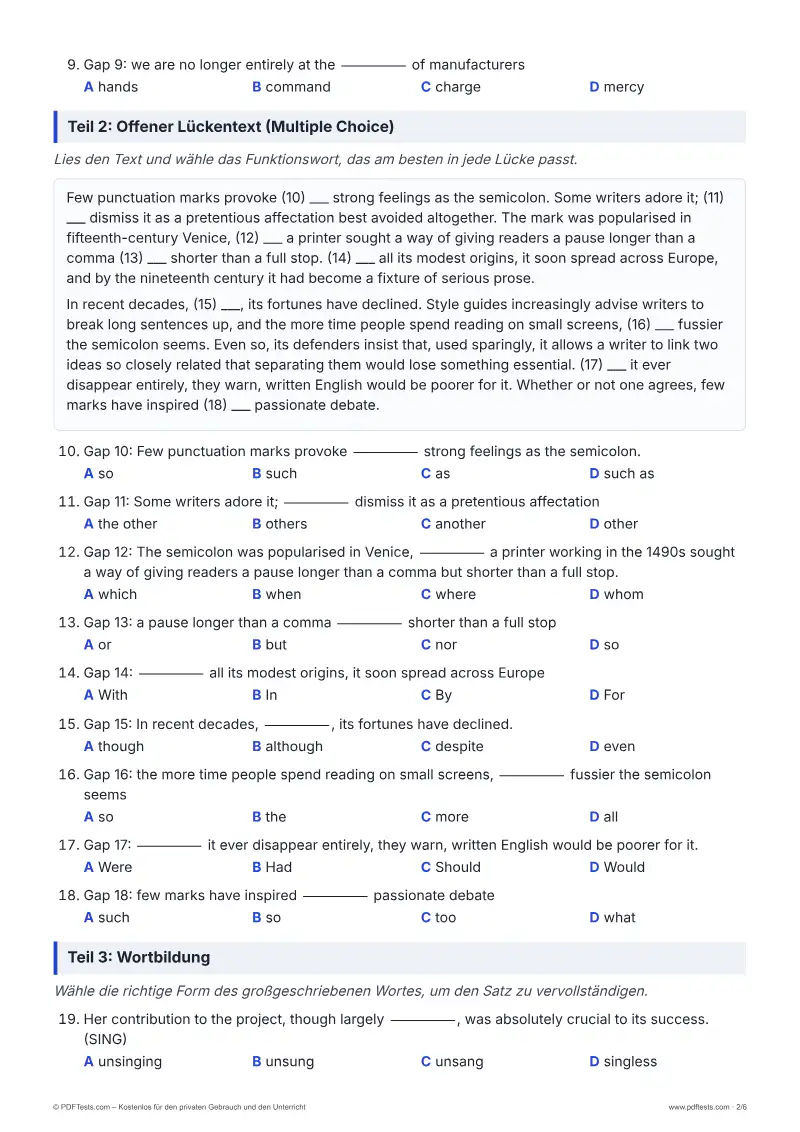
Teil 2: Offener Lückentext (Multiple Choice)

Lies den Text und wähle das Funktionswort, das am besten in jede Lücke passt.

Few punctuation marks provoke (10) ___ strong feelings as the semicolon. Some writers adore it; (11) ___ dismiss it as a pretentious affectation best avoided altogether. The mark was popularised in fifteenth-century Venice, (12) ___ a printer sought a way of giving readers a pause longer than a comma (13) ___ shorter than a full stop. (14) ___ all its modest origins, it soon spread across Europe, and by the nineteenth century it had become a fixture of serious prose.

In recent decades, (15) ___, its fortunes have declined. Style guides increasingly advise writers to break long sentences up, and the more time people spend reading on small screens, (16) ___ fussier the semicolon seems. Even so, its defenders insist that, used sparingly, it allows a writer to link two ideas so closely related that separating them would lose something essential. (17) ___ it ever disappear entirely, they warn, written English would be poorer for it. Whether or not one agrees, few marks have inspired (18) ___ passionate debate.

  1. Gap 10: Few punctuation marks provoke _____ strong feelings as the semicolon.

  2. Gap 11: Some writers adore it; _____ dismiss it as a pretentious affectation

  3. Gap 12: The semicolon was popularised in Venice, _____ a printer working in the 1490s sought a way of giving readers a pause longer than a comma but shorter than a full stop.

  4. Gap 13: a pause longer than a comma _____ shorter than a full stop

  5. Gap 14: _____ all its modest origins, it soon spread across Europe

  6. Gap 15: In recent decades, _____, its fortunes have declined.

  7. Gap 16: the more time people spend reading on small screens, _____ fussier the semicolon seems

  8. Gap 17: _____ it ever disappear entirely, they warn, written English would be poorer for it.

  9. Gap 18: few marks have inspired _____ passionate debate

Teil 3: Wortbildung

Wähle die richtige Form des großgeschriebenen Wortes, um den Satz zu vervollständigen.

  1. Her contribution to the project, though largely _____, was absolutely crucial to its success. (SING)

  2. The two parties remain _____ opposed on the question of funding. (DIAMETER)

  3. Rents in the city centre have become _____ high for most young people. (PROHIBIT)

  4. After weeks of fruitless discussion, the negotiations reached an _____ and talks were suspended. (PASS)

  5. The novelist has an _____ ability to capture the rhythms of everyday speech. (CANNY)

  6. The difference between the two versions is barely _____ to the untrained eye. (DISCERN)

  7. She argued her case with such _____ that even her fiercest critics were won over. (CONVINCE)

  8. The scheme was _____ from the outset, so nobody was surprised when it collapsed. (CONCEIVE)

  9. Once signed, the agreement is _____ and cannot be withdrawn under any circumstances. (REVOKE)

Teil 4: Satzumformungen mit Schlüsselwort (Key Word Transformations)

Wähle den Satz, der dieselbe Bedeutung wie der erste Satz hat, das großgeschriebene Schlüsselwort korrekt verwendet und grammatisch richtig ist.

  1. She had no idea that the police were watching her. (LITTLE)

  2. People say that the company is on the verge of bankruptcy. (REPUTED)

  3. Her performance was nowhere near as good as we had expected. (FELL)

  4. Everyone was surprised when he resigned. (CAME)

  5. I don't mind at all whether we eat in or go out. (DIFFERENCE)

  6. He has never really accepted that his career is over. (TERMS)

  7. There is absolutely no possibility of the project being finished by Friday. (QUESTION)

  8. The match was called off because the pitch was waterlogged. (ACCOUNT)

  9. I'm sure she didn't intend to upset anyone. (MEANT)

War diese Seite hilfreich?

Fehler melden

Falsche Lösung, Tippfehler oder unklare Erklärung? Schreiben Sie uns, wir korrigieren es.

Mit einem Arbeitsblatt üben: Use of English C2 – Arbeitsblatt 1

Vorschau

Über diesen Test

Dieser Use-of-English-Test auf Niveau C2 fordert fortgeschrittene Lernende mit 36 prüfungsnahen Multiple-Choice-Aufgaben in vier Teilen heraus: einem lexikalischen Lückentext, einem grammatischen Lückentext, Wortbildung und Satzumformungen mit Schlüsselwort (Key Word Transformations). Er eignet sich für alle, die sich auf Prüfungen auf Proficiency-Niveau vorbereiten, und für Lehrkräfte, die ein verlässliches Übungsblatt zum Ausdrucken suchen.

Themen

Kollokationen und feste WendungenPhrasal VerbsFunktionswörter im KontextInversion und BedingungssätzeWortbildungSatzumformungen mit Schlüsselwort (Key Word Transformations)

So nutzen Sie diesen Test

  1. Laden Sie das PDF herunter und drucken Sie es aus – oder machen Sie den Test unten online.
  2. Beantworten Sie alle Fragen ohne Wörterbuch und ohne Zeitdruck.
  3. Prüfen Sie Ihre Antworten und notieren Sie, was Sie wiederholen sollten.

Hinweise für Lehrkräfte

Setzen Sie den Test als Prüfungssimulation mit Zeitvorgabe ein oder bearbeiten Sie ihn im Unterricht Teil für Teil. Teil 1 und 3 zielen auf knapp danebenliegende Kollokationen sowie Fehler bei Präfixen und Suffixen, etwa unrevokable oder prohibitive statt prohibitively. Teil 2 und 4 konzentrieren sich auf Inversion, Vergleichsstrukturen und feste Wendungen, bei denen Lernende häufig einen Artikel oder eine Präposition weglassen. Als Anschlussaufgabe können die Lernenden mit den Schlüsselwörtern aus Teil 4 eigene Umformungen schreiben.