PDFTests Originals

Adverbs of Frequency – Worksheet 1

A1 Beginner WorksheetEnglish

This A1 worksheet practises adverbs of frequency such as always, usually, often, sometimes, rarely and never. Learners study what each adverb means and where it goes in a sentence: before the main verb and after the verb be. They also practise negatives and questions with How often and ever. It suits beginners in class or at home.
items
39
Time
25 min
PDF
5 pages
Answer key
Included
  • 100% free
  • No sign-up or email
  • Print-ready A4 PDF
Preview of page 1 of Adverbs of Frequency – Worksheet 1 Open PDF
New to this topic? Read the guide first: Adverbs of Frequency: Always, Usually, Often, Sometimes, Never

Do the worksheet online

Type your answers, then press “Check my answers”. Alternative correct answers are accepted.

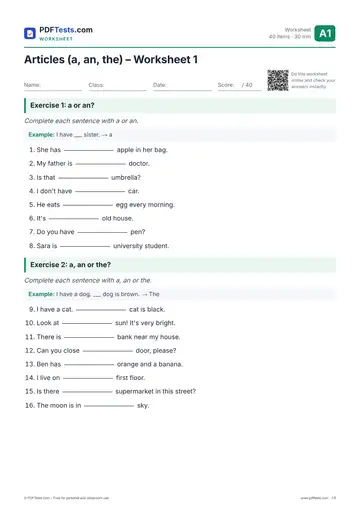
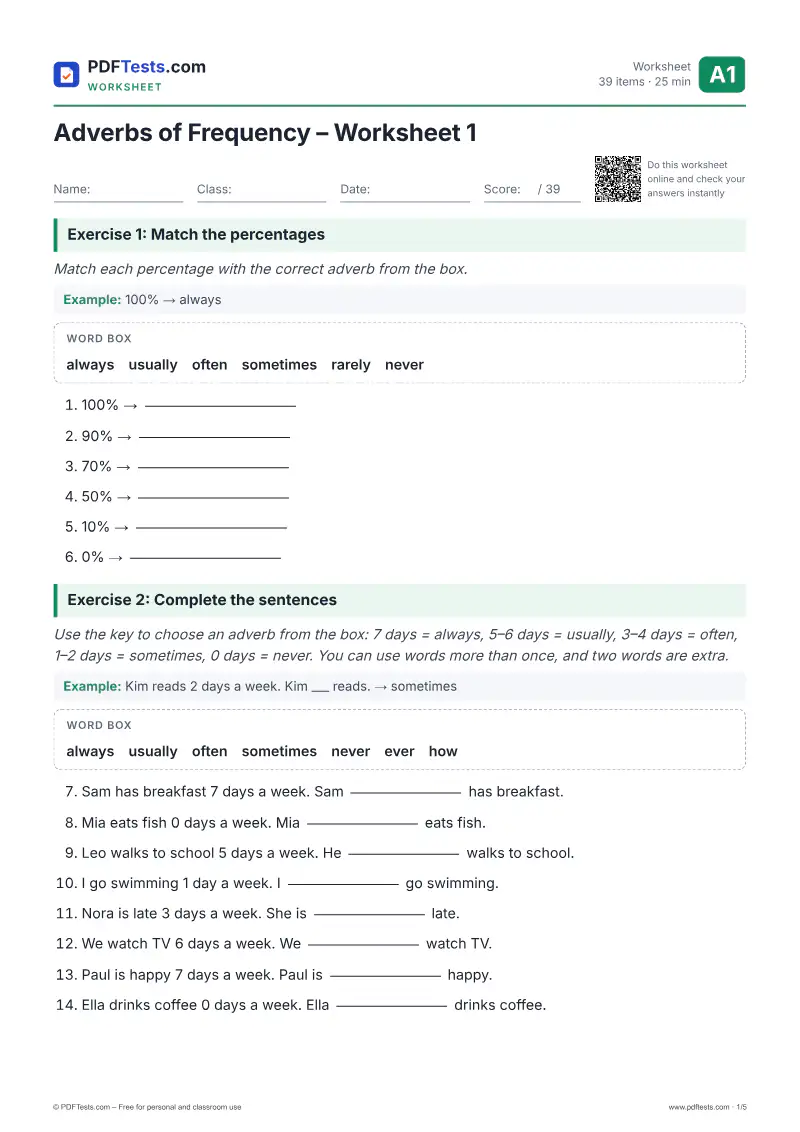
Exercise 1: Match the percentages

Match each percentage with the correct adverb from the box.

Example: 100% → always

Word box alwaysusuallyoftensometimesrarelynever

  1. 100%

  2. 90%

  3. 70%

  4. 50%

  5. 10%

  6. 0%

Exercise 2: Complete the sentences

Use the key to choose an adverb from the box: 7 days = always, 5–6 days = usually, 3–4 days = often, 1–2 days = sometimes, 0 days = never. You can use words more than once, and two words are extra.

Example: Kim reads 2 days a week. Kim ___ reads. → sometimes

Word box alwaysusuallyoftensometimesnevereverhow

  1. Sam has breakfast 7 days a week. Sam has breakfast.

  2. Mia eats fish 0 days a week. Mia eats fish.

  3. Leo walks to school 5 days a week. He walks to school.

  4. I go swimming 1 day a week. I go swimming.

  5. Nora is late 3 days a week. She is late.

  6. We watch TV 6 days a week. We watch TV.

  7. Paul is happy 7 days a week. Paul is happy.

  8. Ella drinks coffee 0 days a week. Ella drinks coffee.

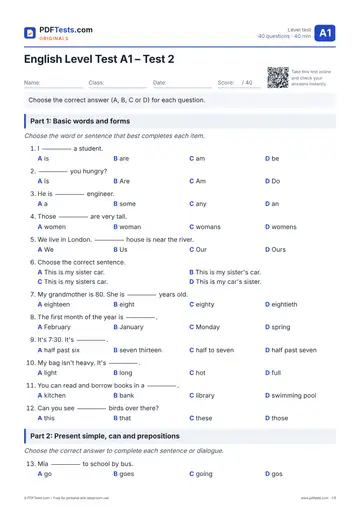
Exercise 3: Put the words in order

Write the words in the correct order to make a sentence or question.

Example: often / we / pizza / eat → We often eat pizza.

  1. always / I / breakfast / have

  2. late / is / never / she

  3. usually / we / to school / walk

  4. tired / often / are / they

  5. sometimes / plays / Ben / football

  6. hungry / always / I / am

  7. TV / watch / don't / usually / I

  8. you / ever / do / cook

  9. how / you / often / swim / do

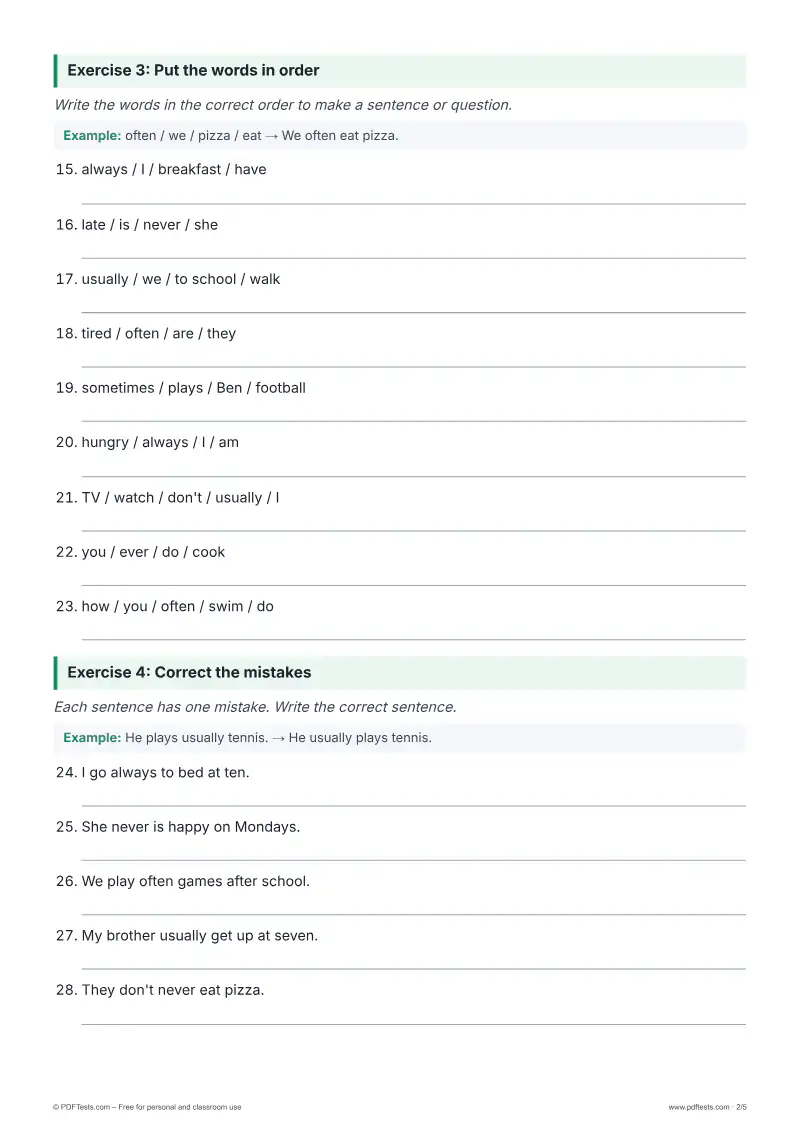
Exercise 4: Correct the mistakes

Each sentence has one mistake. Write the correct sentence.

Example: He plays usually tennis. → He usually plays tennis.

  1. I go always to bed at ten.

  2. She never is happy on Mondays.

  3. We play often games after school.

  4. My brother usually get up at seven.

  5. They don't never eat pizza.

  6. How often you go to the park?

  7. Is he late always?

  8. Do you ever plays the guitar?

Exercise 5: Add the adverb

Rewrite the sentence with the adverb in brackets in the correct place.

Example: I walk to work. (often) → I often walk to work.

  1. I drink milk. (usually)

  2. Lucy is busy. (always)

  3. We eat in a restaurant. (sometimes)

  4. Are you tired? (often)

  5. Does Omar walk to work? (usually)

  6. He doesn't watch films. (usually)

  7. My parents are at home in the afternoon. (never)

  8. Kenji plays computer games. (rarely)

Was this page helpful?

Report a mistake

Spotted a wrong answer, a typo or an unclear explanation? Tell us and we will fix it.

Preview

About this test

Printable A1 worksheet on adverbs of frequency: always, usually, often, sometimes, rarely and never. Covers word order, negatives and questions, with answers.

Topics covered

Adverbs of frequencyWord order with be and other verbsNegatives with adverbsQuestions: How often? / everPresent simple

Notes for teachers

Start with the percentage scale in Exercise 1 and draw it on the board for learners to refer to. The most common mistake is word order. Learners often put the adverb after the main verb (I go always) or before be (She never is late), so drill both patterns: adverb + verb, and be + adverb. As a follow-up, learners can interview a partner with How often do you...? and then write five true sentences about them.

All English A1 tests →