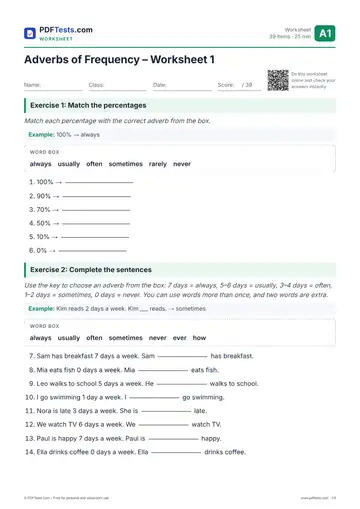
Adverbs of frequency are words like always, usually, often, sometimes and never. They tell us how often something happens. We use them mostly with the present simple to talk about habits and routines: I usually get up at seven.
The main adverbs of frequency
Here are the most common adverbs of frequency, from most often to least often. The percentages are only a guide to help you remember the order. They are not exact.
| Adverb | How often (approx.) | Example |
|---|---|---|
| always | 100% | I always have breakfast. |
| usually | 90% | She usually walks to work. |
| often | 70% | We often watch films at home. |
| sometimes | 50% | They sometimes eat out. |
| rarely / hardly ever | 5% | He hardly ever drinks coffee. |
| never | 0% | I never watch horror films. |
A few notes:
- Normally means the same as usually: I normally finish work at five.
- Rarely and hardly ever have the same meaning. In everyday speech, hardly ever is more common.
- Never means not at any time. It is already negative.
Word order: the two key rules
The position of the adverb is the most important thing to learn. It depends on the verb in the sentence.
Rule 1: Before the main verb
With most verbs (play, go, eat, work, live…), the adverb goes between the subject and the verb.
- I often go to the park.
- My parents usually cook dinner together.
- We never work on Sundays.
Remember: with he, she and it, the verb still needs -s in the present simple. The adverb does not change this.
- He often plays tennis.
- She always gets up early.
- It sometimes rains in summer.
Rule 2: After the verb be
With am, is, are (and was, were), the adverb goes after the verb.
- I am always tired on Mondays.
- She is never late.
- They’re usually at home in the evening.
If you need help with am, is and are, read our guide to the verb to be.
Summary table
| Verb type | Word order | Example |
|---|---|---|
| Most verbs | subject + adverb + verb | Tom usually drives to work. |
| be | subject + be + adverb | Tom is usually busy. |
| can / can’t | subject + can + adverb + verb | You can always call me. |
A simple way to remember: be comes before the adverb; other verbs come after it.
With can and can’t
With can, the adverb goes after can and before the main verb.
- You can usually find him in the library.
- I can never remember her name.
Sometimes and usually at the start
Sometimes and usually can also go at the start of a sentence. Sometimes can go at the end too.
- Sometimes I walk to school.
- Usually we have pasta on Fridays.
- I go swimming sometimes.
Do not put always or never at the start of a normal sentence. Say I always get up early, not Always I get up early.
Negative sentences
Never: no extra negative
Never is already negative, so the verb stays positive. Do not use don’t or doesn’t with never.
- I never eat meat. (not I don’t never eat meat)
- She never watches TV.
don’t / doesn’t + adverb
With other adverbs, the adverb goes after don’t or doesn’t and before the main verb.
- I don’t usually work on Saturdays.
- He doesn’t often call his brother.
- We don’t always agree.
With be, the adverb goes after isn’t, aren’t or ’m not.
- She isn’t usually late.
- I’m not always this hungry.
| Positive | Negative |
|---|---|
| I usually drive. | I don’t usually drive. |
| She often goes out. | She doesn’t often go out. |
| They are always happy. | They aren’t always happy. |
| He sometimes cooks. | He never cooks. |
Note the meaning: I don’t always drive means sometimes I drive and sometimes I don’t. It is not the same as I never drive.
Questions
Do / Does + subject + adverb + verb
For most verbs, put the adverb after the subject.
- Do you often go to the gym?
- Does she usually take the bus?
Be + subject + adverb
With be, the adverb also goes after the subject.
- Are you always this busy?
- Is he often late?
Ever in questions
We often use ever (= at any time) in questions. Answer with an adverb of frequency.
- Do you ever eat fish? — Yes, sometimes. / No, never.
- Is it ever cold here? — Yes, often in winter.
How often…?
To ask about frequency, use How often. For more question words, see our guide to question words.
- How often do you play football? — Twice a week.
- How often does your sister visit you? — Not very often.
Adverbs of frequency vs frequency expressions
Learners often mix up single adverbs (always, often) with frequency expressions (every day, once a week). They go in different places.
| Type | Examples | Position | Example sentence |
|---|---|---|---|
| Adverbs of frequency | always, usually, often, sometimes, never | middle (before the main verb / after be) | I often go to the cinema. |
| Frequency expressions | every day, once a week, twice a month, on Mondays | end (or start) | I go to the cinema once a month. |
More examples of frequency expressions:
- She calls her mum every day.
- We play tennis twice a week.
- They go on holiday three times a year.
- On Fridays, I eat pizza.
Note: once = one time, twice = two times. After that, say three times, four times and so on.
Adverbs of frequency and the present simple
Adverbs of frequency are important signal words for the present simple. When you see always, usually, often, sometimes or never, the sentence is usually about a habit or routine, so you use the present simple.
- I always drink tea in the morning. (a habit)
- I am drinking tea now. (happening at this moment: present continuous)
If you want to review the form, read our Present Simple guide.
Common mistakes
✗ I go always to school by bus. → ✓ I always go to school by bus. The adverb goes before the main verb, not after it.
✗ She always is happy. → ✓ She is always happy. With be, the adverb goes after the verb.
✗ I don’t never eat fish. → ✓ I never eat fish. Never is already negative, so don’t add don’t.
✗ He usually drink tea. → ✓ He usually drinks tea. The verb still needs -s with he, she and it.
✗ Always I get up early. → ✓ I always get up early. Always does not normally start a sentence.
✗ Do you go often to the cinema? → ✓ Do you often go to the cinema? In questions, the adverb goes after the subject and before the main verb.
✗ I every day play football. → ✓ I play football every day. Frequency expressions go at the end, not in the middle.
✗ She doesn’t usually goes out. → ✓ She doesn’t usually go out. After doesn’t, use the base verb without -s.
Quick check
Put the adverb in the correct place or correct the sentence.
- I am tired after work. (always)
- My brother walks to school. (usually)
- She never doesn’t eat meat. (correct the mistake)
- Do you ___ go swimming? (ever or never?)
- They are at the park on Sundays. (often)
Answers
- I am always tired after work.
- My brother usually walks to school.
- She never eats meat.
- ever: Do you ever go swimming?
- They are often at the park on Sundays.
Next step
Now practise the word order until it feels natural. Test yourself with our A1 Adverbs of Frequency test, then use the adverbs with daily routines in the A1 Present Simple test. For extra practice, try our everyday vocabulary test on home, family and daily routine and write five true sentences about your week using always, usually, often, sometimes and never.
Practise this topic: Adverbs of Frequency
Was this page helpful?
What was the problem?
Thank you for your feedback!