PDFTests Originals

US Citizenship English Test Practice – Test 1

A2 Elementary VocabularyEnglish

This 30-question practice test prepares learners for the English reading and writing part of the US naturalization interview. It uses short, simple sentences about US history, government, holidays and civic life at CEFR level A2. It suits citizenship applicants, adult ESL classes and teachers who want a quick, printable check.
Questions
30
Time
30 min
PDF
4 pages
Answer key
Included
  • 100% free
  • No sign-up or email
  • Print-ready A4 PDF
Preview of page 1 of US Citizenship English Test Practice – Test 1 Open PDF
US citizenship English test · all practice tests, levels and tips

Take the test online

Read each question carefully and choose the one best answer. Choose your answers, then press “Check my answers”.

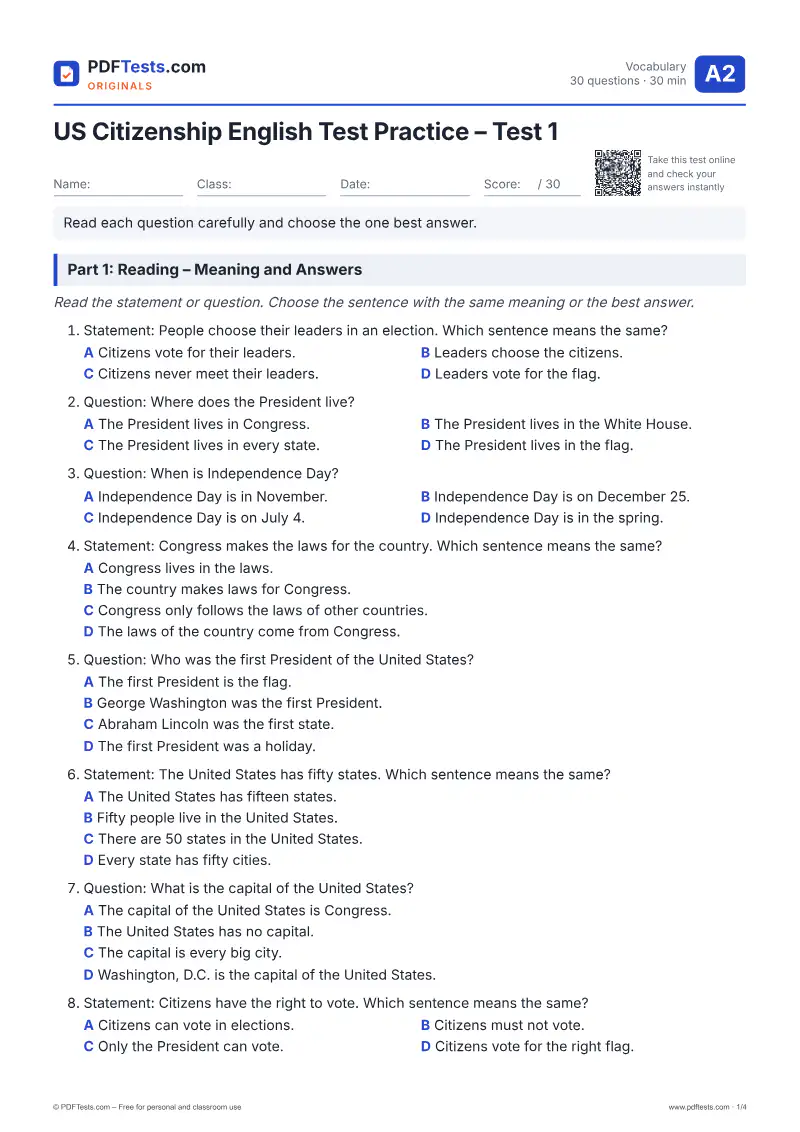
Part 1: Reading – Meaning and Answers

Read the statement or question. Choose the sentence with the same meaning or the best answer.

  1. Statement: People choose their leaders in an election. Which sentence means the same?

  2. Question: Where does the President live?

  3. Question: When is Independence Day?

  4. Statement: Congress makes the laws for the country. Which sentence means the same?

  5. Question: Who was the first President of the United States?

  6. Statement: The United States has fifty states. Which sentence means the same?

  7. Question: What is the capital of the United States?

  8. Statement: Citizens have the right to vote. Which sentence means the same?

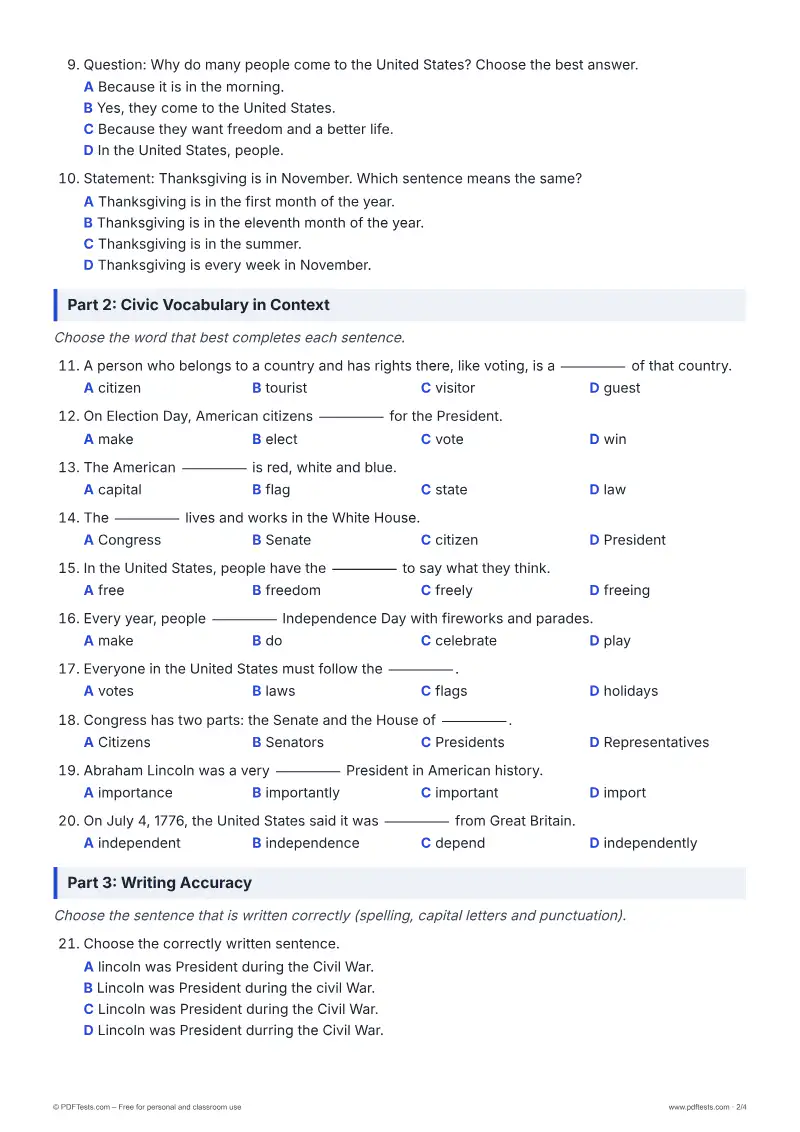
  9. Question: Why do many people come to the United States? Choose the best answer.

  10. Statement: Thanksgiving is in November. Which sentence means the same?

Part 2: Civic Vocabulary in Context

Choose the word that best completes each sentence.

  1. A person who belongs to a country and has rights there, like voting, is a _____ of that country.

  2. On Election Day, American citizens _____ for the President.

  3. The American _____ is red, white and blue.

  4. The _____ lives and works in the White House.

  5. In the United States, people have the _____ to say what they think.

  6. Every year, people _____ Independence Day with fireworks and parades.

  7. Everyone in the United States must follow the _____.

  8. Congress has two parts: the Senate and the House of _____.

  9. Abraham Lincoln was a very _____ President in American history.

  10. On July 4, 1776, the United States said it was _____ from Great Britain.

Part 3: Writing Accuracy

Choose the sentence that is written correctly (spelling, capital letters and punctuation).

  1. Choose the correctly written sentence.

  2. Choose the correctly written sentence.

  3. Choose the correctly written sentence.

  4. Choose the correctly written sentence.

  5. Choose the correctly written question.

  6. Choose the correctly written sentence.

  7. Choose the correctly written sentence.

  8. Choose the correctly written sentence.

  9. Choose the correctly written sentence.

  10. Choose the correctly written sentence.

Was this page helpful?

Report a mistake

Spotted a wrong answer, a typo or an unclear explanation? Tell us and we will fix it.

Preview

About this test

This 30-question practice test prepares learners for the English reading and writing part of the US naturalization interview. It uses short, simple sentences about US history, government, holidays and civic life at CEFR level A2. It suits citizenship applicants, adult ESL classes and teachers who want a quick, printable check.

Topics covered

US civics vocabularyGovernment and CongressAmerican holidaysRights and freedomsCapital letters and spellingPunctuation

How to use this test

  1. Download the PDF and print it, or take the test online below.
  2. Answer every question without a dictionary or time pressure.
  3. Check your answers and note the topics you need to review.

Notes for teachers

Use Part 1 as a warm-up, then work through the civic vocabulary in Part 2 and the writing accuracy items in Part 3. The test targets typical errors such as missing capital letters on holidays, months and place names, wrong collocations (e.g. 'make a holiday' instead of 'celebrate'), and confusion between word forms such as independent/independence. As a follow-up, dictate the correct sentences from Part 3 so learners practice writing them as in the interview.