PDFTests Originals

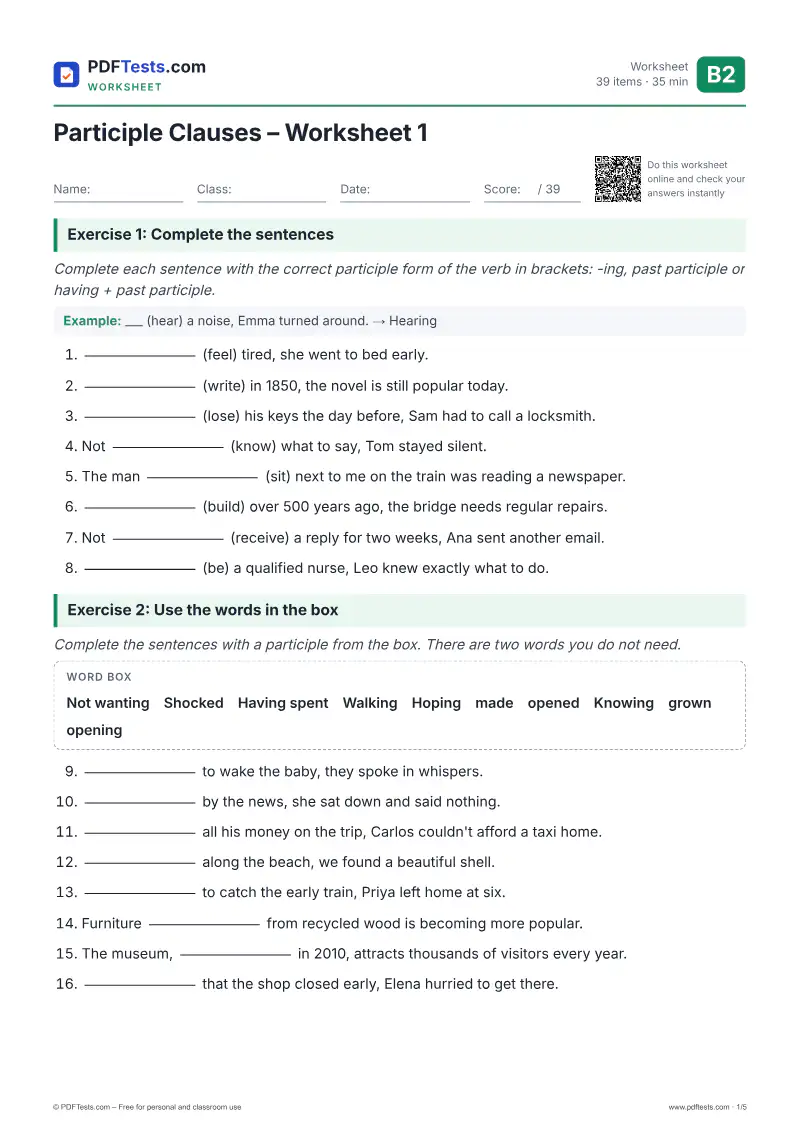
Participle Clauses – Worksheet 1

B2 Upper-intermediate WorksheetEnglish

This worksheet practises participle clauses in English: present participles (-ing), past participles and perfect participles (having + past participle), including negative forms with 'not'. It is for B2 learners who want to make their writing more concise and natural by replacing longer clauses with participle clauses.
items
39
Time
35 min
PDF
5 pages
Answer key
Included
  • 100% free
  • No sign-up or email
  • Print-ready A4 PDF
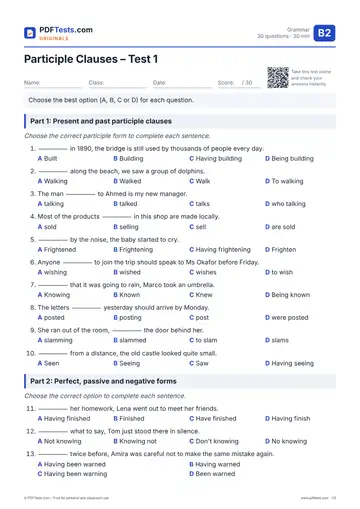
Preview of page 1 of Participle Clauses – Worksheet 1 Open PDF
New to this topic? Read the guide first: Participle Clauses: Rules, Examples and Common Mistakes

Do the worksheet online

Type your answers, then press “Check my answers”. Alternative correct answers are accepted.

Exercise 1: Complete the sentences

Complete each sentence with the correct participle form of the verb in brackets: -ing, past participle or having + past participle.

Example: ___ (hear) a noise, Emma turned around. → Hearing

  1. (feel) tired, she went to bed early.

  2. (write) in 1850, the novel is still popular today.

  3. (lose) his keys the day before, Sam had to call a locksmith.

  4. Not (know) what to say, Tom stayed silent.

  5. The man (sit) next to me on the train was reading a newspaper.

  6. (build) over 500 years ago, the bridge needs regular repairs.

  7. Not (receive) a reply for two weeks, Ana sent another email.

  8. (be) a qualified nurse, Leo knew exactly what to do.

Exercise 2: Use the words in the box

Complete the sentences with a participle from the box. There are two words you do not need.

Word box Not wantingShockedHaving spentWalkingHopingmadeopenedKnowinggrownopening

  1. to wake the baby, they spoke in whispers.

  2. by the news, she sat down and said nothing.

  3. all his money on the trip, Carlos couldn't afford a taxi home.

  4. along the beach, we found a beautiful shell.

  5. to catch the early train, Priya left home at six.

  6. Furniture from recycled wood is becoming more popular.

  7. The museum, in 2010, attracts thousands of visitors every year.

  8. that the shop closed early, Elena hurried to get there.

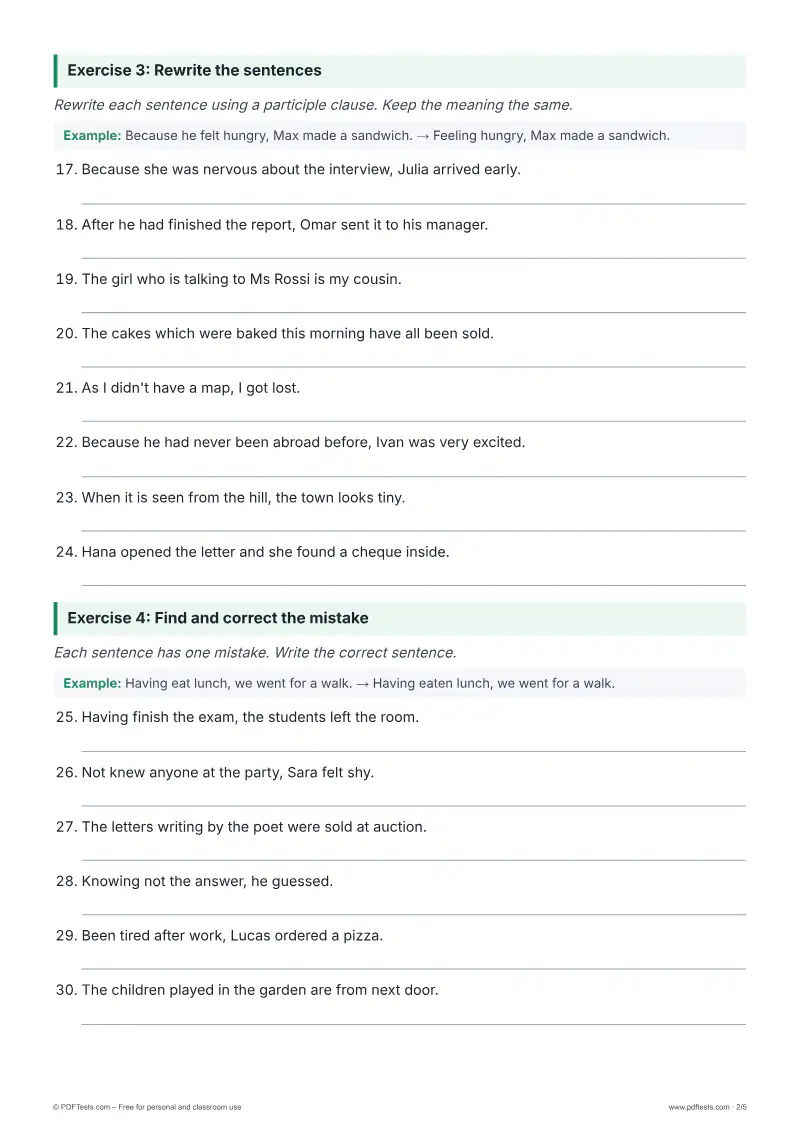
Exercise 3: Rewrite the sentences

Rewrite each sentence using a participle clause. Keep the meaning the same.

Example: Because he felt hungry, Max made a sandwich. → Feeling hungry, Max made a sandwich.

  1. Because she was nervous about the interview, Julia arrived early.

  2. After he had finished the report, Omar sent it to his manager.

  3. The girl who is talking to Ms Rossi is my cousin.

  4. The cakes which were baked this morning have all been sold.

  5. As I didn't have a map, I got lost.

  6. Because he had never been abroad before, Ivan was very excited.

  7. When it is seen from the hill, the town looks tiny.

  8. Hana opened the letter and she found a cheque inside.

Exercise 4: Find and correct the mistake

Each sentence has one mistake. Write the correct sentence.

Example: Having eat lunch, we went for a walk. → Having eaten lunch, we went for a walk.

  1. Having finish the exam, the students left the room.

  2. Not knew anyone at the party, Sara felt shy.

  3. The letters writing by the poet were sold at auction.

  4. Knowing not the answer, he guessed.

  5. Been tired after work, Lucas ordered a pizza.

  6. The children played in the garden are from next door.

  7. Having been invite to the wedding, Nadia bought a new dress.

  8. Taken a deep breath, Marco began his speech.

Exercise 5: Put the words in order

Put the words in the correct order to make sentences and questions.

Example: Hearing / the / news, / she / smiled → Hearing the news, she smiled.

  1. Feeling / ill, / Rosa / stayed / at / home

  2. Looking / back, / would / you / change / anything

  3. the / woman / wearing / the / red / coat / is / our / new / teacher

  4. Having / lived / in / Japan, / she / speaks / Japanese / fluently

  5. Not / having / been / told / the / time, / we / arrived / late

  6. the / photos / taken / on / holiday / are / on / my / laptop

  7. Given / the / chance, / would / you / live / abroad

Was this page helpful?

Report a mistake

Spotted a wrong answer, a typo or an unclear explanation? Tell us and we will fix it.

Preview

About this test

B2 English worksheet on participle clauses: -ing, past and perfect participles, negatives and questions. Printable, with answers.

Topics covered

Participle clausesPresent participles (-ing)Past participlesPerfect participles (having done)Reduced relative clausesNegative participle clauses

Notes for teachers

Start by showing how a full clause (Because she was tired, ...) becomes a participle clause (Being tired, ...), and point out that the subject of both clauses must be the same. Typical mistakes include using the wrong participle (writing instead of written), putting 'not' after the participle, and forgetting the past participle after 'having'. As a follow-up, ask learners to rewrite a short paragraph of their own writing using at least four participle clauses.

All English B2 tests →