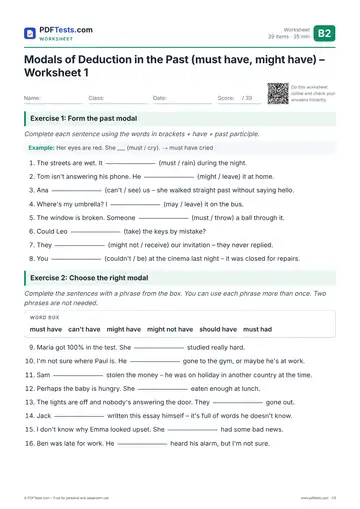
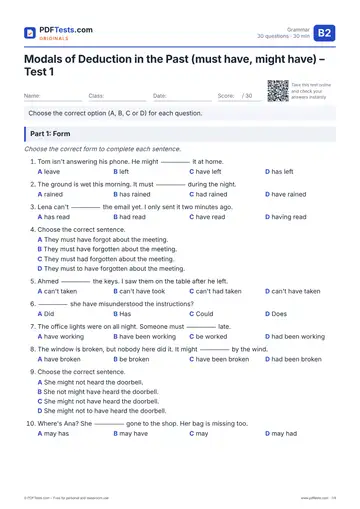
Modals of deduction in the past let you make logical guesses about something that happened, based on the evidence you have now. The form is modal + have + past participle: She must have left early, They might have missed the bus, He can’t have seen us. The modal you choose shows how certain you are.
The certainty scale
Each modal sits at a different point between “I’m sure it happened” and “I’m sure it didn’t happen”.
| How sure are you? | Modal | Example |
|---|---|---|
| Almost certain it happened | must have | The streets are wet. It must have rained last night. |
| It possibly happened | may have / might have / could have | She might have taken the earlier train. |
| It possibly didn’t happen | may not have / might not have | He may not have got my message. |
| Almost certain it didn’t happen | can’t have / couldn’t have | You can’t have finished already. You only started ten minutes ago. |
The key point: the opposite of must have is can’t have or couldn’t have, not mustn’t have.
Form
The structure never changes for different subjects. There is no -s, no had, and no did.
Affirmative
| Subject | Modal | have | Past participle |
|---|---|---|---|
| I / you / he / she / it / we / they | must | have | forgotten |
| I / you / he / she / it / we / they | may / might | have | left |
| I / you / he / she / it / we / they | could | have | taken |
In speech and informal writing: must’ve, might’ve, may’ve (less common), could’ve.
Negative
| Subject | Modal + not | have | Past participle |
|---|---|---|---|
| She | might not / mightn’t | have | heard |
| She | may not | have | heard |
| She | can’t / cannot | have | heard |
| She | couldn’t | have | heard |
Questions
| (Question word) | Modal | Subject | have | Past participle |
|---|---|---|---|---|
| – | Could | they | have | got lost? |
| Where | could | I | have | put my keys? |
| Who | might | – | have | sent this? |
| – | Can | he really | have | said that? |
Could is the most common modal in deduction questions. Can … have in questions usually expresses surprise or disbelief. Must and may are rarely used to begin questions of this kind.
Continuous and passive forms
You can also make deductions about actions in progress or about things done to someone or something:
- Continuous (modal + have been + -ing): He didn’t answer. He must have been sleeping.
- Passive (modal + have been + past participle): The window must have been left open all night.
- They might have been waiting for hours.
- The email can’t have been sent – it’s still in my outbox.
Uses
must have: a confident conclusion
Use must have when the evidence leads you to one logical explanation. You didn’t see it happen, but you are almost sure.
- Her eyes are red. She must have been crying.
- There’s no milk left. Someone must have finished it this morning.
- You must have been exhausted after that flight.
Note that must have is only for deduction. To talk about a past obligation, use had to: I had to work late yesterday. If you want to review the difference between obligation and deduction, see our guide to must, have to and should.
may have, might have, could have: a possibility
Use these three when you think something is possible but you aren’t sure. In deduction, their meanings are very close. Might is very common in conversation; may sounds slightly more formal.
- I can’t find my wallet. I might have left it at the café.
- The results may have been affected by the weather.
- Don’t worry, she could have forgotten to charge her phone.
They are often used to list possible explanations:
- He’s late. He might have overslept, or he could have got stuck in traffic.
For a negative possibility, use might not have or may not have:
- She might not have seen your message yet.
Do not use couldn’t have here. Couldn’t have means you are sure something didn’t happen, not that it possibly didn’t.
can’t have, couldn’t have: impossible
Use can’t have or couldn’t have when the evidence tells you something is impossible.
- You can’t have seen Maria at the party. She’s in Japan.
- He couldn’t have stolen the money – he was with me all evening.
- That can’t have been cheap.
The two are largely interchangeable. Couldn’t have is especially common in narratives and when reporting a past situation: The police realised he couldn’t have committed the crime.
Pronunciation: must’ve, not must of
In natural speech, have is reduced to a weak form /əv/:
| Written | Spoken (approx.) |
|---|---|
| must have | /ˈmʌstəv/ – must’ve |
| might have | /ˈmaɪtəv/ – might’ve |
| could have | /ˈkʊdəv/ – could’ve |
| can’t have | /ˈkɑːntəv/ (UK), /ˈkæntəv/ (US) |
Because /əv/ sounds like of, people sometimes write must of or could of. This is always wrong. Write must have or must’ve.
In speech, stress usually falls on the modal and the main verb: She MUST have FORgotten.
Signal words and paraphrases
Deductions usually come with evidence, introduced by words such as so, because, since, judging by… or a separate sentence of evidence.
In exams, especially key word transformation tasks, you often have to turn an expression of certainty into a modal. Learn these pairs:
| Original sentence | With a past modal |
|---|---|
| I’m sure he forgot. | He must have forgotten. |
| I bet they were annoyed. | They must have been annoyed. |
| It’s possible she was ill. | She might / may / could have been ill. |
| Perhaps the shop was closed. | The shop may have been closed. |
| Maybe he didn’t hear you. | He might not have heard you. |
| I’m certain they didn’t win. | They can’t / couldn’t have won. |
| It’s impossible that she said that. | She can’t have said that. |
Present or past deduction?
The same modals work for the present, but with a bare infinitive instead of have + past participle. Choose the form that matches the time of the situation you are guessing about, not the time you are speaking.
| Present deduction | Past deduction |
|---|---|
| He must be tired. | He must have been tired. |
| She might be working. | She might have been working. |
| They can’t be at home. | They can’t have been at home. |
| It could be Tom at the door. | It could have been Tom on the phone. |
- Sara isn’t answering. She must be in a meeting. (now)
- Sara didn’t answer earlier. She must have been in a meeting. (earlier)
If the present forms are not yet automatic for you, read our guide to modals of deduction in the present and try the B1 Modals of Deduction test first.
Deduction or criticism? could have, should have
Learners often confuse past deduction with other modal + have structures that look identical but have a different meaning.
could have can describe a possibility that existed but was not used. Here you are not guessing – you know what happened.
- Deduction: I don’t know how he got here. He could have taken the bus. (maybe he did)
- Unused possibility: He could have taken the bus, but he chose to walk. (he didn’t)
- Complaint: You could have told me you were coming. (you didn’t tell me)
should have expresses criticism or regret, not deduction:
- I should have left earlier. (I didn’t, and I regret it)
needn’t have means something was done but wasn’t necessary:
- You needn’t have brought a gift.
Could have and might have also appear in the result clause of the third conditional: If we’d left earlier, we might have caught the train. You can practise this with our B2 Third and Mixed Conditionals test.
Common mistakes
- ✗ He must have went home. → ✓ He must have gone home. Use the past participle after have, not the past simple.
- ✗ She must of forgotten. → ✓ She must have forgotten. Of is a spelling error based on the spoken weak form.
- ✗ He mustn’t have seen us – he didn’t wave. → ✓ He can’t have seen us. The negative of deductive must is can’t or couldn’t.
- ✗ It must rain last night. → ✓ It must have rained last night. For a past deduction you need have + past participle.
- ✗ She can’t had left. → ✓ She can’t have left. The auxiliary is always have, never had or has.
- ✗ She couldn’t have heard you, but I’m not sure. → ✓ She might not have heard you. Couldn’t have shows certainty; use might not / may not have for a negative possibility.
- ✗ I must have finished my report yesterday, so I stayed late. → ✓ I had to finish my report yesterday. For past obligation, use had to, not must have.
Quick check
- The lights are off and nobody is answering. They ___ (go) out.
- I’m not sure where Tom is. He ___ (miss) the train.
- Sara ___ (write) this note – it isn’t her handwriting.
- Rewrite: I’m sure Jake was joking. → Jake ___.
- Correct the mistake: You must of left your phone in the car.
Answers
- must have gone
- might / may / could have missed
- can’t / couldn’t have written
- Jake must have been joking.
- You must have (must’ve) left your phone in the car.
Next step
Now that you know the certainty scale, the form and the most common traps, put it into practice: test yourself with our B2 Modals of Deduction in the Past test, paying special attention to the difference between can’t have and might not have. When you are scoring consistently well, move on to our guide to advanced modal verbs, which covers more subtle uses such as needn’t have, would have and be bound to.
Practise this topic: Modals of Deduction in the Past
Was this page helpful?
What was the problem?
Thank you for your feedback!