PDFTests Originals

Passive Voice – Worksheet 1

B2 Upper-intermediate WorksheetEnglish

This worksheet practises the form, meaning and use of the passive voice at B2 level. It covers all main tenses, modal verbs, passive infinitives and -ing forms, negatives, questions and impersonal structures such as 'is said to'. It suits upper-intermediate learners in class or studying at home.
items
39
Time
35 min
PDF
5 pages
Answer key
Included
  • 100% free
  • No sign-up or email
  • Print-ready A4 PDF
Preview of page 1 of Passive Voice – Worksheet 1 Open PDF
New to this topic? Read the guide first: Passive Voice: Forms, Uses and Common Mistakes (B2)

Do the worksheet online

Type your answers, then press “Check my answers”. Alternative correct answers are accepted.

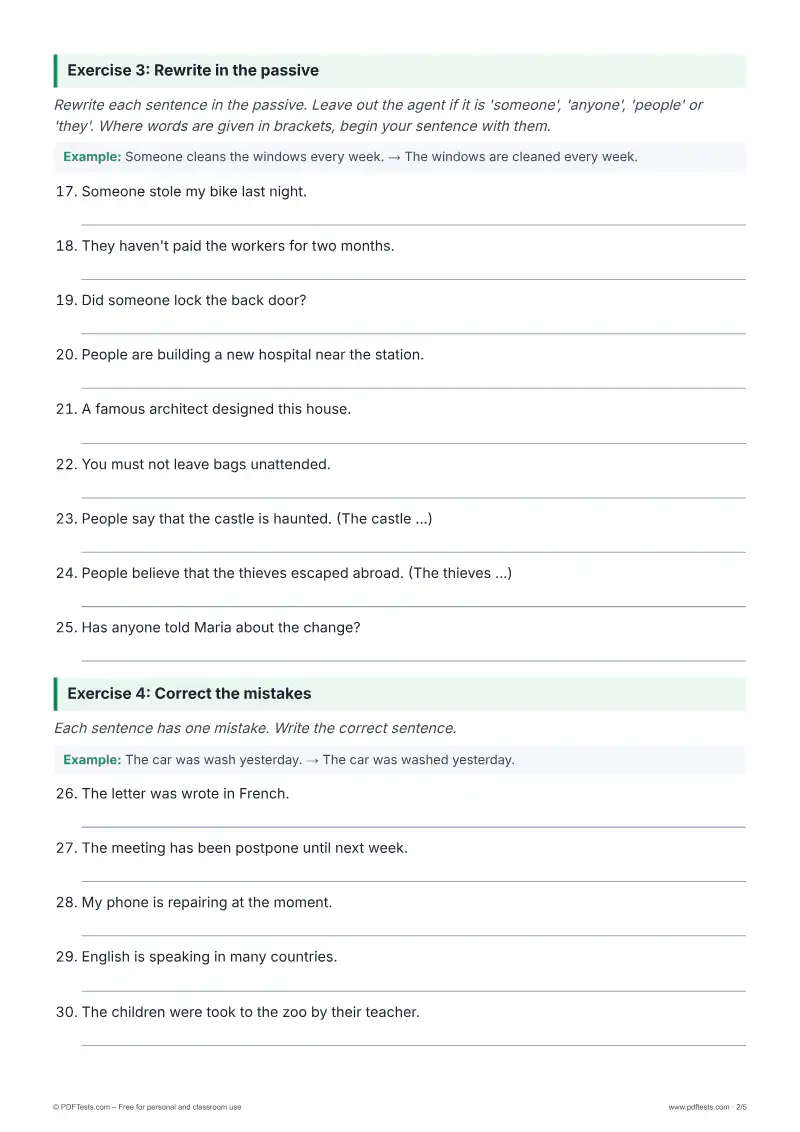
Exercise 1: Complete the sentences

Complete each sentence with the correct passive form of the verb in brackets.

Example: The museum ___ (build) in 1895. → was built

  1. Our office (clean) every evening after everyone has left.

  2. When I arrived at the garage, my car (still / repair), so I had to wait.

  3. Since the start of the year, more than 200 new jobs (create) in the area.

  4. The documents (not / sign) yet, so we can't send them.

  5. (will / the winners / announce) tomorrow morning?

  6. By the time the firefighters arrived, most of the building (destroy).

  7. This form must (complete) in black ink.

  8. I hate (interrupt) when I'm speaking.

Exercise 2: Choose from the box

Complete the sentences with words from the box. Use each word once. There are two extra words.

Word box is beingwill have beenhas beenwashad beenbeto bebeingbeenis

  1. Sorry, you can't use the lift – it repaired at the moment.

  2. The report finished by Friday, so you'll have it before the weekend meeting.

  3. The novel translated into over thirty languages so far.

  4. The thief caught two hours after the robbery.

  5. Nobody told us that the flight cancelled until we reached the airport.

  6. These tablets should taken with food.

  7. She expects promoted next year.

  8. He doesn't like told what to do.

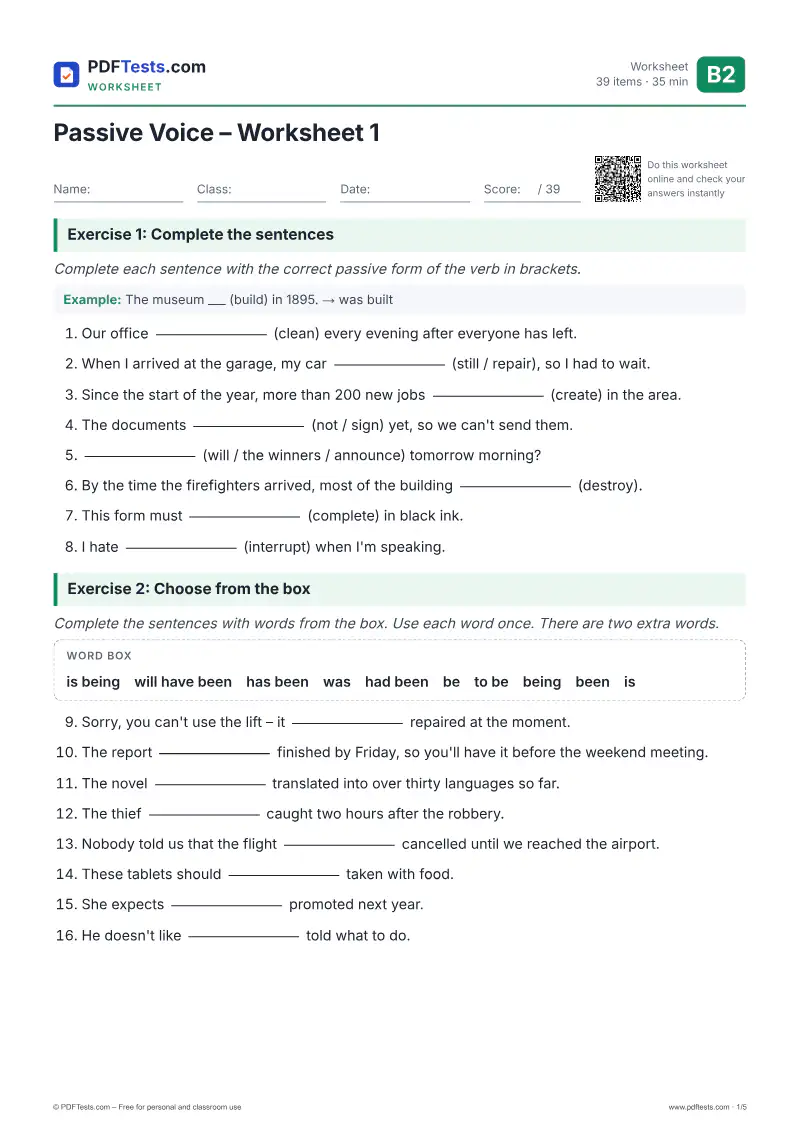
Exercise 3: Rewrite in the passive

Rewrite each sentence in the passive. Leave out the agent if it is 'someone', 'anyone', 'people' or 'they'. Where words are given in brackets, begin your sentence with them.

Example: Someone cleans the windows every week. → The windows are cleaned every week.

  1. Someone stole my bike last night.

  2. They haven't paid the workers for two months.

  3. Did someone lock the back door?

  4. People are building a new hospital near the station.

  5. A famous architect designed this house.

  6. You must not leave bags unattended.

  7. People say that the castle is haunted. (The castle ...)

  8. People believe that the thieves escaped abroad. (The thieves ...)

  9. Has anyone told Maria about the change?

Exercise 4: Correct the mistakes

Each sentence has one mistake. Write the correct sentence.

Example: The car was wash yesterday. → The car was washed yesterday.

  1. The letter was wrote in French.

  2. The meeting has been postpone until next week.

  3. My phone is repairing at the moment.

  4. English is speaking in many countries.

  5. The children were took to the zoo by their teacher.

  6. Where was your jacket make?

  7. The road will being closed for two days.

  8. This problem should have been solve years ago.

Exercise 5: Put the words in order

Put the words in the correct order to make passive sentences or questions.

Example: was / the / cake / by / made / Tom → The cake was made by Tom.

  1. been / the / have / invited / not / we / to / party

  2. was / painting / when / stolen / the / ?

  3. is / to / expected / the / rise / price / of / petrol

  4. being / the / are / still / interviewed / candidates

  5. be / can / online / tickets / bought

  6. your / been / have / checked / bags / yet / ?

Was this page helpful?

Report a mistake

Spotted a wrong answer, a typo or an unclear explanation? Tell us and we will fix it.

Preview

About this test

Printable B2 passive voice worksheet: all tenses, modals, questions, negatives and 'is said to' structures, with answers for checking.

Topics covered

Passive voicePassive tensesModal passivesPassive questions and negativesImpersonal passive (is said to)Passive infinitive and -ing form

Notes for teachers

Start with the gap-fill and word box for controlled practice of form, then use the transformation task to discuss when to leave out the agent. Common mistakes include using the past simple instead of the past participle (was wrote), forgetting 'being' in continuous passives, and wrong word order in questions. As a follow-up, ask learners to write a short news report or a description of a process, such as how chocolate is made, using at least eight passive forms.

All English B2 tests →