The passive voice moves the focus away from the person who does an action and onto the action itself or the person or thing affected by it. It is formed with be + past participle (The bridge was built in 1932). At B2 you need it in every tense, with modal verbs, and in reporting structures such as He is said to be very rich.
If you need a refresher on the basics first, read our guide to the passive voice in the present and past simple.
When to use the passive
Use the passive when the doer of the action is less important than the action or its result.
1. The doer is unknown, obvious or unimportant
- My bike was stolen last night. (We don’t know who stole it.)
- The suspect has been arrested. (Obviously by the police.)
- Thousands of emails are sent every second.
2. You want to focus on a process or result
- The main road is being resurfaced this week.
- All the tickets had been sold by Friday.
3. Formal, academic and news writing
- Applicants are asked to submit their CV by 30 June.
- The samples were heated to 80°C.
4. To keep known information at the start of the sentence
English usually puts information the reader already knows first and new information last. The passive helps with this:
- The Mona Lisa is one of the most famous paintings in the world. It was painted by Leonardo da Vinci.
5. To avoid saying who is responsible
- Mistakes were made during the project.
- You have been charged twice for this order.
How to form the passive
The rule is always the same: put be in the correct tense, then add the past participle of the main verb. The object of the active sentence becomes the subject of the passive sentence.
The passive in different tenses
| Tense | Active | Passive |
|---|---|---|
| Present simple | They clean the office every day. | The office is cleaned every day. |
| Present continuous | They are cleaning the office. | The office is being cleaned. |
| Past simple | They cleaned the office yesterday. | The office was cleaned yesterday. |
| Past continuous | They were cleaning the office. | The office was being cleaned. |
| Present perfect | They have cleaned the office. | The office has been cleaned. |
| Past perfect | They had cleaned the office. | The office had been cleaned. |
| Will future | They will clean the office. | The office will be cleaned. |
| Be going to | They are going to clean the office. | The office is going to be cleaned. |
| Future perfect | They will have cleaned the office by 9. | The office will have been cleaned by 9. |
The passive forms of the present perfect continuous (has been being cleaned) and future continuous (will be being cleaned) exist but sound awkward. Native speakers usually rephrase or use another tense.
Negatives and questions
Make negatives and questions with the auxiliary verb, exactly as in active sentences.
| Tense | Affirmative | Negative | Question |
|---|---|---|---|
| Present simple | It is made in Italy. | It isn’t made in Italy. | Is it made in Italy? |
| Past simple | They were invited. | They weren’t invited. | Were they invited? |
| Present perfect | It has been fixed. | It hasn’t been fixed. | Has it been fixed? |
| Will future | You will be told. | You won’t be told. | Will I be told? |
| Present continuous | It is being checked. | It isn’t being checked. | Is it being checked? |
With question words, the order is the same: Where was the photo taken? Why hasn’t the email been answered?
Modal verbs in the passive
For the present or future, use modal + be + past participle:
- This form must be signed by a parent.
- The meeting could be moved to Thursday.
- Phones should be switched off during the exam.
For the past, use modal + have been + past participle:
- The package might have been delivered to the wrong address.
- The files can’t have been deleted – I saved them this morning.
- This problem should have been reported weeks ago.
Passive infinitives and -ing forms
Verbs that take an infinitive or an -ing form can also be followed by a passive version.
- to be + past participle: I hope to be offered the job. The car needs to be serviced.
- being + past participle: She hates being interrupted. I don’t remember being told about the change.
Using by to mention the agent
The person or thing that does the action is called the agent. Add it with by only when it gives useful or new information.
- The novel was written by a 19-year-old student. (useful)
- ✗ The thief was arrested by the police. (obvious, so usually omitted)
Use with for the tool or material used, not the doer:
- The door was opened with a credit card.
- The room was decorated by my sister with paper lanterns.
Verbs with two objects
Verbs such as give, send, offer, show, tell, teach, lend, promise and award can have two objects: a person and a thing. Either can become the subject of the passive sentence.
| Active | Passive (person as subject) | Passive (thing as subject) |
|---|---|---|
| They gave me a voucher. | I was given a voucher. | A voucher was given to me. |
| They offered her a promotion. | She was offered a promotion. | A promotion was offered to her. |
Starting with the person is more common and sounds more natural in everyday English.
Note that explain, describe, suggest and announce do not follow this pattern: The rules were explained to me, not I was explained the rules.
Reporting structures: It is said that… / He is said to…
In news reports and formal writing, the passive is used with verbs like say, believe, think, report, expect, know, consider, claim and estimate to give information without naming the source. There are two patterns.
Pattern 1: It + passive + that clause
- It is believed that the thief escaped through a window.
- It has been reported that the minister will resign.
Pattern 2: Subject + passive + to-infinitive
The form of the infinitive depends on when the reported action happens.
| Time of the action | Structure | Example |
|---|---|---|
| Same time / general | is said to + infinitive | She is said to be the best surgeon in the country. |
| In progress | is said to be + -ing | The company is thought to be planning job cuts. |
| Earlier | is said to have + past participle | The thief is believed to have escaped through a window. |
Compare: People say he lives abroad. → He is said to live abroad. / People say he lived abroad. → He is said to have lived abroad.
The get passive
In informal spoken English, get can replace be. It usually describes something that happens suddenly, unexpectedly or that is unwelcome.
- He got fired for being late too often.
- Our flight got cancelled because of the storm.
- Did you get paid this week?
Avoid the get passive in formal writing, and don’t use it with verbs describing states: It is known that…, not It gets known that….
Passive vs structures learners confuse it with
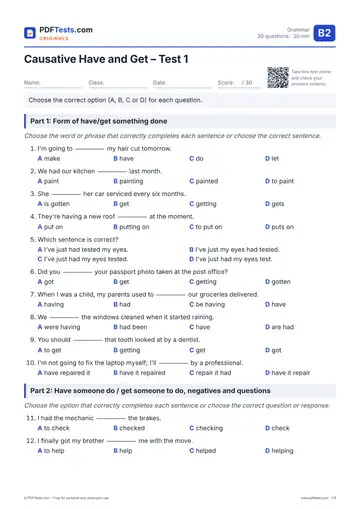
Passive vs causative have/get
Both use a past participle, but the meaning is different.
- My car was repaired. (focus on the car; we don’t say who arranged it)
- I had my car repaired. (I arranged for someone to do it)
- She had her phone stolen. (something bad happened to her)
See our guide to causative have and get for the full rules.
Passive vs active intransitive verbs
Verbs with no object – happen, arrive, die, occur, seem, disappear, fall – cannot be passive, because there is no object to become the subject.
- ✓ The accident happened on the motorway.
- ✓ Prices have risen sharply.
Passive vs past participle as an adjective
The shop is closed can describe a state (it is not open) rather than an action. Context shows the difference: The shop is closed (state) vs The shop was closed by the council in 2020 (action).
Common mistakes
- ✗ The accident was happened at 6 pm. → ✓ The accident happened at 6 pm. Happen has no object, so it has no passive.
- ✗ The new hospital is building now. → ✓ The new hospital is being built now. The continuous passive needs being.
- ✗ The report has written. → ✓ The report has been written. The perfect passive needs been.
- ✗ The letter was wrote in 1890. → ✓ The letter was written in 1890. Use the past participle, not the past simple.
- ✗ The project must be finish by Friday. → ✓ The project must be finished by Friday. After be, the verb is always a past participle.
- ✗ He is said to steal the money last year. → ✓ He is said to have stolen the money last year. Use the perfect infinitive for earlier actions.
- ✗ This portrait was painted with Picasso. → ✓ This portrait was painted by Picasso. Use by for the doer, with for the tool.
- ✗ I was explained the new system. → ✓ The new system was explained to me. Explain cannot take a person as the passive subject.
- ✗ The film was been shown on TV. → ✓ The film was shown on TV. The past simple passive has only one form of be.
Quick check
- Complete: The results ___ (announce) tomorrow morning.
- Complete: Please use another entrance – the main door ___ (paint) at the moment.
- Rewrite: People say that he is a millionaire. → He ___
- Correct the mistake: The package might have delivered to the wrong address.
- Choose: She hates interrupting / being interrupted when she’s speaking.
Answers
- will be announced
- is being painted
- He is said to be a millionaire.
- The package might have been delivered to the wrong address.
- being interrupted
Next step
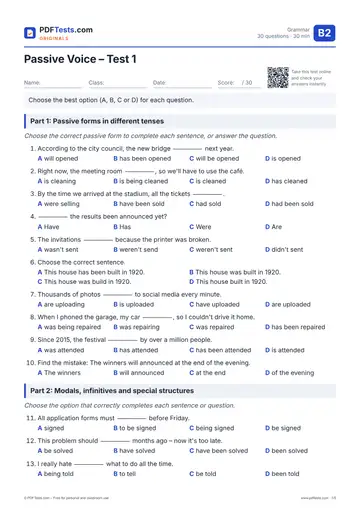
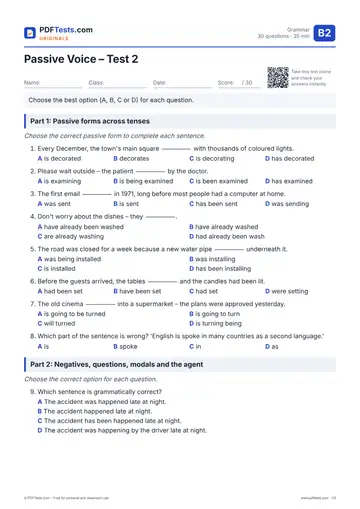
Now put the rules into practice: start with our B2 Passive Voice test 1, which covers all tenses and modal passives, then move on to B2 Passive Voice test 2 for reporting structures and two-object verbs. If you keep mixing up the passive and have something done, follow up with the B2 Causative Have and Get test to fix the difference for good.
Was this page helpful?
What was the problem?
Thank you for your feedback!